Ayahuasca Retreat Peru Vs Costa Rica

If you’re weighing an ayahuasca retreat in Peru vs Costa Rica, 3 trade-offs decide it: the law, the flight and the hospital. Peru has the clearer law. It named ayahuasca in a note on its reservation to a UN drug treaty and declared its traditional use national heritage in 2008. Costa Rica is the shorter trip: from 5 major US airports, Cusco, reached via Lima, is 1.7 to 2.7 times as far by air as San José. But Costa Rica’s drug law never mentions the brew, and its health ministry warned the public against healing rituals in January 2025.
On hospitals it’s a draw. Both countries keep their best care in the cities, and in both the center, not the state, sets the medical rules.
Our network has houses in both countries, including Peru Ayahuasca Retreats in the Sacred Valley and a sister house on Costa Rica’s Osa Peninsula. A standard 7-night week costs $5,800 at either, so price shouldn’t decide this for you.

Which Country Fits A First Ayahuasca Retreat?
For a first retreat, the center matters more than the country, because in both countries the screening and the emergency plan are the center’s to set. If the country has to decide it, pick Peru for legal footing and the tradition’s home region, and Costa Rica for a shorter flight and no high-altitude adjustment.
The difference between an ayahuasca retreat in Peru and one in Costa Rica is legal footing, distance and emergency care. Peru recognizes traditional use as national heritage. Costa Rica’s drug law is silent, and its health ministry has warned against the practice. Costa Rica is closer to the US. In both, care outside the cities can be limited.
Peru’s travel advisory from the State Department says the government “does not regulate groups that offer ayahuasca or kambo.” Of Costa Rica, it says these substances “are not regulated by the Costa Rican Ministry of Health.” So you’re the one who has to check the screening and the distance to a hospital.
Ayahuasca Retreat Peru Vs Costa Rica, Side By Side
On paper, Peru wins the legal rows and Costa Rica wins the travel rows. Neither wins on oversight, which is the row that matters most for your safety.
| Peru, Sacred Valley | Costa Rica, Osa Peninsula | |
|---|---|---|
| Legal status of the brew | Traditional use declared national heritage on 24 June 2008, and named in a clarification of Peru’s UN treaty reservation | Not named in the drug law. DMT, its active compound, is on the national control list |
| What official health sources say | The US CDC: the rituals “are not illegal” | Costa Rica’s Ministry of Health warned against them, 27 January 2025 |
| Oversight, per the US State Department | Peru “does not regulate groups that offer ayahuasca” | The substances “are not regulated” by the health ministry |
| US advisory level | Level 2, issued 4 September 2026 | Level 2, issued 2 April 2026 |
| US wording on ayahuasca | “should not consume” | “Exercise extreme caution” |
| Flights from the 5 US airports below | Nonstop to Lima, then a second flight to Cusco | Nonstop to San José |
| Air distance from Miami | 2,986 miles to Cusco, via Lima | 1,122 miles to San José |
| Care outside the big cities | Limited outside Lima and other major cities | Services “may be limited” outside San José |
| Malaria | Insignificant in the Sacred Valley, per the CDC | Present in Alajuela and Limón provinces, per the CDC |
| Our house: elevation | About 2,800 m | Sea level |
| Our house: emergency access | Clinic 20 minutes away, Cusco hospital about 1 hour by paved road | Puerto Jiménez clinic 25 minutes away, air ambulance airstrip 15 minutes away |
| Our price for 7 nights | $5,800 | $5,800 |
Other centers price their weeks below and above ours, and our breakdown of the full price range shows what each tier pays for.

How Does The Law Differ Between Peru And Costa Rica?
Peru’s law is explicit and Costa Rica’s is silent. Peru wrote ayahuasca into its treaty obligations and its heritage register. Costa Rica’s drug law never mentions the brew, and its health ministry is on record against rituals sold as healing.
Start with the treaty. Article 32 of the 1971 UN Convention on Psychotropic Substances lets a country exempt some wild plants from part of the treaty when it joins. The plants must be “traditionally used by certain small, clearly determined groups in magical or religious rites.” Peru did this. It joined on 28 January 1980. A clarification it sent the UN a year later, preserved in the UN Treaty Collection record, names the plant: “Ayahuasca, a liana which grows in the Amazon region.” The same record shows Costa Rica ratifying on 16 February 1977, with no reservation.
Then the heritage register. Peru’s Ministry of Culture lists Resolución Directoral Nacional 836/INC, dated 24 June 2008 and published in El Peruano on 12 July 2008. It declares “los conocimientos y usos tradicionales del Ayahuasca practicados por comunidades nativas amazónicas” part of Peru’s cultural heritage: the traditional knowledge and uses of native Amazonian communities.
Of Cusco, the register lists only La Convención, a province that reaches into the Amazon. The Sacred Valley isn’t on it, and we don’t pretend otherwise: our maestros bring the tradition up from the Amazon. We cover Peru’s legal position for US travelers in a separate guide.
The CDC sums up Peru’s position in its travel chapter on Peru: “The ayahuasca rituals are not illegal, but the safety and regulations for recreational use have not been established.”
Costa Rica’s drug law, Ley 8204, covers every substance listed in the UN drug conventions, plus national lists kept by the health and agriculture ministries.
On 27 January 2025 the Ministry of Health issued a public health warning on ayahuasca and ibogaine. It says DMT, the brew’s active compound, is on both the international and the national lists. It calls ritual practices that promise “procesos de sanación,” healing processes, “una práctica no autorizada,” an unauthorized practice. It also tells the public not to join rituals that use psychoactive substances for therapeutic purposes.
Of the 4 comparison pages ranking for this search, 2 present Costa Rica as the legally easier choice. On the documents, Peru has the firmer footing. Its government has named the practice twice, at the UN and in its heritage register. Costa Rica’s law names nothing, and its health ministry has come out against it. The finding has 2 limits, and none of this is legal advice:
- It doesn’t show that Costa Rica’s centers are illegal. Centers there operate openly, and the drug law doesn’t ban the brew by name. What the documents show is that no Costa Rican law protects the practice and the health authority has warned against it in public.
- It doesn’t make Peru safer. Legal status tells you what the state allows. The US government’s wording on Peru is the stronger of the 2, as the advisories below show.
Where Ayahuasca Comes From, And Who Leads Ceremonies In Costa Rica
Ayahuasca comes from South America, and Costa Rica sits outside the vine’s native range. Kew’s Plants of the World Online lists the native range of Banisteriopsis caapi, the ayahuasca vine, as 8 regions: Argentina Northwest, Bolivia, Brazil North, Brazil West-Central, Colombia, Ecuador, Peru and Venezuela. No Central American country is on it.
The people match the plant. A 2011 anthropological overview of indigenous ayahuasca use traces the brew to groups of the Upper Amazon, the Orinoco Basin and the Pacific lowlands of Colombia and Ecuador. Its author’s 1986 literature search found references to 72 indigenous groups, a list the overview calls “most probably not exhaustive.”
So a Costa Rican retreat brings the tradition in. A 2021 study in Scientific Reports recruited guests at 3 retreat centers, 2 in Peru and 1 in Costa Rica. All 3 hosted shamans of the Shipibo lineage, which the authors place in the west Amazon basin. Our houses work the same way. In both countries our ceremonies are led by Shipibo maestros from Paoyhan and Nueva Betania, 2 communities in the Peruvian Amazon, working far from home.
Peru still holds most of the field. ICEERS counted at least 232 retreat centers in 2019 across 5 Amazonian countries and Costa Rica, and 173 of them were in Peru. It also noted that Costa Rica “has emerged as a preferred location for ayahuasca entrepreneurs to establish such centers.”
How Far Is Each Country From The US?
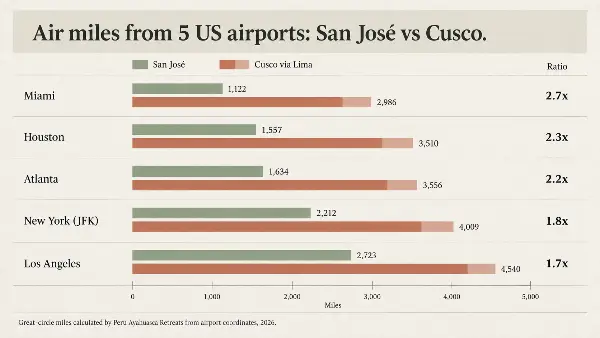
From each of 5 major US airports, San José is roughly 1,800 to 1,950 miles closer than Cusco, which needs a second flight, usually from Lima. On that routing, Cusco is 1.7 to 2.7 times as far by air.
These are great-circle distances, which we calculated from each airport’s coordinates. Real routes run a little longer, and a connection adds hours that no map shows.
| From | To San José | To Lima | To Cusco, via Lima | Cusco trip vs San José |
|---|---|---|---|---|
| Miami | 1,122 mi | 2,622 mi | 2,986 mi | 2.7x |
| Houston | 1,557 mi | 3,146 mi | 3,510 mi | 2.3x |
| Atlanta | 1,634 mi | 3,191 mi | 3,556 mi | 2.2x |
| New York (JFK) | 2,212 mi | 3,645 mi | 4,009 mi | 1.8x |
| Los Angeles | 2,723 mi | 4,176 mi | 4,540 mi | 1.7x |
In relative terms the gap is widest from Florida and narrowest from the West Coast. All 5 airports have nonstop flights to San José and to Lima, and none fly direct to Cusco. For our Peru house, the last leg is a 90-minute drive from Cusco airport, and we pick you up there. In either country, ask for the door-to-door time, because a short flight can end in a long drive.
Hospitals, Evacuation And The Minutes That Matter
Good hospital care in both countries sits in the cities, and retreats sit well outside them. What matters more is the distance from the maloca, the ceremony house, to care, in minutes.
The State Department’s Costa Rica page says: “In San José, medical care is usually good. Outside of San José, services may be limited.” It warns that “an air ambulance flight can cost $50,000 and will often take place only after full payment is provided.” For Peru, it says care is limited outside Lima and the other major cities, and that psychological and psychiatric services are limited “even in larger cities.” Both countries’ pages “strongly recommend supplemental insurance to cover medical evacuation.”
From our Sacred Valley house, a clinic is 20 minutes away and a Cusco hospital about 1 hour, on a paved road. Our Osa house is 25 minutes from Puerto Jiménez’s public clinic, and an air ambulance is on call at an airstrip 15 minutes away. Get those 2 numbers from any center you’re considering, and ask who drives. If you’re still weighing the Amazon, the Iquitos comparison looks at hospital access in both Peruvian regions.
Neither country sets a binding screening standard, so every center makes its own rules. Peru’s National Institute of Health published a safe-use guide in August 2024, but it offers recommendations, not requirements. You can read our screening rules before you apply.
What 2026 Travel Advisories Say About Each Country
Both countries sit at Level 2, “exercise increased caution,” but the ayahuasca wording differs. For Peru the State Department says US travelers “should not consume” ayahuasca or kambo. For Costa Rica it says “Exercise extreme caution if you choose to participate in a spiritual ceremony or ritual.”
The Peru advisory, issued on 4 September 2026, cites crime, terrorism, unrest and kidnapping. Its do-not-travel zones leave out the Sacred Valley. In the advisory’s words, the city of Cusco and nearby sites “like the Sacred Valley, the Inca Trail, and Machu Picchu, are not located in the affected area.” The Costa Rica advisory, issued on 2 April 2026, cites crime.
Both countries’ pages report harm to US citizens who took these substances. The Costa Rica page says US citizens “have been victims of sexual assault, serious injury, and theft while under the influence of these substances.” The Peru advisory says US citizens “have suffered serious illness and, in some cases, died after taking these drugs,” and have also been sexually assaulted, injured or robbed while under the influence. What our week involves sets out how we answer that warning.
Read side by side, Washington tells Americans to stay away from ayahuasca in Peru and to use extreme caution with it in Costa Rica. That’s the reverse of the legal picture, and both things are true at once.
Vaccines For A Trip That Covers Both Countries
The CDC rates the Sacred Valley’s malaria risk as insignificant and aims its Peru yellow fever advice at the eastern, Amazon regions. Travelers arriving from most of Peru need yellow fever proof to enter Costa Rica.
The rule is on the CDC’s Costa Rica page. It covers travelers aged 9 months and over arriving from Peru. The exceptions are the cities of Cusco and Lima, 4 northern regions, and “the highland tourist areas of Machu Picchu and the Inca Trail.” The Sacred Valley isn’t on that list, so as written, the rule covers guests coming from our Peru house, and from any retreat in Loreto, Ucayali or Madre de Dios. If your trip covers both countries, ask a travel clinic before you book and carry the certificate.
For malaria, the CDC recommends prescription pills for parts of Costa Rica. Its country table, last reviewed in 2023, names Alajuela and Limón provinces and reports rare to no transmission elsewhere. Our Osa house is in Puntarenas province, outside both.
When Costa Rica Makes More Sense Than Peru
Costa Rica makes more sense when the flight or the altitude is what stops you. Peru makes more sense when you want the tradition’s home region and a country that names the practice in its heritage register.
Pick Costa Rica if:
- You’re flying from Florida or the South, where the gap is widest.
- Altitude worries you or your doctor. Our Costa Rica house is at sea level and our Sacred Valley house at about 2,800 m. Peru’s lowland option is the Amazon, which brings its own yellow fever and malaria rules.
- You want nonstop flights. All 5 airports above fly nonstop to San José, so ask the center how far it is from there.
Pick Peru if:
- You want to drink in a country that recognizes the tradition as national heritage.
- You want to drink in a country where the vine grows wild.
- You weigh the legal footing above the US government’s wording.
Because we run both houses, this advice costs us nothing either way. Write to us with your medications and your travel limits, and we’ll tell you which house fits you, or whether neither does. You can read about our Peru week and who runs it before you write. An ayahuasca retreat in Peru vs Costa Rica is a choice between legal footing and distance, and you can make it on the documents rather than on the brochures.
FAQs
Is an ayahuasca retreat in Peru or Costa Rica easier to reach from the US?
Costa Rica. From 5 major US airports, Cusco, reached via Lima, is 1.7 to 2.7 times as far by air as San José, and no US airport flies direct to Cusco. From Miami it’s 1,122 miles to San José against 2,986 miles to Cusco.
Did Costa Rica’s health ministry warn against ayahuasca?
Yes. On 27 January 2025 Costa Rica’s Ministry of Health issued a public warning on ayahuasca and ibogaine. It called rituals promising healing an unauthorized practice and told people not to take part in rituals that use psychoactive substances for therapeutic purposes.
Is Costa Rica a traditional place to drink ayahuasca?
Not by origin. The ayahuasca vine’s native range, per Kew’s Plants of the World Online, covers 8 regions of South America and no Central American country. The only Costa Rican center in a 2021 Scientific Reports study hosted Shipibo-lineage shamans, and our house there works with Shipibo maestros too.
Is Peru or Costa Rica stricter about ayahuasca retreat safety?
Neither sets binding rules. The US State Department says Peru leaves the groups serving ayahuasca unregulated and that Costa Rica’s health ministry doesn’t regulate the substances. Peru’s 2024 safe-use guide gives recommendations, not requirements. ICEERS counted 173 retreat centers in Peru alone in 2019, each setting its own medical rules, so get them in writing before you book.
Is an ayahuasca retreat in Peru or Costa Rica closer to emergency care?
It depends on the center, not the country. The State Department describes care outside San José as possibly limited and care outside Peru’s big cities as limited, and it strongly recommends evacuation insurance for both. From our Sacred Valley house, a Cusco hospital is about 1 hour away by paved road. Ask any center for its number in minutes.
Does Costa Rica ask for yellow fever proof after a Peru retreat?
Usually, yes. Costa Rica asks for proof from travelers aged 9 months and over arriving from Peru, except from Cusco and Lima cities, Machu Picchu, the Inca Trail and 4 northern regions. The Sacred Valley and the Amazon regions aren’t exceptions, so if your trip pairs an ayahuasca retreat in Peru with time in Costa Rica, check with a travel clinic before booking.