How To Choose An Ayahuasca Retreat In Peru
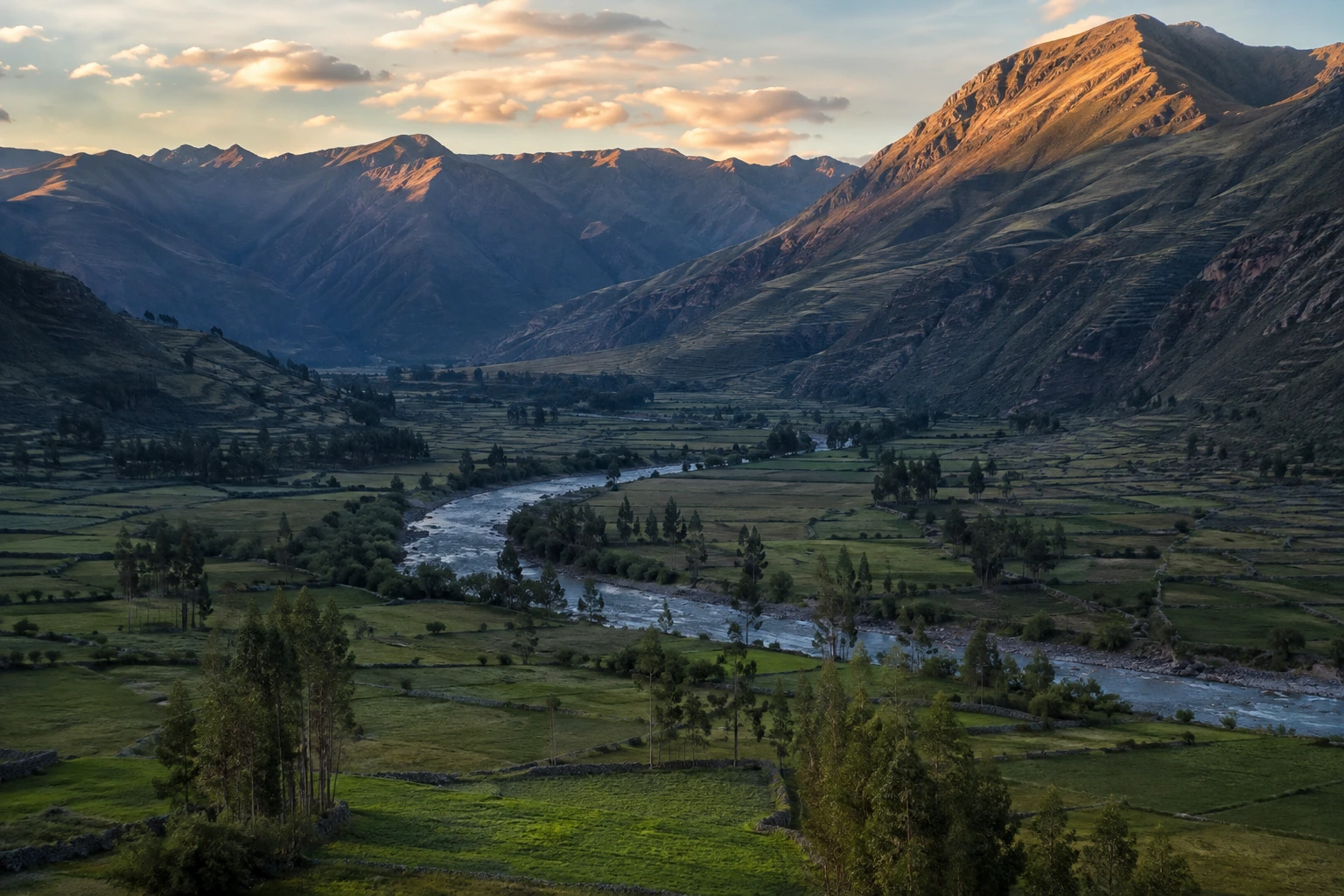
Choosing an ayahuasca retreat in Peru comes down to 9 questions and whether a center will answer them in writing before you pay. Nothing else you can check from a laptop is reliable. There is no license to look up, no inspector, no accreditation body. The US State Department says it plainly on its Peru information page: facilities offering ayahuasca “are not regulated by the Peruvian government and may not follow health and safety laws or practices.”
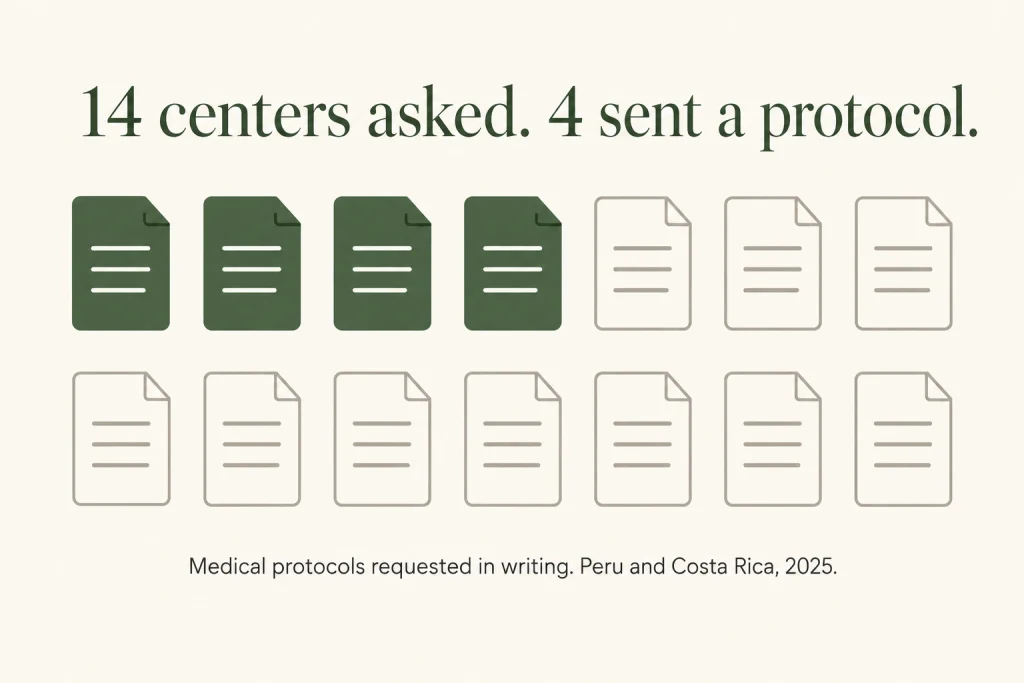
Through 2025 I visited 14 retreat centers across Peru and Costa Rica as a paying guest, before I opened one. I asked all 14 for their medical protocol in writing. Four sent it.
That number is the whole article. Below are the 9 questions, what a passing answer sounds like, and what a failing one sounds like.
How Do You Choose an Ayahuasca Retreat in Peru?
You verify 4 things a website cannot prove, then you ask for the rest in writing. If a center will not put its medical protocol on paper before taking your money, stop there.
Choosing an ayahuasca retreat in Peru means verifying 4 things a website cannot prove: who reads your medical file, how far the nearest hospital is, how many healers are in the room with you, and what happens after you fly home. Peru does not license or inspect these centers, so the buyer does the checking.
Every guide to this subject tells you to ask questions. Almost none of them tell you what a good answer sounds like, which leaves you on a call hearing “we take safety very seriously” with no way to grade it. So this article publishes the passing answers and the failing ones side by side, and then publishes ours, so you can score us against anyone else on the same scale.
No One Regulates Ayahuasca Retreats in Peru
Ayahuasca is legal in Peru, but legal is not the same as supervised. No Peruvian agency licenses retreat centers, inspects malocas, or checks whether a shaman has trained for 30 years or 8 weeks.
Peru declared the traditional knowledge and use of ayahuasca part of the national cultural heritage in 2008, and that protection is real. It covers the tradition. It does not cover the tourism industry that grew around it. If you want the legal detail, we wrote a separate piece on whether ayahuasca is legal in Peru.
The practical result is that every trust signal you see on a retreat website is self-issued. Certifications are invented. Badges mean nothing. A center that says it is “fully certified” is describing a certificate it printed. There is no registry to check it against, and the State Department page above is the closest thing to an official statement on the matter.
The same page warns Americans not to use ayahuasca at all, and reports that US citizens have suffered serious illness, died, or been sexually assaulted, injured or robbed in these settings. We link it rather than hide it. A center that will not show you the government warning about its own industry is already filtering what you get to see.
The 9 Questions, and the Answers That Pass
Send these by email before you pay a deposit. It costs you one message, and the reply sorts the field faster than any review site.
| Ask this | An answer that passes | An answer that should worry you |
|---|---|---|
| Who reads my medical file, and what are their credentials? | A named, licensed physician, credentials given, license number available on request | “Our experienced team reviews everything” |
| Will you send me your medical protocol in writing before I pay? | A document lands in your inbox within a few days | “We can talk it through on a call” |
| How many guests and how many healers are in the room at once? | Two numbers you can divide | “We keep our groups small” |
| What share of applicants do you decline, and what are the automatic no’s? | A percentage plus a named list of conditions | “We assess everyone individually” |
| Who is medically responsible during ceremony, on site or on call? | On site, awake, named, with the equipment listed | “Someone is always nearby” |
| How far is the nearest clinic and hospital, in minutes? | Two numbers in minutes and the hospital named | “We are not far from town” |
| What is the taper for my specific medication, and who verifies it? | A drug class, a number of weeks, and a request to speak to your prescriber | “Just stop taking it two weeks before” |
| Who are the healers, where are they from, and how many years each? | Names, home communities, years in lineage | “Authentic Shipibo shamans” |
| What aftercare is included, for how long, and who delivers it? | A named person, a call schedule, and an end date | “We stay in touch with all our guests” |
Nine emails. Nine replies. The centers that answer with specifics and the centers that answer with adjectives separate themselves in about 48 hours, and you have not spent anything.
What Does Real Medical Screening Look Like?
A physician reads your file before anyone takes a payment, and the center can tell you which conditions it refuses outright. A form you fill in after you have paid is not screening. It is paperwork.
The reason screening matters more than atmosphere is pharmacological. The ayahuasca vine inhibits monoamine oxidase, and in 1998 Callaway and Grob warned in the Journal of Psychoactive Drugs that combining it with an SSRI “may induce a serotonin syndrome with potentially grave outcome.” That is a 28 year old pharmacology paper, not breaking news. Any center that does not ask what you take has decided not to know.
Ask for the list of automatic declines. A center that has one will read it to you. Ours are MAOIs of any kind, diagnosed schizophrenia or bipolar I, uncontrolled hypertension, a cardiac event within the last 12 months, epilepsy, severe liver disease, and pregnancy or breastfeeding. SSRIs, SNRIs, lithium, tramadol, triptans, stimulants and beta blockers get reviewed individually, and any taper gets planned around your own prescriber’s timeline rather than around a week we want to fill. The full lists sit on our ayahuasca retreat page.
The taper question is the one people get wrong. If a center tells you to stop an antidepressant two weeks before without speaking to your doctor, that is not caution, that is liability being handed to you. Our physician writes to your prescriber. The three weeks of dieta before you fly exist for the same pharmacological reason, not for purity.
Sacred Valley, Iquitos or Pucallpa: Which Location Is Safer?
Each region trades a different risk. The Amazon centers near Iquitos and Pucallpa sit at low altitude but hours from a hospital. Cusco region centers are close to real medicine and put you at altitude. Neither is wrong. Only one of them is usually explained to you.
| Region | Elevation | Getting there | The trade you are making |
|---|---|---|---|
| Iquitos, Loreto | Near sea level, no acclimatization needed | Fly from Lima, no road access to the city | Deep jungle setting, but many centers are hours further by river from the nearest hospital |
| Pucallpa, Ucayali | Near sea level, no acclimatization needed | Fly from Lima, then road or river | Fewer centers and closer to Shipibo home communities, with the same distance-to-care problem |
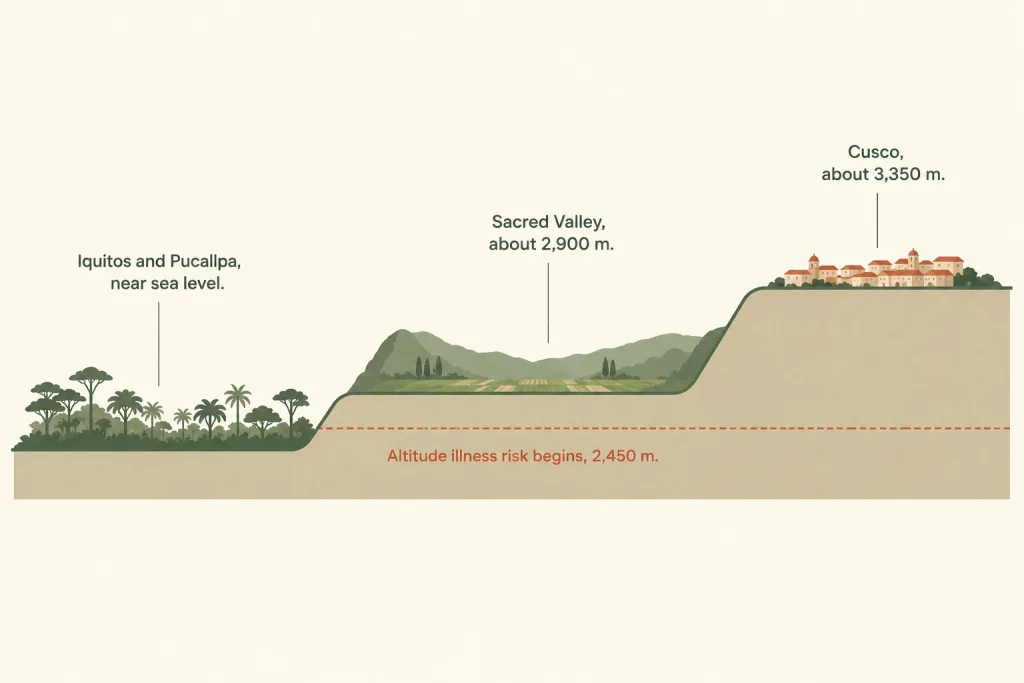
| Sacred Valley, Cusco | Roughly 2,900 m on the valley floor, altitude is a live factor | Fly Lima to Cusco, then drive down into the valley | An hour from a Cusco hospital, but your body is adjusting to thin air during the same week |
There is a second Peru-specific question worth asking, and almost nobody does. Ask a Cusco region center where its maestros come from. The Shipibo lineage is from Ucayali, not from the Andes. The Sacred Valley is Quechua territory. A center working with Shipibo maestros in a Quechua valley should tell you that plainly instead of implying a local lineage it does not have. We do, because the alternative is a story.
Altitude Is a Peru Problem Nobody Puts on the Checklist
Cusco sits at roughly 3,350 m, well above the elevation where altitude illness starts. You are about to spend 5 hours in a dark room on an empty stomach, and no retreat guide mentions this.
The CDC’s Yellow Book puts the line at a sleeping altitude of 2,450 m, roughly 8,000 ft, “and sometimes lower,” and it names Cusco as one of the places travelers reach by a rapid ascent by airplane. Its guidance for exactly this case is to sleep lower than the airport for 1 or 2 nights before going higher.
That single line should shape which Peru retreat you pick and how you book flights. The Sacred Valley floor sits roughly 400 to 500 m below Cusco, which is why our house is down in the valley rather than up in the city. Ask any Cusco region center what their elevation is and whether they build acclimatization days into the week. If they have never been asked, that tells you something too.
Can You Trust Ayahuasca Retreat Reviews?
Not for the thing you are trying to learn. A 5 star review tells you a guest had a good week. It tells you nothing about screening, staffing, or what happened the night something went wrong.
This is where I disagree with almost every guide in this field, including the ones telling you to trust your intuition. Reviews and gut feeling are the 2 most recommended filters and the 2 least reliable, because the thing being reviewed is mostly the guest’s own preparation and neurochemistry.
The evidence points the same way. The Global Ayahuasca Survey, published in PLOS Global Public Health in 2022, collected answers from 10,836 people. Among the 8,216 who answered on physical effects, 69.9% reported an acute physical adverse effect and 2.3% needed medical care. Among 7,839 answering on mental health, 55.9% reported an adverse mental effect and 11.9% sought professional support. The predictors the authors identified were age at first use, existing physical health conditions, anxiety disorders, a prior substance use disorder, and use in a non-supervised context. Not price. Not reputation. Not how the website made you feel.
Read reviews last, and read only the ones that describe a specific protocol or a specific problem and how staff handled it. Those are rare and they are the only ones carrying information.
Red Flags That Should End the Conversation
Five answers should end your interest immediately, and each one has a legitimate version that a real center gives instead.
- “We have never had a problem.” That is not a safety protocol. Ask what the protocol is and who executes it at 3am.
- No medical questions before payment. If money moves before a clinician has read your file, the order of operations tells you what the priority is.
- Unnamed healers. “Our experienced shamans” is a way of not telling you. Names, communities and years, or move on.
- A cure promised. Nobody can promise you an outcome. We make no medical claims and neither should anyone else.
- Ceremony every night. A week of consecutive ceremonies leaves nothing to process anything in.
That last one has research behind it. In a 2023 Scientific Reports study, Weiss and colleagues surveyed 339 ceremony participants, and among the 306 non-veterans, 42% reported reexperiencing a previous adverse life event during ceremony, at a mean intensity of 3.94 out of 5. In a room of 12 that is roughly 5 people. If it surfaces on Tuesday and the next cup is Wednesday, nobody has room to work with it. Rest nights are where the staff you paid for actually earns the fee. Our ceremony nights and rest days are laid out in the hour by hour ceremony guide.
How We Answer the 9 Questions
Here are our answers, published so you can hold them next to anyone else’s. We opened in July 2026 and we are not going to pretend to a history we do not have.
| The question | Our answer |
|---|---|
| Who reads my medical file? | Dr. Elena Márquez, internal medicine, Cusco, more than 10 years practicing. She reads every application before a place is offered or a payment taken. |
| Protocol in writing before payment? | Yes. Ask and we send it. Applying costs nothing and a physician reviews your file within 48 hours. |
| Guests and healers in the room? | 12 guests maximum, 2 maestros in every ceremony, plus a physician awake until first light. |
| Rejection rate and automatic no’s? | Roughly 1 application in 5 does not proceed. Declines are free, given in writing, and come with a referral list. |
| Medical cover during ceremony? | On site all 7 nights, awake through every ceremony, with oxygen and a defibrillator and a protocol rehearsed monthly. |
| Distance to care? | 20 minutes to a clinic, 1 hour to a Cusco hospital we hold a standing arrangement with. |
| Medication taper? | Planned with your own prescriber, never compressed to fit a retreat date. |
| Who are the maestros? | Rono Meni, 31 years, Paoyhan. Sanken Bea, 26 years, Nueva Betania. Inin Soi, 19 years, Paoyhan. All Shipibo, from Ucayali, named and paid a full professional fee whether 4 guests come or 12. |
| Aftercare? | 12 months included. Four calls in the first 3 months, then quarterly, with the same lead who read your file, on your time zone. |
The rest of the team, the property and the reason we run 22 weeks a year instead of 50 are on our about page. If you want our protocol in writing, start an application and ask for it. We send it before anything is charged.
The full 7 night week, the dates and the price sit on the front page, and the rest of our plain answers about Peru live in the blog.
And if our answers do not beat someone else’s, go there. Choosing an ayahuasca retreat in Peru should come down to which set of answers you trust, not which website made you feel something.
Frequently Asked Questions
How do you choose an ayahuasca retreat in Peru?
Ask 9 questions in writing before you pay: who reads your medical file, whether the protocol comes in writing, guest and healer numbers, the rejection rate, medical cover during ceremony, distance to a hospital in minutes, the taper for your medication, the healers’ names and years, and what aftercare is included. Of 14 centers I visited across Peru and Costa Rica in 2025, only 4 would send a medical protocol in writing.
Are ayahuasca retreats in Peru regulated or licensed?
No. The US State Department states that facilities offering ayahuasca in Peru “are not regulated by the Peruvian government and may not follow health and safety laws or practices.” Ayahuasca use itself is legal and was declared national cultural heritage in 2008, but no agency licenses centers or inspects them. Any certification badge you see is self-issued.
What questions should I ask before booking an ayahuasca retreat?
Start with the one that sorts fastest: will you send me your medical protocol in writing before I pay. Then ask for the physician’s name and credentials, the guest to healer numbers, the rejection rate, the distance to the nearest hospital in minutes, and who delivers aftercare and for how long. Specific answers pass. Adjectives do not.
How many people should be in an ayahuasca ceremony?
Ask for both numbers and divide them yourself. We run 12 guests with 2 maestros and a physician in the room, and we cap it there. Centers running 25 or 30 guests with a single healer are selling a different product, and the Global Ayahuasca Survey of 10,836 people found that unsupervised context was among the predictors of adverse effects, while price was not.
Is Iquitos or Cusco better for an ayahuasca retreat?
They trade different risks. Iquitos and Pucallpa sit near sea level with no altitude issue, but many centers are hours further from a hospital. Cusco region centers are about an hour from real medicine, at roughly 2,900 to 3,400 m, where the CDC says altitude illness begins above 2,450 m. Pick the trade you would rather make, and ask each center to name it.
Can I trust ayahuasca retreat reviews?
Not for safety. A review reflects one guest’s week, which is shaped mostly by their own preparation and state of mind. Reviews that describe a specific protocol, or a problem and how staff handled it, are worth reading. Star ratings are not. Read them last, after the 9 questions have already narrowed your list.
What medical screening should an ayahuasca retreat require?
A licensed physician reading your full medication and diagnosis history before any payment, plus a published list of automatic declines. Ours are MAOIs, diagnosed schizophrenia or bipolar I, uncontrolled hypertension, a cardiac event within 12 months, epilepsy, severe liver disease, and pregnancy. The SSRI interaction is documented: a 1998 paper in the Journal of Psychoactive Drugs warned it “may induce a serotonin syndrome with potentially grave outcome.” Any ayahuasca retreat in Peru that skips this step is transferring the risk to you.