Ayahuasca Retreat Iquitos Vs Sacred Valley: What Actually Differs

Choosing between an ayahuasca retreat in Iquitos and one in the Sacred Valley comes down to 2 things you can check before you book, and neither of them is atmosphere. Iquitos sits in Loreto, where the CDC recommends yellow fever vaccination and where malaria runs through the whole Amazon basin. The Sacred Valley sits at about 2,800 m, high enough that altitude illness is a real risk on your first night. Everything else people argue about here, jungle against mountains, which tradition feels more real, is preference. Those 2 things are medicine.
I run a centre in the Sacred Valley. I’m not a healer and I don’t sit in ceremony. I read the applications and I pay the invoices, so this comparison is written from the operations side rather than the brochure side. I’ve also been the person comparing these pages, and I remember how little of this was on any of them.
An ayahuasca retreat in Iquitos means the Peruvian Amazon, in a city that Britannica describes as reachable only by air and river. An ayahuasca retreat in the Sacred Valley means the Andes near Cusco, at about 2,800 m, reached by a 90 minute drive on sealed road. Same medicine, 2 different medical maps.
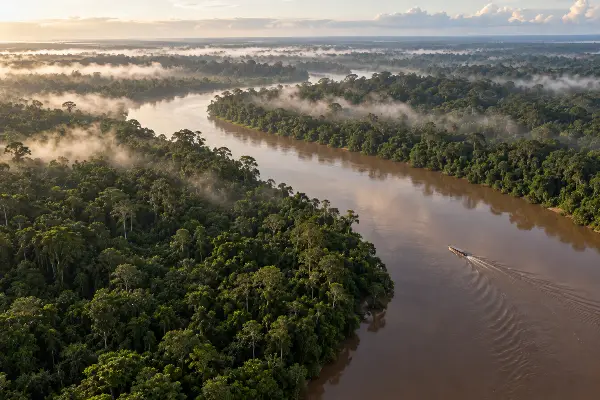
Iquitos Vs Sacred Valley At A Glance
The differences that change your booking are logistical and medical, not scenic. Here they are in one place.
| Iquitos | Sacred Valley | |
|---|---|---|
| Setting | Amazon lowland, Loreto region | Andes, Urubamba valley floor near Cusco |
| Elevation | Lowland Amazon | About 2,800 m, valley floor |
| Yellow fever vaccine | CDC recommends it for all of Loreto | Not recommended for this area |
| Malaria risk | Present, whole Amazon basin | CDC calls it insignificant here |
| Altitude illness risk | None | Real, from the first night |
| Road access to the city | None. Air or river only | Cusco has an international airport |
| Transfer to the property | Road, river, or both | 90 minutes, sealed road, no river crossing |
| Nearest hospital | Varies widely by lodge | About 1 hour, Cusco |
| Flight legs from a US hub | 2, plus a boat in many cases | 2 |
Both regions hold real lineage and real ceremonies. Neither is a compromise. But one asks you for a vaccine and a prophylactic drug decision, and the other asks you for 2 or 3 slow days before anything begins. Those asks are not interchangeable, and they suit different people. If you already know the Andes is where you’re headed, our Sacred Valley retreat centre page sets out the property, the elevation and the drive in detail.
What Actually Separates The Two Destinations?
Geography decides 2 things here. It decides what your doctor has to sign off on before you fly, and it decides how far you are from a hospital if a night goes wrong. It does not decide authenticity, and the pages that argue about authenticity are avoiding the checkable part.
That matters more than it sounds. Through 2025 I visited 14 retreat centres across Peru and Costa Rica as a paying guest, before I opened one. I asked all 14 for their medical protocol in writing. 4 sent it. The 10 that didn’t were spread evenly across both regions, jungle and mountain, budget and premium. Location predicted nothing about how those centres handled risk. The thing that predicted it was whether anyone at the centre had ever written the protocol down.
That test costs you nothing and you can run it today, from your inbox, before you have committed to a region at all. Ask for the medical protocol in writing. Notice how long the reply takes and whether it contains a document or a paragraph of reassurance.
So treat the region as a travel and medical decision, then run the same questions at whichever centre you shortlist. I’ve set out the 9 I’d ask in a separate piece on how to choose an ayahuasca retreat in Peru, and the answers are more revealing than any comparison table.
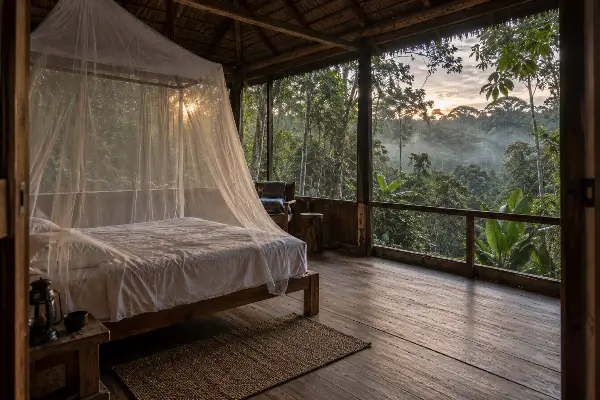
Do You Need Shots For Iquitos?
For Iquitos, yes, in practical terms. The CDC Yellow Book’s Peru page recommends yellow fever vaccination for the eastern regions of Peru, naming all of Loreto, Ucayali and Madre de Dios. Iquitos is in Loreto. Peru does not require proof of vaccination to enter the country, so nobody at the airport will stop you. That makes it a health decision rather than a border formality, which is exactly why it gets skipped.
Malaria is the second half. The CDC states that “malaria transmission occurs on the eastern side of the Andes at elevations below 2,500 m, including all of the Amazon rainforest,” and recommends atovaquone-proguanil, doxycycline, mefloquine, or tafenoquine for travellers going in.
Here is the part that needs a conversation with a doctor rather than a retreat centre. Several antimalarial drugs carry their own neuropsychiatric cautions, and you would be taking one while also stopping other medication for ceremony. I’m not going to tell you how those interact, because I’m not a physician and the honest answer is that this belongs with your prescriber and the centre’s screening doctor, together, before you book. Ask both. If a centre in the Amazon has no view on antimalarials at all, that tells you something about the screening.
For the Sacred Valley the same CDC page is short: “the risk of malaria is insignificant in the central and south coast, Lima Province, and destinations at high altitude, including Cusco city, Machu Picchu, Sacred Valley, and Lake Titicaca.” No yellow fever recommendation for this area either. That’s the trade. The Amazon costs you a vaccine and a drug decision. The Andes costs you what comes next.
The Altitude Cost Of The Sacred Valley, And Why The Valley Is The Mitigation
The Sacred Valley asks for acclimatisation, and most pages treat this as a small footnote. It isn’t. But the standard framing gets it backwards.
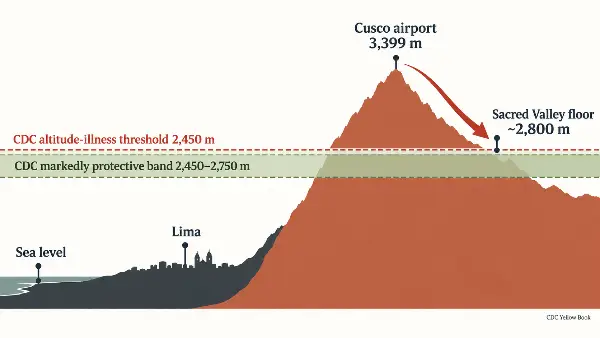
The CDC’s guidance on high-altitude travel states that “any unacclimatized traveler proceeding to a sleeping altitude of 2,450 m (8,000 ft) or above, and sometimes lower, is at risk for altitude illness.” About 25% of visitors sleeping above 2,450 m in Colorado develop symptoms. Onset is 2 to 12 hours after arrival, and it presents as a headache with some combination of appetite loss, dizziness, fatigue and nausea. It reads like a hangover.
Now put that next to the geography. Cusco city sits at 3,399 m. Our valley floor sits at about 2,800 m. The CDC’s own advice is that “acclimatizing for a minimum of 2 to 3 nights at around 2,450 to approximately 2,750 m (8,000 to 9,000 ft) before proceeding to a higher altitude is markedly protective.”
So the Sacred Valley is not the softer version of Cusco. Physiologically it’s the safer one. You land at 3,399 m, and instead of sleeping there, you descend about 600 m and sleep close to the band the CDC describes as protective. People book a few nights in Cusco to acclimatise before coming down to the valley, which is the wrong direction on the CDC’s own reading. If you want days in Cusco, and Pisac, Ollantaytambo and the Maras salt pans are worth them, take them after the week rather than before it.
What that means for the week itself is simple: nobody drinks on arrival night. The body gets time before the medicine does. The nausea that comes with altitude and the nausea that comes with ayahuasca are hard to tell apart in the dark, and a physician trying to assess someone at 1am should not have to guess which one she’s looking at. There’s more on the shape of the week in what to expect at an ayahuasca retreat in Peru.
What Changes The Cost Between The Two Regions?
The ceremony is not where the regions diverge on price. The travel around it is, and it moves in both directions.
The Amazon adds 2 line items the Andes doesn’t have. The first is a clinic visit before you fly, for the yellow fever vaccine and an antimalarial prescription. The second is the final transfer: many jungle centres sit an hour or more upriver from Iquitos, and a boat is not a taxi. Some lodges fold that into the fee and some don’t, which is the single most common thing people are surprised by on arrival.
The Andes adds different ones. If you take the acclimatisation days properly you’re paying for nights in the valley or in Cusco either side of the retreat, and travel insurance with medical evacuation cover matters at altitude in a different way than it does at sea level.
What actually explains a wide gap between 2 centres of the same length is not the region at all. It’s group size, whether a physician is present or on call, whether screening happens before payment, what the room is, and whether anyone contacts you after you fly home. A week with 25 guests and 1 healer is not the same product as a week with 12 and 2, and the price page will not tell you which you are looking at. I’ve broken down every line of what we spend and why in where the money goes on an ayahuasca retreat in Peru.
Compare the whole trip, not the headline fee. A cheaper retreat that needs 2 extra flight segments, a vaccination appointment and 2 hotel nights can land higher than a more expensive one that includes the transfer.
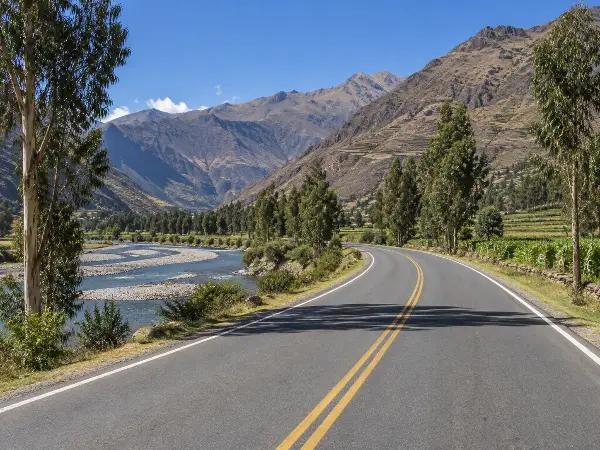
Door To Door, And Why It Decides More Than People Think
Travel time is where the 2 regions separate hardest, and it’s the reason a 9 day slot works for one and not the other.
For the Sacred Valley: fly to Lima, connect to Cusco, and we collect you at arrivals. You’re at the property inside 2 hours of landing in Cusco. The road is sealed the whole way. There’s no river crossing and no seasonal closure, which means the arrival plan in March is the arrival plan in August.
For Iquitos: fly to Lima, connect to Iquitos, then travel on to the lodge by road, river, or both, depending on where it sits. The city itself has no road link to the rest of the country. That’s the trade the Amazon asks for, and for a lot of people it’s worth it, because the remoteness is the point. It also means a missed connection has fewer recovery options.
Nine days is the honest minimum for our week: 1 to arrive, 7 with us, 1 to fly home. Don’t book a flight home for the morning after the final ceremony, and keep the 2 days after you land completely empty. A deep Amazon lodge usually asks for more, because the transfer days are longer at both ends.
Lineage Doesn’t Live In A Postcode
The most common argument against a Sacred Valley retreat is that the medicine belongs to the Amazon, so the Amazon is where it’s real. The first half of that is true and I’m not going to soften it.
This is a Quechua valley. The maestros who work here are Shipibo, from Ucayali communities in the Amazon, and they travel here to work. The icaros and the lineage are Amazonian. This valley is not. We say that on our own ayahuasca programme page because a guest is going to work it out in the first hour and it’s better coming from us.
What follows from it is a question about people, not postcodes. Ours come from the Paoyhan and Nueva Betania communities in Ucayali and carry 31, 26 and 19 years in lineage. 2 of them are in every ceremony. Ask any centre in either region for the same 3 things: names, communities, and years. A centre that answers with “our experienced shamans” has told you what it has.
Being in the Amazon doesn’t guarantee an Amazonian lineage, and plenty of jungle lodges rotate contract healers between them. Being in the Andes doesn’t preclude one. The detail of what happens in the maloca is set by who’s holding it, not by what’s outside the window.
Distance To A Hospital
This is the one operational difference geography really does decide, and it’s the reason I’d point some people away from the Amazon.
We’re about 20 minutes from a clinic and about 1 hour from a Cusco hospital we hold a standing arrangement with, on sealed road, no river crossing. We keep oxygen and a defibrillator on site, a physician stays awake through every ceremony, and the emergency protocol is rehearsed monthly.
A remote Amazon lodge cannot offer the same drive, because there is no drive. Good jungle centres compensate with on-site medical staff, radio or satellite communication, and a standing boat. Poor ones compensate with a phrase like “we’ve never had a problem,” which is a prayer rather than a protocol. Ask for the number in minutes, and ask what happens at 3am rather than at noon.
The US Embassy in Lima issued a health alert on 23 January 2025 telling Americans not to use ayahuasca or kambo. I’d rather quote it than hide from it. Its underlying point is about unregulated facilities and unscreened participants, and the honest response isn’t to argue with the embassy. It’s to be the kind of operation the warning isn’t describing, and to say plainly that ayahuasca is not a treatment for any condition. It is legal in Peru and protected as cultural heritage, and that is a separate question from whether it is safe for you specifically.
Who Should Choose Iquitos Over The Sacred Valley?
Some people should go to the Amazon, and I’d rather say so than pretend otherwise.
Go to Iquitos if the rainforest itself is part of what you’re there for, and you’d feel short-changed sleeping in the Andes. Go if you have the time for longer transfers at both ends. Go if you’re comfortable getting a yellow fever vaccine and having the antimalarial conversation with your prescriber. Go if you want an extended dieta of several weeks, which the Amazon is better set up for.
Choose the Sacred Valley if you have 9 days rather than 14. If altitude is manageable for you but a 4 hour river transfer isn’t. If you’re on medication that needs a supervised taper and you want a physician and a hospital within an hour. If you’re travelling with someone who isn’t drinking. Or if you want Machu Picchu in the same trip, which is a train ride from Ollantaytambo.
Don’t choose either on the strength of a vaccine schedule alone. If your medical history is complicated, the region is the second question. The first is whether any centre will screen you properly, and roughly 1 in 5 applications to us doesn’t proceed.
What Our 2026 Sacred Valley Week Looks Like
Seven nights, 4 ceremonies with a rest night between each, and 12 guests at most in single-occupancy rooms that nobody shares. 2 maestros are in every ceremony. Our attending physician has practised internal medicine in Cusco for more than a decade, reads every application, and stays on site and awake through all 4 nights.
The screening is a 34 question application, read by a physician within 48 hours, and it takes about 2 weeks end to end. Nothing is charged to apply. Roughly 1 in 5 applications doesn’t proceed, and anyone we decline gets the reason in writing and a referral list. The 3 week dieta starts before you fly and continues for a week after you land.
Our fee is $5,800 for the 7 nights. It covers all 4 ceremonies, the room, all meals from a dieta kitchen with a nutritionist, plant baths and bodywork, private transfers from Cusco both ways, physician screening and on-site care, and 12 months of integration with the same person who read your file. We run 22 weeks a year rather than 50, which is most of the reason the number is what it is.
We opened in July 2026 and we don’t have a decade of reviews. I’m not going to buy any. What we can hand you instead is the centre itself, in detail, including the list of conditions that are an automatic no. If the medical map points you toward the Andes, you can start an application without being charged anything.
FAQs
Is an ayahuasca retreat in Iquitos or the Sacred Valley better for a first ceremony?
Neither region is better for a first ceremony, but they ask different things of you. Iquitos requires a yellow fever vaccine, an antimalarial decision, and longer transfers. The Sacred Valley requires acclimatisation to about 2,800 m before you drink. For a first retreat on limited leave, the Sacred Valley is usually the simpler trip.
Do I need a yellow fever vaccine for an ayahuasca retreat in Iquitos?
The CDC recommends yellow fever vaccination for all of Loreto, the region containing Iquitos. Peru does not require proof of vaccination to enter, so nobody will check it at the airport. That makes it your decision and your doctor’s, not a border formality.
Is there malaria risk in the Sacred Valley?
No. The CDC states that malaria risk is insignificant at high-altitude destinations including Cusco city, Machu Picchu and the Sacred Valley. Transmission occurs on the eastern side of the Andes below 2,500 m, which covers the whole Amazon basin including Iquitos.
How high is the Sacred Valley, and will the altitude affect ceremony?
Our valley floor sits at about 2,800 m, and Cusco city is 3,399 m. The CDC puts the altitude illness threshold at 2,450 m, with roughly 25% of visitors above that line developing symptoms in Colorado. Nobody drinks on arrival night, because altitude nausea and medicine nausea are hard to separate in the dark.
Is Sacred Valley ayahuasca less authentic than Amazon ayahuasca?
The lineage matters more than the postcode. Our maestros are Shipibo from Ucayali communities in the Amazon and carry 31, 26 and 19 years between them. Ask any centre, in either region, for names, communities and years in lineage. Being in the Amazon does not by itself guarantee an Amazonian lineage.
How far is each destination from a hospital?
We’re about 20 minutes from a clinic and about 1 hour from a Cusco hospital, on sealed road with no river crossing. Distances from remote Amazon lodges vary widely and often involve a boat. Ask any centre in either region for the specific drive or river time, in minutes.
Can I combine an ayahuasca retreat with Machu Picchu?
Yes, and it’s easier from the Sacred Valley, where Machu Picchu is a train ride from Ollantaytambo. Do the sightseeing before the retreat rather than after. Keep the 2 days after your final ceremony empty.
Deciding between an ayahuasca retreat in Iquitos and the Sacred Valley is mostly a medical and logistical question wearing a spiritual costume. Check the vaccine map, check the altitude, check the drive to a hospital, then ask both centres the same 9 questions and see which one answers in writing.