Ayahuasca Retreat Cost In Peru: Where The Money Goes
Ayahuasca retreat costs in Peru run from $500 to $8,500 in 2026. Most week-long retreats that name their healing team and screen you medically sit between $2,500 and $6,000. We charge $5,800 for 7 nights.
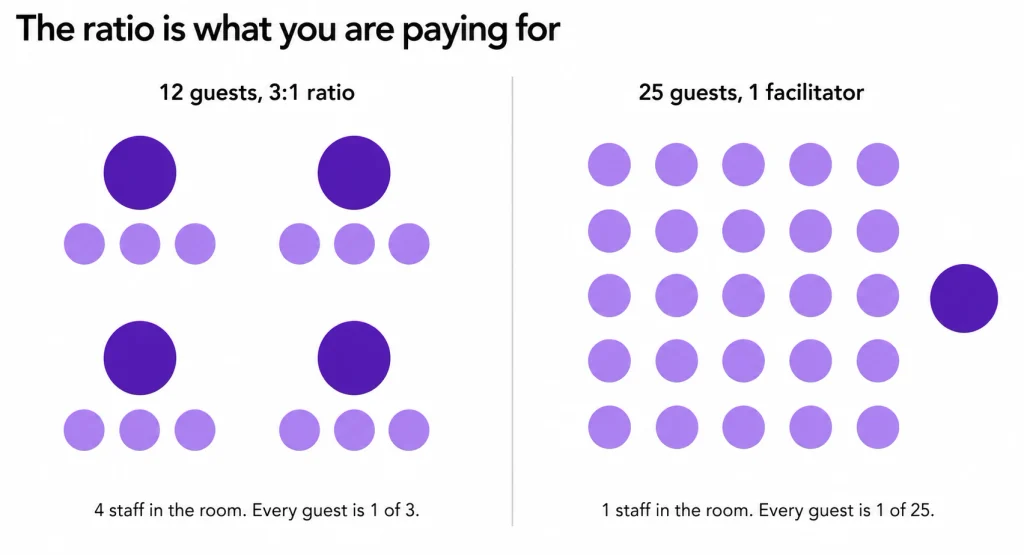
The range is that wide because the thing being sold is not the same at both ends. At $700 you are buying a bed and a cup. At $5,800 you are buying a 3:1 guest-to-maestro ratio, a physician who stays awake through every ceremony, and 12 months of calls after you fly home. The medicine is the cheapest part of either one.
I run this center. I am not a healer and I do not sit in ceremony. I pay the invoices, so I know what every line costs. This is the breakdown I wanted when I was the one comparing price pages.
How Much Does an Ayahuasca Retreat Cost in Peru?
Between $500 and $8,500 for a 7 night stay, with most credible centers between $2,500 and $6,000. Below $1,500 you are almost always looking at a larger group, fewer nights, and no medical cover.
Ayahuasca retreat cost is the total a center charges for lodging, meals, ceremonies, staff and aftercare across a set number of nights. In Peru that runs from roughly $500 to $8,500. What moves the number is staff-to-guest ratio, medical cover and how long the support lasts after you leave. The brew itself is a rounding error.
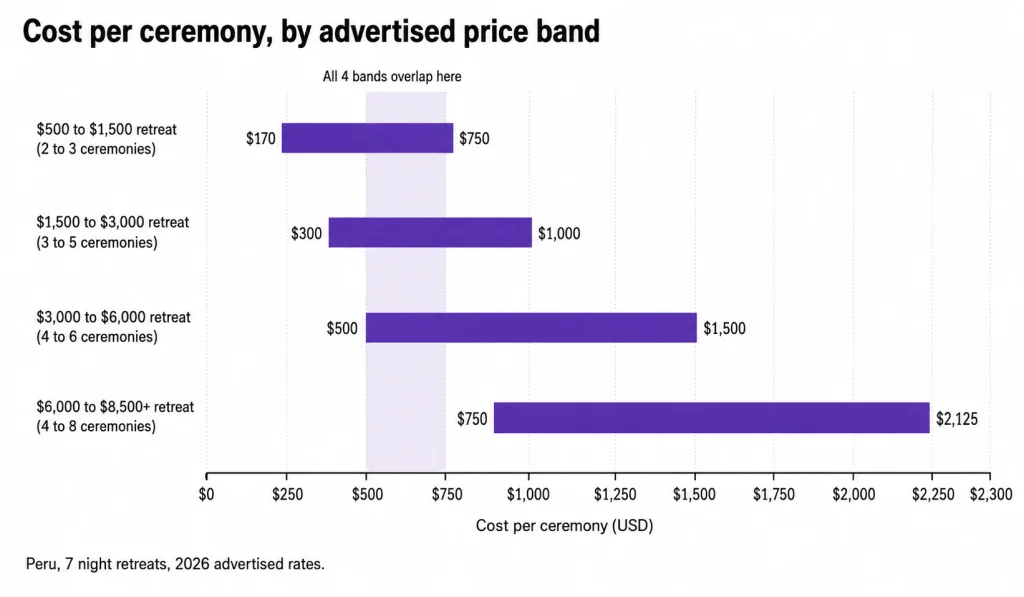
Here is what Peruvian centers published in 2026, with the per-ceremony math done. The cost-per-ceremony column is my arithmetic, not theirs.
| Advertised price, 7 nights | Ceremonies | What it usually includes | Cost per ceremony |
|---|---|---|---|
| $500 to $1,500 | 2 to 3 | Shared room, group of 15 to 30, no physician, no aftercare | $170 to $750 |
| $1,500 to $3,000 | 3 to 5 | Shared or private room, some written screening, group of 12 to 20 | $300 to $1,000 |
| $3,000 to $6,000 | 4 to 6 | Private room, physician cover, structured aftercare, group of 8 to 14 | $500 to $1,500 |
| $6,000 to $8,500+ | 4 to 8 | Resort-grade rooms, spa services, add-on medicines | $750 to $2,125 |
Two things jump out of that table. The cheap band and the expensive band overlap on cost per ceremony. And the thing that separates them is not the medicine. It is how many people are in the room with you and who is awake at 3am.
What the Price Pays For
Staff is the largest line by a wide margin, and it is the only line that changes what happens to you in the maloca. Everything else is hospitality.
A 7 night retreat has 6 real cost centers. Maestros, who are paid for the week whether 4 guests come or 12. A physician, which is a salaried night shift for 7 nights, not a phone number. A dieta kitchen, which cooks salt-free and oil-free and cannot buy in bulk from a normal supplier. Ground transport from Cusco. Medical equipment and its restocking, including oxygen and a defibrillator. And aftercare, which is staff time spread across the year after you have already paid.
There is a seventh cost that nobody discusses, and it is the reason price pages look irrational. We run 22 weeks a year, not 50. Fixed costs run for 12 months and get recovered across those 22 weeks. A center running 45 weeks a year with 25 guests spreads the same overhead across roughly 5 times the guest-nights. It can charge $1,200 and survive. That is not a discount. It is a different business with a different room.
What Does a Single Ayahuasca Ceremony Cost?
Divide the retreat price by the number of ceremonies and you get $170 to $2,125 across the Peruvian market. At our price it is $1,450 per ceremony. But that number lies, and it lies in both directions.
It overstates the cost because you are not only buying 4 nights in a maloca. You are buying 7 nights of lodging and food, a 2 week screening process, and 12 months of integration calls. It understates the cost at the cheap end because a ceremony with 1 healer and 28 guests is not the same unit as a ceremony with a 3:1 ratio. You are comparing an hour of group attention against 5 hours of individual attention and calling both “a ceremony.”
The honest unit is cost per guest-night with staffing held constant. Ours works out to about $829 a night. If a center is charging $150 a night, ask which of the 6 cost centers above they removed. One of them is always missing, and it is usually the physician.

Is a Cheap Ayahuasca Retreat Safe?
Sometimes. Price is a weak predictor of safety. Supervision is a strong one, and the research says so plainly.
The Global Ayahuasca Survey, published in PLOS Global Public Health in 2022, collected responses from 10,836 people. Among the 8,216 who answered on physical effects, 69.9% reported an acute physical adverse effect. Among 7,839 answering on mental health, 55.9% reported an adverse mental effect. Those numbers sound alarming until you read the next two: 2.3% needed medical care afterward, and 11.9% sought professional mental health support.
Now the part that matters for your budget. The predictors of adverse effects were not cost. They were age at first use, existing physical health conditions, anxiety disorders, a prior substance use disorder, and use in a non-supervised context. Nobody in that dataset was harmed by paying too little. People were harmed by drinking without supervision and without screening.
So a $1,200 retreat with 12 guests, 3 healers and a doctor is safer than a $6,000 retreat with 25 guests and a facilitator with a first aid card. The price tells you almost nothing. The staffing tells you nearly everything.
Two things belong in this section that most cost guides leave out. The US State Department’s Peru information page tells Americans not to use ayahuasca at all, notes that citizens “have suffered serious illness and, in some cases, died,” and states that facilities offering it “are not regulated by the Peruvian government.” That last clause is the important one. There is no license to check. No inspector visits. Whatever screening a center does, it does voluntarily, and you are the only person auditing it.
And the drug interaction is real. A 1998 paper by Callaway and Grob in the Journal of Psychoactive Drugs warned that the harmala alkaloids in ayahuasca inhibit monoamine oxidase, and combining them with SSRIs “may induce a serotonin syndrome with potentially grave outcome.” That is a 1998 pharmacology paper, not new information. A center that does not ask what you take is not saving you money. It is transferring risk to you.
The Costs That Are Not on the Price Page
Budget another $1,200 to $2,400 on top of the retreat fee. Almost no center puts these on the page, and 3 of them are not optional.
- Flights. $700 to $1,300 from most US hubs, including the Lima to Cusco leg.
- Travel insurance with medical evacuation. $100 to $300. Not a nice-to-have. The State Department’s own guidance is blunt: “U.S. Medicare/Medicaid does not apply overseas,” most overseas hospitals “do not accept U.S. health insurance,” and specialized care “can cost tens of thousands of dollars,” payable in full at discharge.
- A night in Cusco before you travel up. $40 to $150. Arriving altitude-sick on ceremony day is a bad trade.
- The taper. If you are on an SSRI or SNRI, you need appointments with your prescriber. That is 2 or 3 visits and a copay each.
- Time off work. 9 or 10 days once you count travel. For most guests this is the second biggest cost after the retreat itself.
Add it up and a $5,800 retreat is a $7,000 to $8,200 decision. A $900 retreat is a $2,100 to $3,300 decision. The gap narrows once travel is in the math, which is worth knowing before you pick on headline price.
How Many Ceremonies Should a Week Include?
Four across 7 nights, with a rest night between each. More ceremonies in the same week is a worse product sold as a better one.
Centers advertising 6 or 7 ceremonies in 7 nights are competing on a number that buyers can compare, the same way airlines compete on legroom nobody measures. Consecutive nights leave no room to process anything, and they leave the staff nothing to work with either.
Here is why the rest night is a cost, not a saving. In a 2023 ceremony study in Scientific Reports, Weiss and colleagues surveyed 339 participants. Among the 306 non-veterans, 42% reported reexperiencing a previous adverse life event during ceremony, at a mean intensity of 3.94 out of 5. That is roughly 5 people in a room of 12. If that surfaces on Tuesday and the next cup is Wednesday, nobody has time to work with what came up. The rest night is where the staffing you paid for does its job, and it costs the center a night of capacity to provide. Read what a ceremony night involves if you want the hour-by-hour version.
Peru Compared With Costa Rica and Brazil
Peru is the cheapest of the three for a comparable staffing model, mostly on labor and land, not on quality. Costa Rica centers commonly run $3,400 to $12,900. Brazil sits lower, roughly $1,800 to $6,000.
Costa Rica’s premium buys 2 things: a shorter flight from North America and a clearer legal position. Peru’s advantage is that ayahuasca is legal in Peru, protected as national cultural heritage since 2008, and that the lineages are still here. If you are choosing on price alone, Peru wins. If you are choosing on flight time, it does not.

What We Charge in 2026 and Why
$5,800 for 7 nights and 4 ceremonies, single occupancy, everything on site included. A returning-guest retreat in January runs $6,400. Payment plans run over 3 or 6 months and applying costs nothing.
| In the $5,800 | Not in the $5,800 |
|---|---|
| 4 ceremonies, a rest night between each | Flights ($700 to $1,300 from most US hubs) |
| Single occupancy room, 7 nights | Travel insurance with medical evacuation |
| Dieta kitchen, all meals | Hotel nights in Cusco before or after |
| Plant baths | Your prescriber’s taper appointments |
| Physician screening and on-site care | |
| An optional kambo session | |
| Transfers from Cusco | |
| 12 months of integration, on US time zones |
The staffing behind that number: 12 guests per retreat and never more, a 3:1 guest-to-maestro ratio, and maestros carrying 31, 26 and 19 years in lineage from the Paoyhan and Nueva Betania communities in Ucayali. Dr. Elena Márquez reads every application, runs intake, and stays on site awake through all 4 ceremonies. Roughly 1 application in 5 does not proceed. Screening takes about 2 weeks and a physician reads your file within 48 hours.
We are 20 minutes from a clinic and an hour from a Cusco hospital, with oxygen and a defibrillator on site. That distance is a cost. A jungle center 6 hours upriver is cheaper to run and further from help. Both trade-offs are defensible. Only one of them should be sold to you without mentioning it. The full inclusions sit on our 7 night retreat page, and the dieta starts 3 weeks before you fly, which is covered in the preparation guide.
What to Ask Before You Pay a Deposit
Ask for the medical protocol in writing. That single request sorts the field faster than any review site, and I can tell you the hit rate.
Through 2025 I visited retreats across Peru and Costa Rica as a paying guest. Fourteen centers, as a guest. Four would put their medical protocol in writing. Not 4 that had one. Four that would send it to me when I asked. The other 10 either had nothing written down or would not share it with someone about to hand them several thousand dollars.
That is the test. It costs you 1 email and it is free.
- Will you send me your medical protocol in writing before I pay?
- Who is medically responsible during ceremony, what are their credentials, and are they on site or on call?
- How many guests, how many maestros, and what is the ratio in the room?
- What is your rejection rate, and what conditions are automatic declines?
- What is the taper requirement for my specific medication, and who verifies it?
- How far is the nearest clinic and the nearest hospital, in minutes?
- What aftercare is included in the price, for how long, and who delivers it?
- What is not included that I will have to pay for?
A center that answers all 8 with specifics is probably worth its price. A center that answers with adjectives is telling you something. If you want ours in writing, start an application and ask. It costs nothing and we send it before any payment.
Frequently Asked Questions
How much does an ayahuasca retreat cost in Peru in 2026?
Between $500 and $8,500 for 7 nights, with most centers that screen medically sitting between $2,500 and $6,000. Our 7 night retreat is $5,800, which works out to $829 a night or $1,450 per ceremony. Budget another $1,200 to $2,400 for flights, insurance and hotel nights.
Is a cheap ayahuasca retreat safe?
Price is a weak signal. The Global Ayahuasca Survey of 10,836 people found adverse effects were predicted by unsupervised settings, existing health conditions and anxiety disorders, not by what the retreat cost. A $1,200 retreat with a doctor and a 3:1 ratio beats a $6,000 retreat with 25 guests and no medical cover.
What is included in the ayahuasca retreat cost?
It varies more than any other line in this market. At the low end, a bed, meals and 2 or 3 ceremonies. At $3,000 and above you should expect a private room, physician screening, and aftercare. Ours includes 4 ceremonies, single occupancy, all meals, plant baths, physician care, transfers from Cusco and 12 months of integration.
How much does one ayahuasca ceremony cost?
Between $170 and $2,125 per ceremony across the Peruvian market, based on advertised 7 night rates. That number is misleading on its own, because a ceremony with 1 healer and 28 guests is not the same product as one with a 3:1 ratio. Compare cost per guest-night with staffing held constant instead.
Why do ayahuasca retreat costs vary so much in Peru?
Staff and occupancy. A center running 45 weeks a year with 25 guests spreads its overhead across roughly 5 times the guest-nights of one running 22 weeks with 12 guests. It can charge a third as much and stay solvent. The medicine costs almost nothing either way.
Are there hidden costs I should budget for?
Yes, roughly $1,200 to $2,400. Flights run $700 to $1,300 from most US hubs. Travel insurance with medical evacuation is $100 to $300 and it is not optional, because US Medicare and Medicaid do not apply overseas and most Peruvian hospitals expect payment in full at discharge.
Does a higher price mean better healers?
No. Price correlates with facilities and group size more than with lineage. Ask for years in lineage and the community each maestro comes from. Ours carry 31, 26 and 19 years from Paoyhan and Nueva Betania in Ucayali. If a center will not name its maestros, the price is buying something else. Ayahuasca retreat cost in Peru tracks group size and facilities far more closely than it tracks who is singing over you at 2am.