Commodification Of Ayahuasca: A Retreat Answers 14 Questions
The commodification of ayahuasca means an Amazonian healing brew now sells as a product, through retreats like ours and through the plant trade. Some of that money reaches Shipibo families. But a 2020 UC Berkeley study found that most of the benefit and power stays in richer countries. In 2019, the Chacruna Institute asked 14 questions about this trade, and this page answers all 14 for our retreat.
Our lead healer owns 30% of the business. The 2 healers who work beside her earn about 2.8 times Peru’s minimum wage. Every year, 5% of our gross revenue goes to a village fund, and 2 elected village leaders help decide how it’s spent. None of our vine is cut in the wild.

What Is The Commodification Of Ayahuasca?
The commodification of ayahuasca means turning a brew that Amazonian peoples use for healing and ritual into a product sold to outsiders. Ceremonies get a price, retreats get marketed online, and the vine and leaf get traded far from the forest. It brings income to some families and raises hard questions about fairness, ownership and plant supply.
Chacruna, a nonprofit that studies plant medicines, turned that debate into 14 questions. They cover pay, power, plants, marketing and the law. Chacruna doesn’t treat every sale as a wrong. It points out that Amazonians often join the trade by choice, train foreign apprentices, and see a fair fee as reasonable and necessary.
Our Answers To The 14 Questions, In Brief
We publish 1 price, pay our healers a monthly wage, fund the village and plant our own vine, and our lead healer holds a 30% stake. Chacruna’s questions are shortened below, and every answer is a fact you can ask us to show you.
| # | Chacruna’s question, in short | Our answer |
|---|---|---|
| 1 | How do local people pay healers? | Our lead healer treats sick neighbors for free, and guests pay a published price |
| 2 | Is the price fair? | 1 price list, the same for every guest, with no VIP tier |
| 3 | Does well-being come before money? | We turn down 11% of applicants after medical review |
| 4 | Is the marketing sensational? | No paid or rewarded reviews, and no luxury tier |
| 5 | Can people with less money attend? | 2 scholarship places a year, and the fee can be paid in 3 parts |
| 6 | Do local and Indigenous people hold power? | Our lead healer owns 30% and decides who drinks and how much |
| 7 | Are they paid fairly? | Base pay of S/ 3,500 to S/ 4,000 a month, 2.8 to 3.3 times the minimum wage |
| 8 | How were the leaders trained? | Our lead healer trained under her grandmother from age 16 and names 6 generations of teachers |
| 9 | Where do the plants come from? | More than 300 planted vines, 3 family farms, 0 wild harvest |
| 10 | Does the center give back? | 5% of gross revenue to a village fund every year |
| 11 | How do volunteer and work-trade deals work? | Facilitators train for at least 6 months before the team signs them off |
| 12 | Is there support after ceremonies? | A year of follow-up by call and email, at no extra charge |
| 13 | Are legal standards followed? | A registered Peruvian company with general liability insurance |
| 14 | Is ayahuasca used to push for more money? | No add-on ceremonies or upgrades are sold, and staff tips are optional |

Is It Wrong To Charge For Ayahuasca?
Charging isn’t wrong on its own. What matters is who sets the price, who gets the money and what the price pushes people to do.
Brazil drew a harder line. In 2010 its national drug policy council set rules for the churches that use ayahuasca. Those rules treat selling the brew as commerce rather than faith, though a group may share what it costs to make. Peru took another road.
In her own village, our lead healer treats sick neighbors for free. Guests pay, and the fee covers the healers’ pay, a physician on site through every ceremony, food and a year of aftercare.
Every guest pays from the same price list. There’s no premium ceremony and no private healer add-on, and you can read what each medicine involves before you apply. Our cost guide shows where the money goes, line by line.
How Much Do Ayahuasca Healers Get Paid?
Each center sets its own pay. Here’s ours, next to Peru’s minimum wage.
| Who | Base pay a month | On top of base pay |
|---|---|---|
| Lead healer, a co-owner | S/ 4,000 | 30% of net profit, paid every quarter |
| The 2 healers who work with her | S/ 3,500 each | Health insurance and a yearly bonus tied to bookings |
| Peru’s minimum wage from October 1, 2026 | S/ 1,230 | Due to rise to S/ 1,300 in the first half of 2027 |
Peru raised its minimum wage from S/ 1,130 to S/ 1,230 in a decree published in El Peruano on September 28, 2026. At that rate, the 2 healers’ base pay is about 2.8 times the minimum. For the lead healer it’s about 3.3 times, before her profit share.
All 3 healers are family, and all 3 come from the community. A profit-sharing pool for the 2 without shares has been discussed. It isn’t in place yet.
When you ask any center about pay, ask whether healers are paid by the ceremony, by the month or with a share of the business.

Who Holds Power At An Ethical Ayahuasca Retreat
At an ethical ayahuasca retreat, the healers make the ceremony decisions and own part of what they build. Ours does both.
Every ceremony decision belongs to our lead healer: the dose, the shape of each night, the number of ceremonies in a week and who is ready to drink. Her 30% stake went into the company papers, drawn up with lawyers in Lima, in 2018. Our co-founder runs operations and marketing and makes no ceremony decisions.
Our lead healer began training under her grandmother at 16, and she can name 6 generations of teachers before her. New facilitators train for at least 6 months, in 3 phases, before the team signs them off. Her vote decides. She has turned down 1 trainee who finished all 3 phases.
Chacruna lists missing names and home communities as a sign that healers are being used as tokens. So ask any center for each healer’s name, community and years of practice, in writing. Our guide to spotting a fake shaman shows how to check a community from home.
The Village Gains More From Money Than From Guests
Our position: a retreat does more for a village by sending it money than by sending it tourists. We base it on 2 studies from Shipibo country.
A 2020 dissertation from UC Berkeley studied how the ayahuasca trade affects Shipibo communities. It found that money does flow back, but that “benefits and power continue to be concentrated in the North.” The communities it studied were still poor.
A 2022 study of shamanic tourism, published in the Journal de la Société des Américanistes, looked at Shipibo-Konibo villages and towns. It found the tourism fed a return of sorcery, aimed at rival healers and at the tourists themselves.
So our guests stay on our land, and no part of the week is a village visit. The village gets these instead:
- 5% of our gross revenue each year, paid into a fund run by a committee of 3: 1 member from our center and 2 elected by the community.
- Jobs in groundskeeping, the gardens and maintenance, worth about $15,000 to $20,000 a year in wages on top of the healers’ pay.
- A lead healer who comes from the village and still lives there.
What Our Community Fund Has Paid For
The committee picks the projects. Here they are, newest first.
| Year | Project | Cost (US$) |
|---|---|---|
| 2025 | Part of a community solar project, still underway | $5,000 |
| 2023 | A new roof for the meeting house | $2,800 |
| 2022 | A canoe for the health post | $1,200 |
| Since 2021 | 2 community health workers | $3,600 a year |
| 2020 | A clean water filtration system | $4,500 |
The fund also buys school supplies every year. It isn’t a registered foundation, because at its size the legal and reporting costs would eat too much of it.
Is The Ayahuasca Vine Running Out?
There’s no reliable count, so nobody knows. The record points to local shortages.
The Berkeley study found that tourism demand has cut local access to the vine and to chacruna. And a researcher at Embrapa, Brazil’s farm research agency, told Mongabay in 2026 that no reliable data exists on where the plants grow or how much is taken. Mongabay also reported that collectors now travel farther to find the plants.
Where Our Vine And Leaf Come From
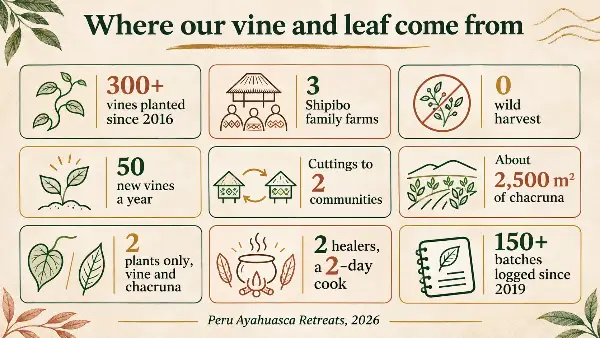
We don’t cut wild vine. Every vine we use was planted, on our land or on 3 Shipibo family farms.
We’ve planted more than 300 vines since 2016, and the oldest are now mature. At harvest we take part of a plant and leave the roots in the ground. We plant 50 new vines a year and give cuttings to 2 nearby communities. Our chacruna garden covers about 2,500 square meters, and growers in the village top it up.
The brew is those 2 plants and nothing else. 2 healers cook it: the lead healer and the second healer. Each batch takes 2 days, and we’ve kept a log of every batch since 2019. It now runs past 150.
A Higher Price Doesn’t Buy A Fairer Retreat
In our experience, a higher price buys comfort. It doesn’t tell you who gets paid.
Brazil’s 2010 rules warn against tour packages sold on the brew’s effects, and against promises of miracle cures.
We don’t sell a luxury tier or a premium room. In our first 18 months, an investor pushed for luxury amenities and higher prices. It was our lead healer who said no.
No guest gets paid or rewarded for a review, and we sell no upgrades during the week. If price is your worry, our guide to cheap ayahuasca retreats shows what a low fee cuts.
Who Gets In When Money Is Tight
Price keeps people out, so we set aside 2 scholarship places a year.
They’re full or partial, paid from a set share of fees. Indigenous community members, veterans and first responders get priority, and each applicant sends a short statement of need. Any guest can pay the fee in 3 parts.
Some centers offer work trade instead. If you’re weighing one, ask what the volunteer learns, who supports them after a hard night, and whether the work replaces a paid local job.

What Do Indigenous Groups Say About Selling Ayahuasca?
They don’t speak with 1 voice. Some reject the trade, and others choose to work in it.
In a 2024 Petrie-Flom Center piece from Harvard Law School, a Tukano artist and a Brazilian anthropologist write about the Indigenous Ayahuasca Conference, first held in 2017. At its 2022 meeting, an Ashaninka leader called ayahuasca an ancestor and asked, “Would you sell your grandfather?”
Mongabay reported in 2026 that the conference met again in Acre in January 2025. It closed with a letter rejecting every form of ayahuasca trade that built a global market outside ethical limits.
Chacruna adds a warning of its own: critics in rich countries may not grasp what Amazonian families need.
Our answer is in how we’re built: the lead healer co-owns the business, the healers decide who drinks, and we don’t mix traditions. Our co-founder is a foreigner, and that tension doesn’t go away. Since 2016, Peru has listed Shipibo healing songs as national heritage, and we treat them as knowledge that belongs to our healers.
Does Peru Regulate The Ayahuasca Trade In 2026?
Not in practice. Peru protects traditional use of ayahuasca, but no agency licenses or inspects the retreats that sell it.
A 2008 resolution, reported by Peru’s state news agency, made the traditional knowledge and uses of ayahuasca practiced by native Amazonian communities part of the nation’s cultural heritage. It set that use apart from Western uses that are out of context, consumerist and commercial.
A 2022 paper in the journal Cultura y Droga found that 13 years later, rules to protect that heritage in practice were still pending. Commercial pressure, the paper said, kept growing. The US State Department says the Peruvian government doesn’t regulate groups that serve ayahuasca. Drinking it is still legal, as our page on ayahuasca law in Peru explains.
Since no one inspects us, here’s what we hold ourselves to. We’re a registered Peruvian company, and the lead healer’s stake is in the legal papers. We carry general liability insurance with a Peruvian insurer. That policy doesn’t cover what happens in ceremony, so every guest needs travel insurance with medical evacuation.
What The Fee Buys Before And After Your Week
A medical screening before you come and a year of follow-up after you leave. Neither costs extra.
We turn down 11% of applicants after a medical review and a video call. Another 5% to 7% never attend, mostly over medication tapers. Our medical screening page lists what we check.
Follow-up runs for 12 months by call and email. A WhatsApp line is answered within 4 hours during waking hours.
How To Ask Any Retreat The 14 Questions
Send them in writing and compare the replies. Numbers and dates beat adjectives.
Start with the 3 that tell you the most: what the healers earn, who owns the business and where the vine comes from. Then ask the rest. For safety, including screening and the distance to a hospital, use our 17 questions to ask before you book.
No one can undo the commodification of ayahuasca, but each retreat decides how fair its share of it is. When you’re ready to compare us, read how our ayahuasca retreat runs, and send us your 14 questions.
FAQs
What is the commodification of ayahuasca?
It’s the turning of ayahuasca, an Amazonian healing brew, into a product sold to outsiders through retreats, marketing and the plant trade. Research from UC Berkeley in 2020 found that the trade sends some money back to Shipibo communities, while most of the benefit and power stays in richer countries.
Is the commodification of ayahuasca always harmful?
No. Payment is how healers in the trade make a living, and Amazonian families often choose to join it. The harm depends on where the money goes and what it pushes people to do. Brazil’s 2010 rules for ayahuasca churches treat selling the brew as commerce, while Peru protects traditional use and leaves retreats unlicensed.
Is drinking ayahuasca cultural appropriation?
It depends on who holds the knowledge, who decides how it’s used and who gets paid. At a 2022 Indigenous ayahuasca conference, an Ashaninka leader compared ayahuasca to a grandfather and asked if anyone would sell theirs. Other Amazonians train foreign apprentices and welcome outsiders to their ceremonies. Ask any center who owns it and who decides who drinks.
How are ayahuasca healers paid?
It varies by center, so ask whether healers are paid by the ceremony, by the month or with a share of the business. At our center, the lead healer owns 30% of the company. The 2 healers who work with her are salaried staff with health insurance.
Is the ayahuasca vine endangered?
Nobody knows how much wild vine is left, because no reliable count exists. In Shipibo country, a 2020 study found that tourism demand has cut local access to the vine and to chacruna. We cut no wild vine, and we plant 50 new vines every year.
How can an ayahuasca retreat give back to the community?
Send money and jobs to the village, and let the community decide how the money is spent. Shamanic tourism inside Shipibo-Konibo villages fed a return of sorcery, a 2022 study found, so we keep guests on our own land. Every year, a fixed share of our gross revenue goes to a village fund run by a committee of 3, and the community elects 2 of its members.