Ayahuasca Icaros: What They Are And Who Teaches Them
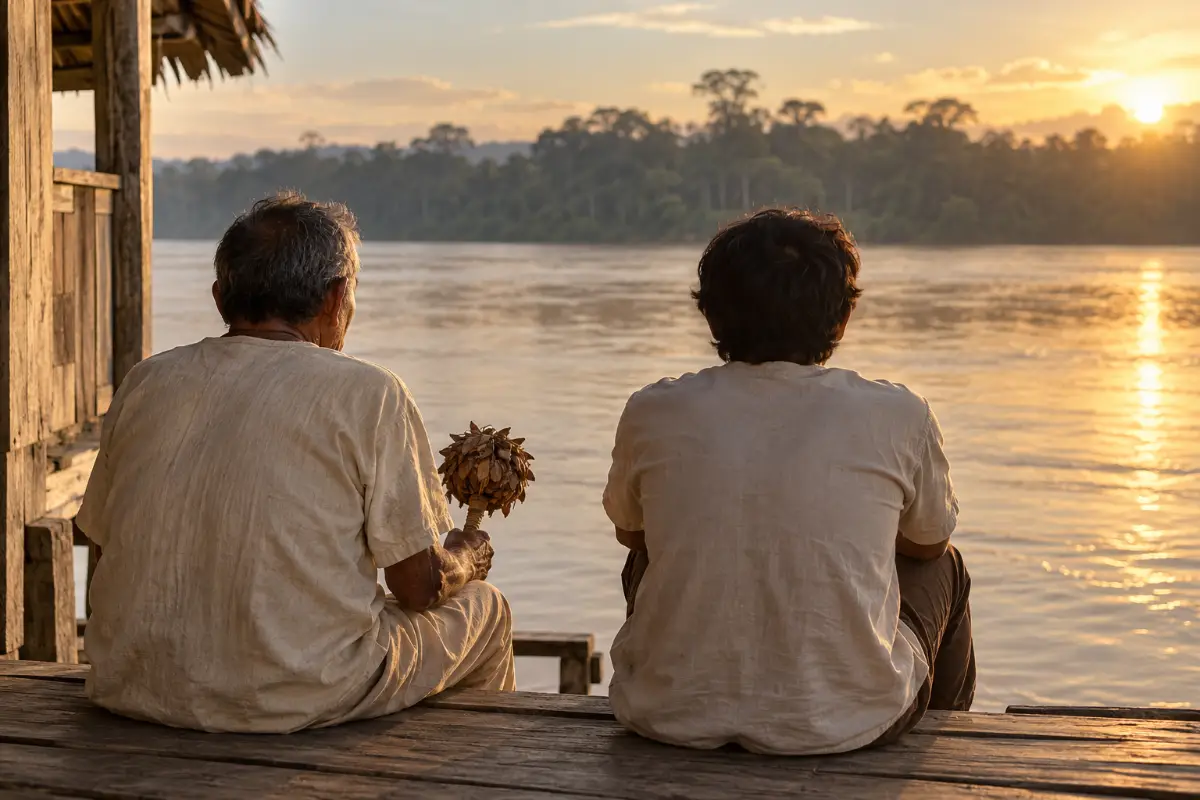
Ayahuasca icaros are the medicine songs a healer sings or whistles during an ayahuasca ceremony. Healers use them to open and close the night, to sing over the brew and to work with guests 1 at a time. In June 2016, Peru declared the icaros of the Shipibo-Konibo-Xetebo people national cultural heritage.
You’ll often read that the songs come from the plants. The healers’ own accounts, and Peru’s resolution, say people teach them too, a relative or another teacher, before a plant diet gives the song its force. That difference matters when you compare retreats, because only 1 of those 2 claims can be checked.
I own a 12-guest retreat in Peru’s Sacred Valley. I don’t sing there: in each ceremony, 2 Shipibo maestros do.
What Are Ayahuasca Icaros?
Ayahuasca icaros are medicine songs that Amazonian healers sing or whistle during a ceremony and sometimes over the brew before anyone drinks. Shipibo healers usually sing them in Shipibo. Healers learn them from teachers and during plant diets, called dietas, that can last months. Peru made the Shipibo-Konibo-Xetebo people’s icaros national heritage in 2016.
Each healer carries a personal set. A 1984 study of 4 healers around Iquitos, published in the Journal of Ethnopharmacology, called icaros “highly individualistic.” It says “the number and quality of a shaman’s icaros is the best expression of his knowledge and power.”
You’ll find the claims below on icaro pages, including some that rank well. The right-hand column shows what the primary record says.
| What you’ll read | What the record shows | Source |
|---|---|---|
| “Icaro” has no translation | It likely comes from the Quechua ikaray, to blow smoke in order to heal, or from the Kukama ikara, “song” | Peru’s Ministry of Culture, 2016; a 2011 history of ayahuasca use |
| Icaros come only from the plants | Healers describe learning from a teacher and from plants, often in the same breath | Ministry of Culture, 2016; studies from 1984, 2009 and 2018 |
| Only a shaman sings icaros | They aren’t only for healers. Some songs mothers sing while breastfeeding count as icaros | Ministry of Culture, 2016 |
| The words don’t matter, only the vibration | The resolution calls the energetic side central, but it gives the words their own dimension and says the words and the vibrations both carry power | Ministry of Culture, 2016 |
| Every ayahuasca ceremony has icaros | 37.7% of 6,749 drinkers reported live icaros at their last ceremony | International survey, Frontiers in Pharmacology, 2021 |
| A real shaman knows hundreds | 1 healer studied in 1984 knew about 60 to 70. 3 others said they knew over 100 | Journal of Ethnopharmacology, 1984 |
| Research shows icaros heal | A 2022 survey of 2,751 drinkers found a correlation with mystical-experience scores (r = 0.314), which isn’t proof of healing | Frontiers in Psychology, 2022 |
| Icaros are only for ceremonies | The resolution lists songs for fishing, for finding love and for easing the death of a terminally ill person | Ministry of Culture, 2016 |
Where Does The Word Icaro Come From?
The word has 2 proposed origins, and both translate. Peru’s 2016 heritage resolution traces it to the Quechua word ikaray. Quoting an anthropologist’s list of Shipibo song types, it defines ikaray as “la acción de soplar humo con el objetivo de curar”: blowing smoke in order to heal.
A 2011 history of ayahuasca use in Peru doubts the Quechua origin. Its author reports a linguist who says “it is not a Quechua word.” Kukama speakers on the Ucayali River also told him that “any song in Kukama is called ikara.” So a site that says icaro has no translation is wrong either way. The word means blowing smoke to heal, or it means song.
Shipibo speakers have words of their own. Bewa is the generic word for any song, medicine or not. A 2022 paper co-written by a Shipibo author, in the journal Literatura: teoría, historia, crítica, uses rao bewa, medicine song, for healing songs. It notes that ikaro is the name in the region’s Spanish. Peru’s resolution gives besho as the Shipibo-Konibo name for íkaros.
Shipibo healers usually sing in their own language. In the resolution’s words, the songs “suelen ser cantados en lengua shipibo-konibo.” A 2009 paper in Curare, a journal of medical anthropology, calls ikaro a loanword from Kukama. Ikaro songs, it adds, usually show “similarities to Kukama or even Quechua singing style.” Outside ceremony, you can talk with our maestros through a translator at any point.
The words matter to the healer even when you can’t follow them. The resolution gives each icaro a “dimensión semántica,” the phrases sung and their meanings. It says “la palabra y las vibraciones del canto tienen poder”: the words and the vibrations of the song both carry power. The same 2009 paper observes that “healing efficiency does not correlate significantly with the patient’s comprehension of the lyrics,” since treatments judged to work included mestizo and foreign patients.
What Peru’s 2016 Resolution Says An Icaro Is
Peru’s Ministry of Culture made the íkaros of the Shipibo-Konibo-Xetebo people national cultural heritage in Resolución Viceministerial 068-2016-VMPCIC-MC, signed on 15 June 2016 and published in El Peruano on 22 June. Article 1 calls the songs a thread that runs through Shipibo culture. It also calls them an expression of a bond with nature built on “aprender de ella, cuidarla, escucharla y respetarla”: learning from it, caring for it, listening to it and respecting it.
Peru’s Amazon research institute, IIAP, asked for the declaration in November 2015, with support from FECONAU, the federation of native communities of Ucayali. The text makes 4 points worth knowing.
Icaros aren’t only for healers. They “ni solo pueden ser entonados por el chamán,” the text says, so the shaman isn’t the only one who can sing them. It counts some songs mothers sing while breastfeeding and a healer’s songs to start a new student. Songs for fishing and for finding love count too, and so do songs to ease the death of a suffering, terminally ill person.
Icaros are sung to things as well as people. A healer sings an íkaro to “algún objeto o pócima,” an object or a potion, to “cargar” it, which means to charge it, for cleansing, protection or healing. That’s the idea behind singing over the brew before it’s served.
The learning diet is strict. The student gives up sugar, salt, oil, fried food, alcohol, Western medicine, drugs and sex, and drinks a preparation of 1 specific sacred plant, sometimes for months. The diet also changes the sound, the resolution says: it gives the song “un timbre más suave,” a softer tone, so it reaches deeper into the patient’s body.
There are 2 ranks of healer. The meraya has the highest level of mastery and is the only one who can enter all 4 worlds of Shipibo belief. The onaya, also spelled onanya, is what most people would call a shaman.
A heritage declaration protects a people’s songs. It doesn’t license any healer or retreat, ours included. It sits beside Peru’s 2008 ayahuasca declaration, which covers the traditional use of the brew itself.
Icaros Are Taught By People As Well As Plants
Healers learn icaros from other people and from the plants. A common telling has the plants hand over every song, with no person teaching anything. Healers’ own accounts include both.
Peru’s resolution says the knowledge passes “al interior de la familia del chamán como también a discípulos externos.” That means inside the healer’s family and to outside students. It passes “en base al principio de la confianza,” on trust. For the shamans, it adds, the plants themselves “muchas veces,” often, make the learning possible through a diet. Everyday íkaros are taught by parents to their children.
A 2018 study of how Shipibo healers learn their curing songs found the same mix. “Most singers explain that they learned singing (along with other medical techniques) from a teacher, say, their father, uncle, etc.” Then, “often in the same instant,” they insist “they received the songs from spiritual beings.” The author calls it “seemingly paradoxical.”
His 2009 paper gives the order. A future healer “will usually first practice singing along with his teacher or any related médico in curing sessions. The diet will then provide individual songs and vocal abilities (like reaching very high pitches).” The 1984 Iquitos study calls icaros “a particular gift of the spirits,” though it adds that “sometimes a teacher can transmit an icaro to his pupil.”
The plant side is real too. 16 Amazonian healers took part in a 2022 study in the Journal of Ethnopharmacology, 2 of them tied to Shipibo tradition by ancestry or teachers. Icaros, it says, “are often given to the healer by the plants themselves.” Training “can range from several months to years.” A healer put it plainly: “you have to do long diets… a year, two years.”
The Shipibo co-authored paper joins the 2 halves. To heal, it says, learning a song’s phrases isn’t enough: “es necesario que antes se incorpore la fuerza espiritual de las plantas.” The plants’ spiritual force has to be taken in first.
You can use this before you book. A claim that the plants gave a healer every song can’t be checked. A named teacher, and a list of the plants dieted and for how long, can. Ask every center who taught the people who’ll sing at your mat, and add it to your questions worth asking. Our guide to spotting a fake shaman shows how to look up a native community in Peru’s public database, and our maestros’ communities are listed in it.
What Icaros Do During A Ceremony
Icaros run through the whole ceremony. The healers sing almost without a break, from the first song as the brew takes hold to songs sung to each guest in turn and a closing song near dawn. That matches the resolution, which describes the songs as sung “de manera constante a lo largo de la sesión curativa,” steadily through the healing session.
In our maloca, across the 4 ceremonies of a week, 2 Shipibo maestros sing for up to 12 guests. That gives each maestro 6 guests to reach. The first icaro starts some 40 minutes after the cup. Individual icaros begin around 12:30 am, and a closing icaro near 5:30 am ends the ceremony. With 6 guests per maestro, the time each guest gets is worth asking any center about.
Not every icaro is sung out loud. The resolution’s list of song types includes one that “puede ser un silbido o un susurro,” a whistle or a whisper. The 1984 study notes that whistled icaros “present more variation than the sung” ones. In an international survey of ayahuasca drinkers, analyzed in Frontiers in Pharmacology in 2021, 16.7% reported whistling at their last ceremony.
Tobacco often travels with the songs. The resolution calls tobacco a plant “usado para la limpieza espiritual y la protección,” used for spiritual cleansing and protection. A separate 2021 study in the same journal interviewed 8 healers. One of them tied sopladas, the blowing of smoke, to the diet: “The usage of tobacco, the sopladas, the songs, all of that gets prepared and refined in the diets.” In the international survey, 31.8% said smoke was blown for healing and purification at their last ceremony.
The Chacruna Institute’s Ayahuasca Community Guide for the Awareness of Sexual Abuse tells guests they can stop or refuse any treatment, an individual healing included.
Do All Ayahuasca Ceremonies Use Icaros?
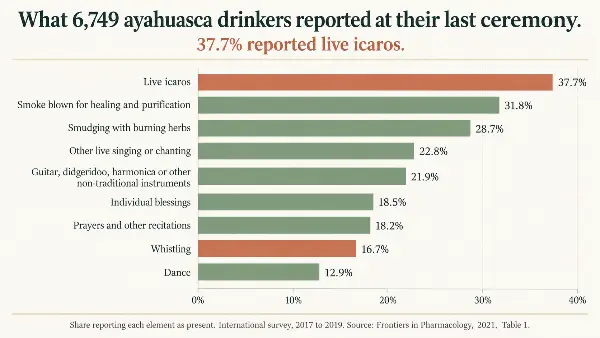
No. A 2021 paper in Frontiers in Pharmacology analyzed an international survey of ayahuasca drinkers, collected between 2017 and 2019. Of 6,749 respondents, 37.7% reported live icaros at their last ceremony. Across the full sample, 52.1%, or 3,553 people, had last drunk with an ayahuasca church.
| What 6,749 drinkers reported at their last ceremony | Share |
|---|---|
| Live icaros | 37.7% |
| Smoke blown for healing and purification | 31.8% |
| Smudging with burning herbs | 28.7% |
| Other live singing or chanting | 22.8% |
| Guitar, didgeridoo, harmonica or other non-traditional instruments | 21.9% |
| Individual blessings | 18.5% |
| Prayers and other recitations | 18.2% |
| Whistling | 16.7% |
| Dance | 12.9% |
That leaves 62.3% of those 6,749 who didn’t report live icaros. Icaros belong to Amazonian healing traditions, Shipibo and mestizo, and they aren’t part of every ayahuasca ceremony. If a retreat runs a playlist or a guitar all night, it’s offering a different type of ceremony, and it’s fair to ask what replaced the songs.
What Research Has Measured About Icaros By 2026
Not enough to show that icaros heal anything. The biggest numbers are correlations from surveys, and the closer studies are small qualitative ones, 2 of them with 5 and 6 participants.
A 2022 survey of 2,751 ayahuasca drinkers, in Frontiers in Psychology, found icaros had the highest correlation with mystical-experience scores of any music it measured (r = 0.314). In neo-shamanic groups, “only icaros were positively correlated” with those scores (r = 0.101). The survey only asked whether each type of music was present, so it can’t show that the songs caused anything.
The 2021 survey analysis bundled live icaros with other traditional practices. Together, those practices “were associated with a higher rated spiritual experience,” but also with more extreme fear, a weaker sense of community, poorer current mental health scores and more self-reported improvement. The analysis didn’t separate the songs from the rest.
The rest is small. A 2008 dissertation studied 5 experienced drinkers. In 2025, the Journal of Psychedelic Studies published a study of 6 guests at a Peruvian treatment center. A 2023 study of patients in addiction treatment at the same center found icaros “therapeutically significant” in their accounts. The oldest, a 1971 paper in the Journal of American Folklore, analyzed 1 recorded session in Iquitos.
We found no controlled study that compared ceremonies with icaros against ceremonies without them. So we count the icaros as the maestros’ craft and your company through the night, and we don’t promise they’ll heal anything.

Recordings, Playlists And The Songs You’ll Hear With Us
A recording keeps an icaro’s melody. It doesn’t keep what healers say makes the song work: the teacher behind it and the diet that followed. Guests can’t record our ceremonies, because they hand in their phones before the cup is served.
Some healers have been wary of tape. During a year of fieldwork around Iquitos in 1968 and 1969, a researcher contacted “about ten healers,” and “only one would permit recording of his music.” Others agreed. The 1984 study recorded most of 1 healer’s 60 to 70 icaros.
Streaming playlists labeled ayahuasca icaros are fine for listening at home. Ask who’s singing and who taught them, the same as you would at a retreat. By the account of the Shipibo co-authored paper above, learning the words isn’t enough to heal with them.
Everything else you’ll hear and feel that night is in our ceremony walk-through.
So treat ayahuasca icaros as working songs: taught by people, deepened by plant diets and, for the Shipibo, protected as national heritage since 2016. Before you book anywhere, ask who will sing, in what language, and who taught them. Then ask us what’s sung in the ceremonies we run.
FAQs
How many icaros does an ayahuasca shaman know?
It varies with training. A 1984 study of 4 healers around Iquitos reports 1 who knew about 60 to 70 icaros, while 3 others said they knew over 100. The same study says the number of icaros depends on the length of a healer’s plant diets.
Why do shamans whistle during an ayahuasca ceremony?
Whistling is a way of delivering an icaro. Peru’s 2016 heritage resolution, quoting an anthropologist’s list of Shipibo song types, describes a kind that can be a whistle or a whisper, with a meaning only the healer understands. In an international survey analyzed in Frontiers in Pharmacology in 2021, 16.7% of 6,749 drinkers reported whistling at their last ceremony.
Are ayahuasca icaros protected by law in Peru?
The icaros of the Shipibo-Konibo-Xetebo people are. Peru’s Ministry of Culture declared them national cultural heritage in Resolución Viceministerial 068-2016-VMPCIC-MC, signed on 15 June 2016 and published on 22 June. The declaration protects the tradition. It doesn’t license individual healers or retreats.
Can anyone sing ayahuasca icaros?
Some icaros, yes. Peru’s resolution says íkaros aren’t sung only by shamans, and it counts some songs mothers sing while breastfeeding and songs for fishing or finding love. Healing icaros are different. Healers describe learning them from a teacher and through long plant diets, and a 2022 paper co-written by a Shipibo author says the words alone aren’t enough to heal.
What is the Shipibo word for an icaro?
Bewa is the generic Shipibo word for any song, medicine or not. A 2022 paper co-written by a Shipibo author uses rao bewa, medicine song, for healing songs, and notes that ikaro is the name in the region’s Spanish. Peru’s 2016 resolution gives besho as the Shipibo-Konibo name for íkaros.
Can you learn icaros from a recording?
You can learn the melody. Healers describe learning healing icaros by singing beside a teacher, then receiving their own songs during plant diets that can run for months. According to Peru’s 2016 heritage resolution, the diet itself gives the song a softer tone, and a recording skips both steps.