What Does An Ayahuasca Medical Screening Check?
An ayahuasca medical screening checks 4 things: the medications you take, the conditions you have been diagnosed with, your cardiac and neurological history, and your family psychiatric history. At our retreat in Peru’s Sacred Valley, a licensed physician reads all of it before a place is offered and before a single dollar is charged. About 1 application in 5 does not proceed. This page lists what we look for, what stops a retreat cold, and what the published evidence says about each one, because almost nobody in this industry shows their working.
I have read a lot of competitor medical pages while writing this. Most of them run 2,000 to 4,500 words, publish a long list of banned drugs, and cite nothing at all. Not a study, not a drug label, not a government document. So here is the version with the sources attached.
What an Ayahuasca Medical Screening Actually Checks
An ayahuasca medical screening is a review of your full medication and diagnosis history by a licensed clinician before you are accepted onto a retreat. It exists because the ayahuasca vine contains monoamine oxidase inhibitors. That inhibition is what makes the brew active by mouth, and it is also what makes certain drugs, foods and heart conditions risky in combination.
Everything else follows from that one fact. The food rules exist because MAO inhibition raises blood pressure in the presence of tyramine. The medication rules exist because MAO inhibition changes how your body clears serotonin. The cardiac rules exist because the brew raises blood pressure on its own. If a center cannot explain its rules in those terms, it copied the list from somewhere.
We ask every applicant for 6 things:
- Every medication, with the dose and how long you have been on it
- Diagnoses, current and past, including ones you consider resolved
- Cardiac and neurological history
- Family psychiatric history, parents and siblings
- Previous psychedelic or plant medicine experience, if any
- Who at home knows you are going
That last one surprises people. It is not a medical question. It is the question that tells us whether anyone would notice if something went wrong, and whether you have told a single person in your life the truth about this trip. Applicants who have told nobody are not declined for it, but we talk about it.
The Conditions That Stop a Peru Retreat Cold
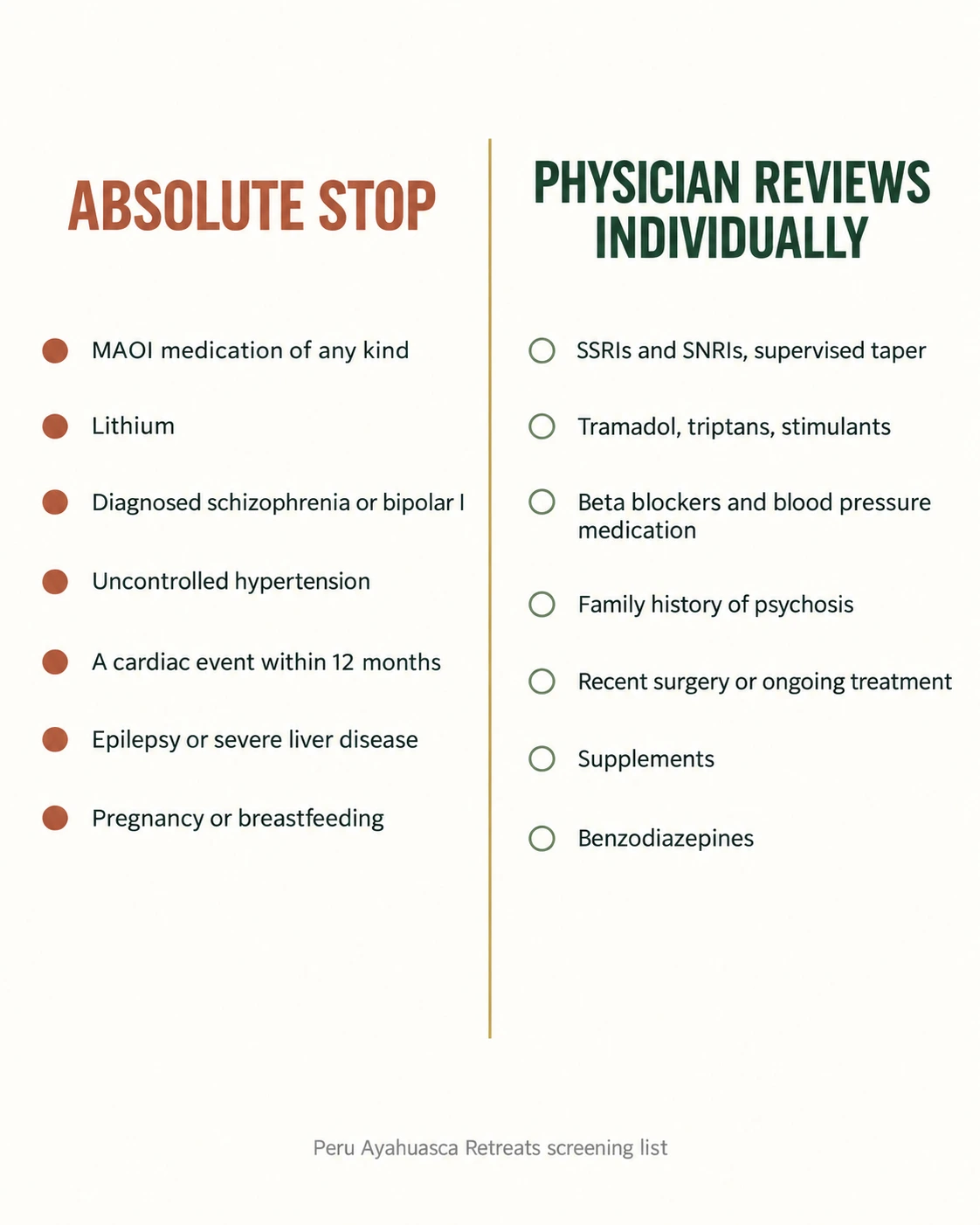
Some answers end the conversation. These are our absolute stops, published in full on our ayahuasca retreat page and applied without exception:
| Absolute stop, no exceptions | Reviewed individually by the physician |
|---|---|
| MAOI medication of any kind | SSRIs and SNRIs, usually with a supervised taper |
| Lithium | Tramadol, triptans, stimulants |
| Diagnosed schizophrenia or bipolar I | Beta blockers and blood pressure medication |
| Uncontrolled hypertension | Family history of psychosis |
| A cardiac event within 12 months | Recent surgery or ongoing treatment |
| Epilepsy or severe liver disease | Supplements, which people forget to list |
| Pregnancy or breastfeeding | Benzodiazepines, taper confirmed by your prescriber |
The right column is not a softer version of the left. It means a physician reads your file and decides, and that the answer sometimes takes a second conversation with your own doctor. Roughly 1 application in 5 does not proceed here. Declined applicants are never charged, always get the reason in writing, and get a referral list.
Publishing a decline rate costs a center bookings, which is why almost none of them do it. It is also the cheapest test you can run on any center you are considering. Ask what proportion of applications they turn down. A center that does not know its own number is not screening, it is collecting forms.
Can You Drink Ayahuasca on Antidepressants?
No, not while you are still taking them, and the taper has to be planned by the doctor who prescribed them. This is the single most common reason an application here stalls.
The pharmacology is not disputed. Ayahuasca inhibits monoamine oxidase. SSRIs and SNRIs block serotonin reuptake. Combining a reuptake blocker with an MAO inhibitor is the classic recipe for excess serotonin, and it is the reason your own prescribing information carries a warning about it.
What is disputed, oddly, is the timing. I compared what 4 of the centers currently ranking for this question tell their guests. One says stop “prior to applying” with no duration at all. One says 4 weeks. One says 2 to 6 weeks. One says 4 weeks and does not distinguish between drugs. None of the 4 cites a source for its number.
Why Fluoxetine Needs Longer Than Every Other SSRI
Because it stays in your body far longer than the rest, and the US Food and Drug Administration already published the number. The fluoxetine prescribing information states that at least 5 weeks should be allowed after stopping fluoxetine before starting an MAOI, and at least 14 days in the other direction.
The same label gives the reason. Fluoxetine has an elimination half-life of 4 to 6 days after chronic dosing. Its active metabolite, norfluoxetine, runs 4 to 16 days. A drug is generally considered cleared after about 5 half-lives. Run that arithmetic on norfluoxetine and you get somewhere between 3 and 11 weeks, which is why a flat “2 weeks off antidepressants” rule is fine for some drugs and badly wrong for one of the most commonly prescribed ones in America.
Ayahuasca is an MAO inhibitor. The FDA has already published the washout period for combining one of those with fluoxetine. In 10 years I have not seen a single ayahuasca center cite it.
Here is how the field compares against the label. Read the last column first.
| Source | SSRI washout given | Fluoxetine treated separately | Cites anything |
|---|---|---|---|
| Retreat center A | “Prior to applying” | No | No |
| Retreat center B | 4 weeks | Yes, 6 weeks | No |
| Retreat center C | 2 to 6 weeks | No | No |
| Retreat center D | 4 weeks | No | No |
| FDA fluoxetine label | Not a general SSRI rule | At least 5 weeks before an MAOI | It is the source |
We do not publish a house number, and that is deliberate. Your washout is set by your prescriber, based on your drug, your dose and how long you have taken it, and our physician confirms it before your place is held. Nobody here will ever tell you to stop a psychiatric medication. We will tell you what we need to see before you can drink, and then we will wait as long as that takes. If your doctor says the taper is unsafe for you, that is the end of it, and we will say so plainly rather than moving you to a later week and hoping.

Lithium Is the One We Are Moving to the Absolute Stops
Our page has listed lithium under individual review. On the evidence, that is the wrong column, and we are moving it.
In 2021, Nayak and colleagues published an analysis in Pharmacopsychiatry of 96 online reports describing classic psychedelic use alongside lithium or lamotrigine. Of the 62 lithium reports, 29 involved seizures. That is 46.8%. Of the 34 lamotrigine reports, none did. Their conclusion is unusually blunt for a journal: “lithium should be considered a contraindication to psychedelic use.”
It is not a clinical trial, and the authors say so themselves. It is self-reported data from an online archive. But a seizure rate near half in one group and zero in the comparison group is not the kind of signal you review case by case in a room with no hospital next door. Lithium is now an absolute stop here, alongside MAOIs.
I am including this because it is the most useful thing on this page for someone reading it about a different center. If you take lithium and a retreat tells you it can be managed, ask them which paper they are relying on. There is one, and it says the opposite.
Is Ayahuasca Hard on Your Heart?
It raises blood pressure, modestly and for a few hours, which matters if your cardiovascular system is already compromised. In a double blind placebo controlled study of 18 volunteers, Riba and colleagues measured a significant rise in diastolic blood pressure of 9 mmHg at 75 minutes on the higher dose. Systolic pressure and heart rate went up too, but not enough to reach statistical significance.
Nine points of diastolic pressure is not dramatic for a healthy adult. It is a different proposition if you have uncontrolled hypertension, had a cardiac event this year, or are on blood pressure medication that interacts with MAO inhibition. That is why those 3 sit where they sit on our list, and why anyone over 60 or with any cardiac history is asked for recent bloodwork and an ECG before the physician signs off.
Now add the parts that are specific to Peru. A ceremony night here means no food since lunch, several hours of purging, a night without sleep, and all of it at 2,800 to 3,000 metres on the Sacred Valley floor. Each of those raises cardiac demand on its own. We cover why altitude changes a Sacred Valley retreat in more detail, and it is the reason our cardiac questions are stricter than the ones you will see from centers at sea level in the Amazon.
Who Reads Your File in 2026, and What Happens Next
A licensed physician reads every application. Not a booking agent, not a facilitator, not a founder with a spreadsheet. Screening takes about 2 weeks, and nothing is charged until it is finished.
The sequence runs like this. You send the medical form. The physician reads it and flags anything that needs a taper, a document or a conversation with your prescriber. Your integration lead calls you, which is where the things a form cannot capture come up: how you sound, what you are expecting, whether you are walking toward something or running from it. Then we either offer you a place on a named week or tell you why we cannot.
Conditional acceptances are common. They usually mean a medication taper that your own doctor has to plan and confirm. A conditional acceptance is not a booking, and we do not hold a bed against one.
By the time you arrive, that file is doing work every night. The physician is on site all 7 nights and awake until first light, and checks in before ceremony with anyone flagged at intake. Oxygen and a defibrillator are in the building, the emergency protocol is rehearsed monthly, and we are 20 minutes from a clinic and an hour from a Cusco hospital we hold a standing arrangement with. Twelve guests, 2 maestros, 1 physician. You can read the whole night in our hour by hour account of a ceremony.
What Happens When Someone Hides a Medication?
We find out, usually at intake, and the retreat changes shape around it. Nobody is shamed. But we cannot keep you safe from a drug interaction we do not know about, and that sentence is in the application, in the video call, and in the arrival briefing.
People hide things for understandable reasons. Fear of being rejected after paying for flights. Fear of being told no after months of working up to it. The problem is that the physician is then making decisions from a file that is wrong, and the person carrying the consequence is you.
The most common omission is not a hard drug. It is supplements. St John’s Wort, 5-HTP, SAM-e and high-dose tryptophan all act on serotonin, and people leave them off the form because a supplement does not feel like a medication. Write them down. Dose and duration.
What Actually Kills People at Ayahuasca Retreats
Not the brew, on the available evidence. Unsupervised settings and unscreened bodies.
The research institute ICEERS examined 58 deaths attributed to ayahuasca between 2010 and 2022 and found that no autopsy has directly attributed a death to acute intoxication from the traditional brew. Where a cause was confirmed, it was something else: tobacco poisoning in 4 cases, water intoxication in 1, scopolamine in 1, cardiac events in 2, and a number of drownings where supervision had failed. Their conclusion is the sentence this whole page is built on. Most of those deaths, they wrote, “could have been avoided if the experiences had followed minimum safety standards, the sessions had been supervised, and experiences had been integrated afterward.”
The peer-reviewed record points the same way. A 2024 systematic review in the International Journal of Toxicology by White, Kennedy, Ruffell, Perkins and Sarris looked at 78 articles on ayahuasca and DMT adverse events and found no deaths in the reviewed literature, and no clear or confirmed case of serotonin syndrome tied to ayahuasca consumption.
Read those 2 findings together and the picture is clear. Supervised, screened administration has a clean record in the published literature. The deaths happened in the gaps: no screening, no clinician, no supervision, other substances in the mix. The Global Ayahuasca Survey of 8,216 people found the same thing from the other direction, listing pre-existing physical health conditions, anxiety disorders and drinking in a non-supervised context among the predictors of adverse effects. In that sample, 2.3% needed medical attention for a physical adverse effect afterward.
So the question worth asking a center is not whether ayahuasca is dangerous. It is whether the people serving it would catch the thing that makes it dangerous for you.
Why Screening in Peru Is Not Like Screening Anywhere Else
Because nobody is checking the checkers. The US State Department states plainly on its Peru information page that facilities offering ayahuasca “are not regulated by the Peruvian government and may not follow health and safety laws or practices.”
Ayahuasca itself is legal here and has been protected as national cultural heritage since 2008, which we explain in our breakdown of whether ayahuasca is legal in Peru. Legal is not the same as licensed. No Peruvian agency inspects retreat centers, sets a screening standard, or audits whether a physician exists. Any safety badge you see on a Peru retreat website was issued by the center that displays it.
Two more things are specific to this country and to this valley. The first is altitude, covered above. The second is distance. In the Amazon, many centers are hours from a hospital by river. In the Sacred Valley we are 20 minutes from a clinic and an hour from Cusco. That difference does not make one region better, it changes which risks each center has to screen out. A center far from medicine has to be stricter, not more relaxed, and the ones that are not strict are making a trade with your file.
What Should You Ask Before You Send Your Medical History?
You are about to hand a business in another country your full psychiatric and cardiac record. Ask for something back first. Five questions, in writing, before you send anything:
- Who reads my medical form, what is their licence, and in which country is it registered?
- What proportion of applications do you decline, and will you tell me in writing if mine is one of them?
- What is your required washout for my specific medication, and what is that number based on?
- Who is awake and medically qualified during ceremony, and what equipment is in the building?
- How far is the nearest clinic and the nearest hospital, in minutes, and do you have a standing arrangement with either?
Specific answers pass. Adjectives fail. “We have experienced staff” is not an answer to question 1, and “we have never had a problem” is not a safety protocol, it is a run of luck. We go through the same test in more depth in our guide to choosing an ayahuasca retreat in Peru, and the same standard applies to every other service we offer.
One last thing about the food rules, since people mix the 2 up. The dieta is a separate protocol from the medical screening, it starts 3 weeks before you fly, and it exists for the same pharmacological reason. We walk through it in our guide to the dieta before an ayahuasca retreat. Screening decides whether you can come. The dieta decides what shape you arrive in.
Nothing on this page is medical advice, and these lists are not exhaustive. If your history is complicated, send the file and let a physician read it. Our ayahuasca medical screening is free, it takes about 2 weeks, and it ends with a real answer either way. You can start an application, look at what a Peru retreat actually costs, or read about the people who would be in the room before you decide anything.
Frequently Asked Questions
What does an ayahuasca medical screening check?
It checks your full medication list with doses, your current and past diagnoses, your cardiac and neurological history, and your family psychiatric history. At our Sacred Valley retreat a licensed physician reads all of it before a place is offered or any payment is taken, and roughly 1 application in 5 does not proceed.
How long do you have to be off antidepressants before ayahuasca?
It depends on the drug, and your prescriber sets it. Fluoxetine is the outlier: the FDA label requires at least 5 weeks after stopping it before starting an MAOI, because its active metabolite norfluoxetine has a half-life of 4 to 16 days. Shorter half-life SSRIs clear faster. A flat house rule of 2 weeks is wrong for fluoxetine.
Can you take ayahuasca while on lithium?
No. A 2021 analysis in Pharmacopsychiatry of 62 reports of lithium taken with a classic psychedelic found seizures in 29 of them, or 46.8%, against none of the 34 lamotrigine reports. The authors concluded that lithium should be treated as a contraindication. We treat it as an absolute stop.
Is ayahuasca dangerous for your heart?
Ayahuasca raises blood pressure for a few hours. A placebo controlled study of 18 volunteers measured a 9 mmHg rise in diastolic pressure at 75 minutes. That is manageable for a healthy adult and a real risk with uncontrolled hypertension or a recent cardiac event, both of which are absolute stops here. At 2,800 to 3,000 metres in the Sacred Valley, fasting and a sleepless night add to the load.
What conditions disqualify you from an ayahuasca retreat?
Ours are MAOI medication, lithium, diagnosed schizophrenia or bipolar I, uncontrolled hypertension, a cardiac event within 12 months, epilepsy, severe liver disease, and pregnancy or breastfeeding. SSRIs, SNRIs, tramadol, triptans, stimulants, blood pressure medication and a family history of psychosis are reviewed individually by the physician.
Has anyone died from drinking ayahuasca?
ICEERS examined 58 deaths attributed to ayahuasca between 2010 and 2022 and found that no autopsy has directly attributed one to acute intoxication from the traditional brew. Confirmed causes included tobacco poisoning, water intoxication, scopolamine and cardiac events. The institute concluded most were avoidable with supervision and basic safety standards.
Are ayahuasca retreats in Peru medically regulated?
No. The US State Department states that facilities offering ayahuasca in Peru are not regulated by the Peruvian government and may not follow health and safety laws or practices. Ayahuasca use is legal and has been protected as cultural heritage since 2008, but no agency licenses or inspects centers. Any certification badge you see is self-issued.