Small Group Vs Large Group Ayahuasca Retreats, Why Group Size Matters
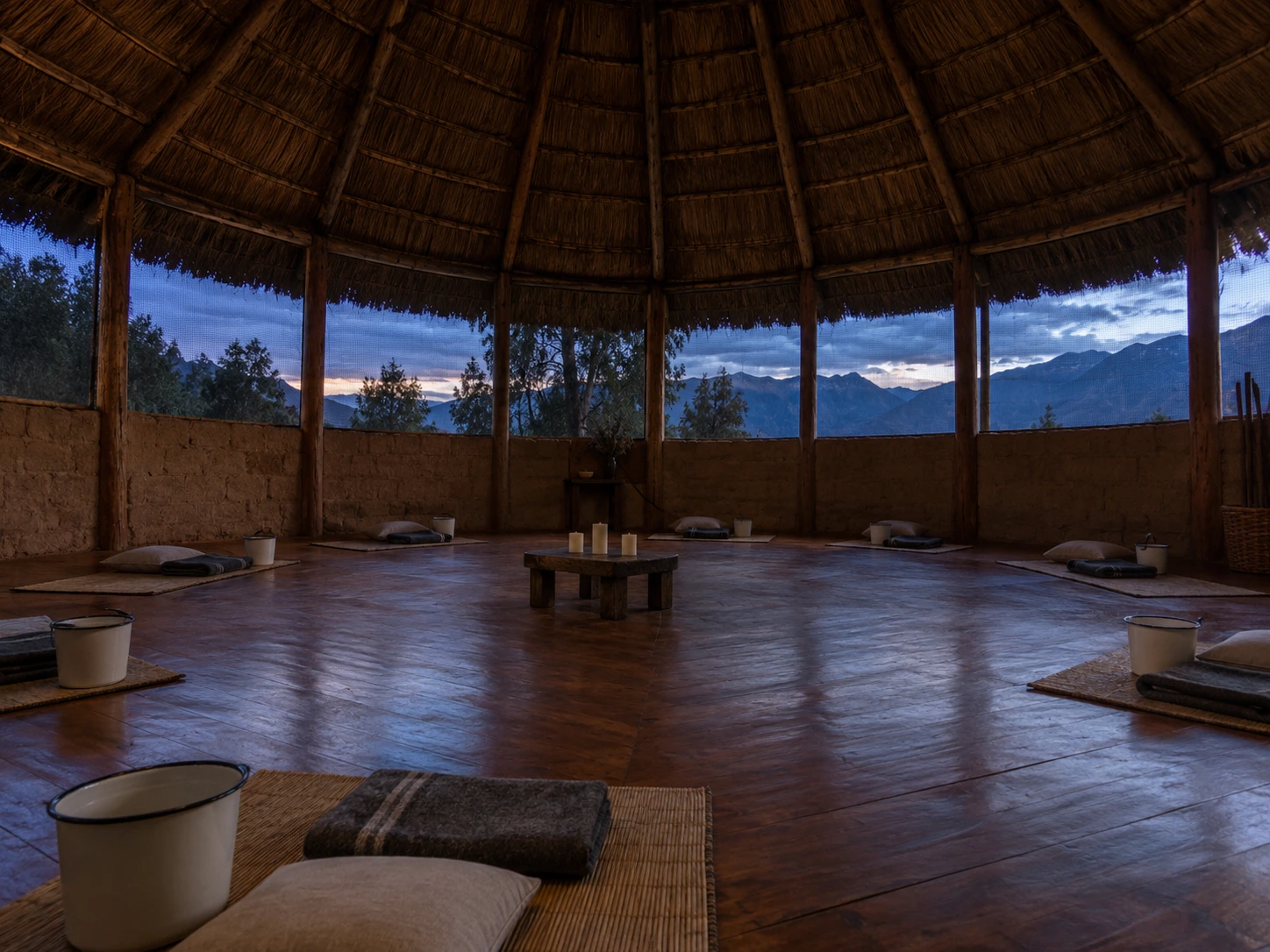
Ayahuasca retreat group size in Peru runs from 6 guests to 30, and the number on its own tells you almost nothing. What decides whether a night is held well is the second number: how many qualified people are awake in the room with you. A small group with 1 shaman is worse supported than a larger group with 3 shamans and a doctor. Almost no Peruvian center publishes both numbers, so most people compare the half they can see. This post gives you our full count, the arithmetic to check anyone else’s, and the point where a large group stops being a trade-off and starts being a risk.
What Ayahuasca Retreat Group Size Means in Peru
Ayahuasca retreat group size is the number of guests who drink in a single ceremony, not the number booked for the week. A 20 guest retreat that splits into 2 ceremonies of 10 is a 10 person room. Ask which a center means, because both get advertised as small.
A 12 guest retreat where everyone drinks together is a 12 person room, and that is the number worth comparing.
The distinction matters more in Peru than almost anywhere else, because there is no regulator setting a ceiling. A center in Iquitos can seat 30 people in a maloca tonight and break no law. A center in the Sacred Valley can seat 6. Both are legal, and the only person applying a standard is you.
So group size is worth checking. It is just the first of 2 numbers, and the field has spent 10 years arguing about the wrong one.
Small Group and Large Group Retreats, Side by Side
Neither format is automatically safer. What changes is how quickly attention reaches you, how much direct healing work you receive, and what happens when 2 people need help at once. Here is the honest comparison, including the parts that favour a bigger room.
| What changes | Small group, 6 to 12 guests | Large group, 18 to 30 guests |
|---|---|---|
| Direct icaro time per guest | Longer. A maestro can reach every mat in a night | Shorter. Some guests receive no individual work on some nights |
| Time to reach a guest who raises a hand | Seconds, if the floor is staffed | Depends on how many facilitators are working the room, and nothing else |
| 2 guests in difficulty at the same time | Manageable with 2 maestros and a physician | Manageable only with a large team, and few centers publish a head count |
| Cost per guest | Higher. Fixed staff costs spread across fewer people | Lower. This is the real reason large groups exist |
| Feeling watched | Some guests find 12 people too intimate | Easier to disappear, which some people want and some people need not to have |
| Group field in the room | Quieter. One person’s hard night is audible to everyone | Louder. Purging and weeping blend into background sound |
| Screening pressure | Every place has to be filled carefully | More places to fill, which is where standards usually slip |
That last row is the one worth sitting with. Group size does not cause bad screening. Volume does. A center that needs 25 beds filled every week has more reason to say yes than a center that needs 12.
How Many People Are in a Typical Ayahuasca Ceremony?
Most ceremonies in Peru seat between 8 and 25 guests, and the spread inside that range is wide. Centers that describe themselves as small tend to sit between 8 and 14. Centers in the Iquitos corridor, where the highest volume of retreats operates, commonly run 15 to 25 and occasionally more. A handful of large operations seat 30 or above.
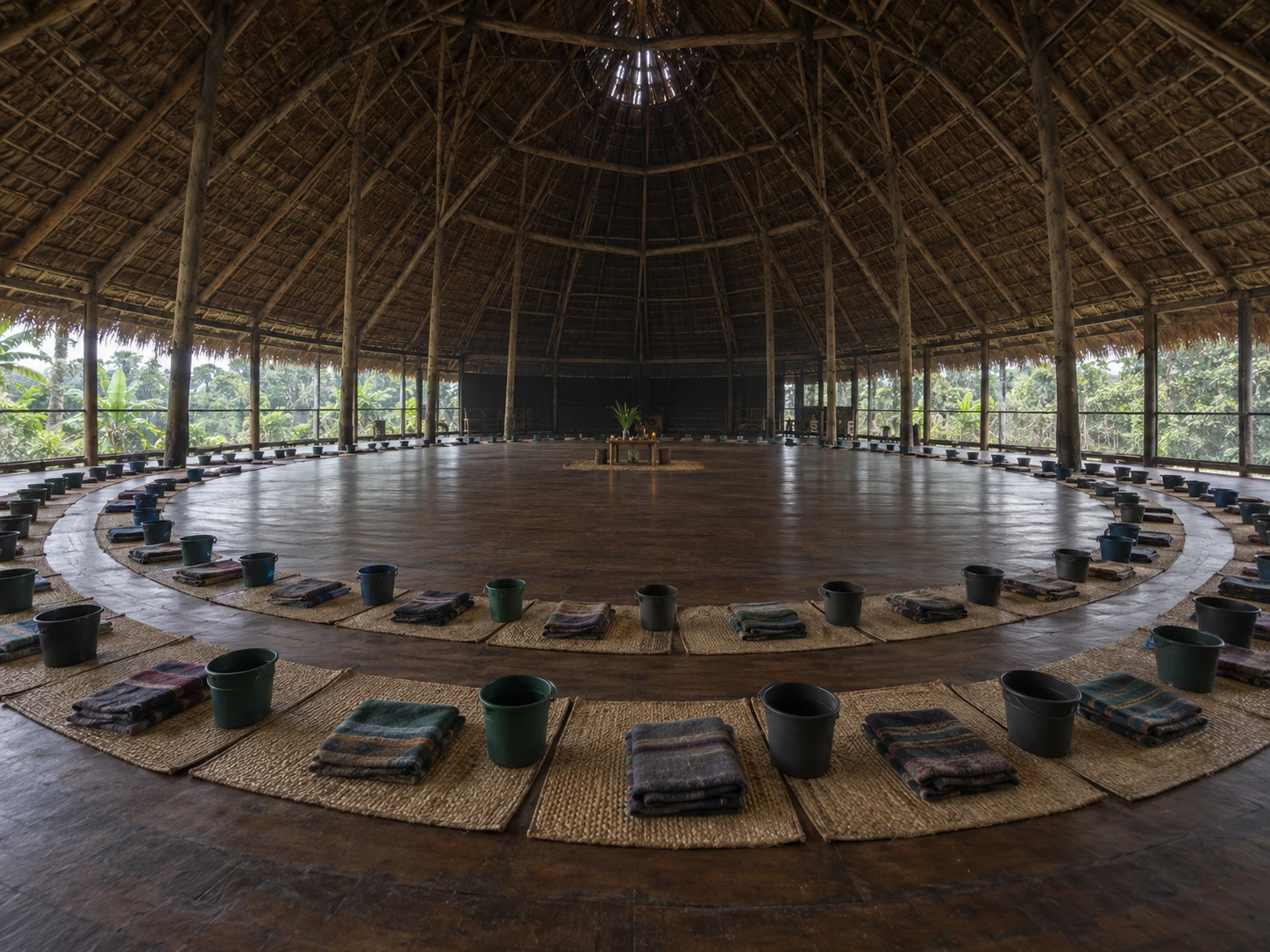
The word small is doing no work in any of this. It appears on the websites of centers seating 8 and centers seating 25. Some published guidance in this space calls 5 to 8 guests the best format, others call 12 to 18 the practical maximum, and others treat 25 as normal. None of those numbers comes with a staff count attached, which is what makes them impossible to compare.
There is one useful rule buried in the range. Above roughly 20 guests, a single ceremonial leader cannot reach every mat in a night. That is not an opinion about energy. It is a division problem: 6 hours across 25 people is under 15 minutes each, before anyone purges, panics or needs walking to a bathroom.
What Is a Good Shaman-to-Guest Ratio?
There is no industry standard, and any center that quotes one as though it exists is quoting itself. What does exist is clinical guidance from supervised psychedelic sessions, and it is stricter than anything the retreat industry advertises.
The Society for the Advancement of Psychotherapy’s review of group psychedelic sessions collects the ratios actually used in research. Lewis and colleagues, writing in the Journal of Psychedelic Studies in 2023, recommend a 1 to 1 participant to therapist ratio with a lead therapist overseeing the group. Oehen and Gasser ran Swiss trial groups of up to 12 subjects with 3 supporting therapists. Blewett, back in 1971, worked in groups of 4 with 1 therapist.
So the peer-reviewed floor for supervised group work sits between 1 to 1 and 1 to 4. No ceremonial retreat in Peru operates at 1 to 1, ours included, and none should claim to. A maloca is not a clinical trial and the work is not the same work. But when a retreat quotes you a ratio of 1 to 3 and presents it as good practice, it is worth knowing that the research it is gesturing at recommends something considerably tighter.
Why Most Published Ratios Do Not Survive Arithmetic
Researchers have already tried to collect this number across the industry and failed. A 2025 PLOS One analysis of 298 retreat companies advertising online reported that most provided so little detail that the authors could not analyse staff-to-participant ratio at all. That is the state of the field. The single number that decides how a hard night goes is the one almost nobody prints.
Where centers do print a ratio, it often does not divide. A room with 12 guests and 2 shamans is 1 shaman for every 6 guests. Written as 1 to 3, it would need 4 shamans. The gap between those 2 sentences is not a rounding error, it is double.

We have to own this one. Our own pages have carried 1 maestro to 3 guests alongside 12 guests and 2 maestros. Those cannot both be true. The honest figure is 1 maestro for every 6 guests, plus a physician and an integration lead in the room, and we are correcting the pages that say otherwise. A post arguing that you should do the division on any center’s claim has no business skipping its own.
Who Is in the Maloca on Our Ceremony Nights in 2026
Here is the whole roster for a ceremony night at our Sacred Valley center, with the arithmetic done in public. We seat 12 guests and never more, across 4 ceremonies in 7 nights.
| In the room | How many | What they do, and for how long |
|---|---|---|
| Guests | 12, never more | Drink at about 9:00 pm, on their own mat until first light |
| Shipibo maestros | 2 in every ceremony | Sing almost continuously, then move mat to mat for individual icaros from around 12:30 am |
| Attending physician | 1 | Internal medicine, based in Cusco. Reads every application, then stays awake in the maloca through all 4 ceremonies |
| Integration lead | 1 | Opens the room, works the floor, then stays with you for 12 months of calls after you fly home |
| Maestro to guest | 1 to 6 | The real division, not the marketing one |
The 3 maestros on our roster carry 31, 26 and 19 years in lineage, and 2 of them are in the maloca on any given night. All are Shipibo, from Ucayali communities in the Amazon, and they travel to the Andes to work. We say that plainly because the Sacred Valley is a Quechua valley and the lineage is not from here. If provenance matters more to you than access, our Iquitos house sits in the maestros’ own watershed and we will book you there instead.
The physician is the part most centers do not have. In practice it means the person deciding whether a racing heart at 1:00 am is the medicine or a problem holds a medical licence, and has been awake in the room for 4 hours watching you before the question comes up. You can read more about the people who hold the room, all of whom are named before you are asked for anything.
Does a Bigger Group Mean Less Individual Icaro Work?
Yes, and this is the part of the group size question that has nothing to do with safety. Individual icaros are the core of Shipibo ceremonial practice. A maestro kneels at your mat and sings directly to you, adjusting to what they see, and that stretch of the night is where most guests locate whatever happened to them.
The arithmetic is unforgiving. In our room, 2 maestros work 12 mats over roughly 5 hours of singing. In a room of 25 with 3 maestros, the same hours cover twice the mats. Guests in large ceremonies often report a full night with no maestro at their mat at all, which is a normal outcome of the division rather than a failure by anyone in the room. If you want to know what that stretch of the night actually sounds like, we have written a plain account of a single night in the maloca.
Some people would rather not be sung over. That is a real preference and a large room serves it. Just know which one you are buying.
What Group Size Changes at 2:00 am in the Sacred Valley
Peru is not one setting, and group size interacts with where a center sits. Ours is on the Urubamba valley floor between Pisac and Ollantaytambo, at about 2,800 m, roughly an hour from a Cusco hospital on sealed road with no river crossing. An Amazon center outside Iquitos or Pucallpa is a boat ride from the nearest road.
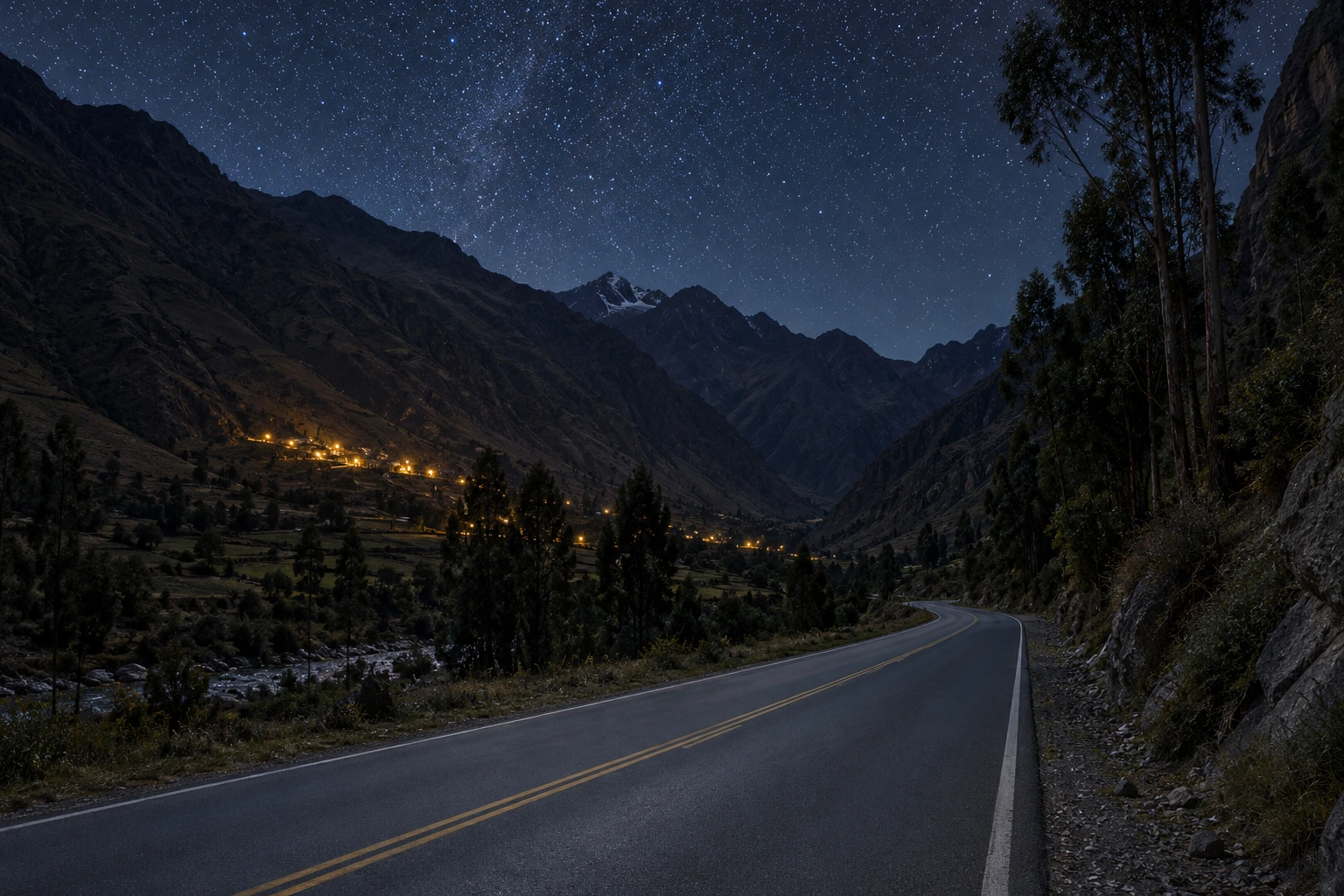
That changes the maths of a bad night. In the valley, an evacuation is a vehicle and a driver. On a river, it is a boat, a pilot, and daylight or a working lamp. Now put 25 guests in either room instead of 12. The staffing question stops being about attention and becomes about capacity: if 2 people need to leave at once, how many trained people are left holding the remaining 23?
Altitude adds its own load in the Andes. Fasting since lunch, purging, and a night without sleep all compound at 2,800 m, on top of the 3 weeks of food and medication rules that come before you fly. That is why we build in 2 acclimatisation days before anyone drinks. A larger group at altitude means more people carrying that load with the same number of eyes on them. The full shape of the week, hour by hour, is in our guide to what to expect at a Peru ayahuasca retreat.
Why Nobody in Peru Sets a Limit on Group Size
Peru recognised ayahuasca ceremonies as national cultural heritage in 2008. That resolution protects the practice. It does not set a group size, a staff ratio, an inspection schedule or a licence to revoke, and the distinction gets blurred by centers quoting the heritage status as though it were an accreditation. We have written separately on how Peruvian law treats ayahuasca for travellers from the United States.
The US State Department puts it flatly on the department’s Peru page: facilities or groups offering ayahuasca “are not regulated by the Peruvian government and may not follow health and safety laws or practices.” No inspector is counting mats. The ceiling is whatever each center decides it is.
Research published in January 2026 gives a sense of what that produces. A JAMA Network Open study of 49 retreat organizations found that 34 of them, 69.4%, worked with a licensed health care professional or someone with emergency response training, and 32, 65.3%, had such a person in attendance at retreats at least some of the time. Read the other way: close to 1 organization in 3 did not report a medically qualified person present. Group size is a secondary question in a room where nobody is qualified to answer the primary one.
The medical case for staffing is not theoretical either. In the Global Ayahuasca Survey published in PLOS Global Public Health, covering 8,216 ayahuasca drinkers, 69.9% reported acute physical adverse effects and 62.0% reported vomiting or nausea. 2.3% required medical attention afterwards. The survey also found physical adverse effects associated with drinking in a non-supervised setting. Roughly 1 person in 40 needing follow-up care is a rate a room of 12 absorbs and a room of 30 does not.
How Do You Check a Peru Center’s Real Ratio?
Send 6 questions by email before you pay anything. What you are testing is not the answers, it is whether they arrive in writing and whether they divide.
- How many guests drink in a single ceremony? Not per retreat. Per ceremony. A good answer is a fixed number with the word maximum attached.
- How many shamans or maestros are in that room, that night? A roster of 6 healers means nothing if 2 work each night. Ask how many are present, not how many exist.
- How many facilitators are on the floor, and for how many hours? This is the team that reaches you when you raise a hand. A center that cannot name a number here has not thought about it.
- Is anyone in the room medically qualified, and are they awake? On call in a nearby town is a different answer from awake on site. Ask which.
- What is the plan if 2 guests need help at the same time? The answer reveals the real staffing more reliably than any published ratio.
- Will you put those 4 numbers in an email? This is the whole test. A center that answers warmly on a call and vaguely in writing has told you something.
Then do the division yourself. Guests divided by maestros gives you the ceremonial ratio. Guests divided by everyone trained in the room gives you the support ratio. If a center’s published ratio does not match either result, ask which people they counted. Our own 9 questions for choosing a Peru retreat covers the screening and medical protocol side of the same conversation.
When a Large Group Is the Right Choice
Small is not a virtue on its own, and pretending otherwise would be the same trick in the other direction.
A large group costs less, and for many people that is the difference between going and not going. Fixed costs, a maestro’s fee for the week, a physician’s night shift, a salt-free kitchen, spread across 25 people instead of 12. We have broken down where the money in a Peru retreat price goes, and staffing is the line that moves most with group size.
A large group can also carry you. Some people find a room of 12 unbearably exposed, and would rather be one of 25 with room to fall apart unobserved. Some want the community that a bigger cohort builds. Those are legitimate reasons, and a well-staffed large retreat is a better choice than a thinly staffed small one every time.
What is not legitimate is a large group with a single ceremonial leader, no medical cover, and a website that calls it intimate. That configuration exists across Peru, and it is the one this whole post is about.
Frequently Asked Questions
How many people are in a typical ayahuasca ceremony in Peru?
Most Peruvian ceremonies seat between 8 and 25 guests, with centers in the Iquitos corridor generally running at the higher end and Andean centers at the lower end. There is no legal maximum in Peru. At our Sacred Valley center the number is 12, never more, across 4 ceremonies in 7 nights.
Is a small group ayahuasca retreat safer than a large one?
Only if the staffing behind it is real. A room of 10 guests with 1 shaman and nobody medically qualified is worse supported than a room of 18 with 3 shamans and a doctor awake on site. Compare guests against the number of trained people present, not against the guest count alone.
What is a good shaman-to-guest ratio at an ayahuasca retreat?
No standard exists in the retreat industry. In supervised psychedelic research the ratios used run from 1 to 1 up to about 1 to 4, which is tighter than anything ceremonial retreats advertise. Our ceremonies run 2 Shipibo maestros for 12 guests, which is 1 maestro for every 6, alongside a physician and an integration lead in the room.
Does ayahuasca retreat group size affect the cost?
Yes, and it is the main reason large groups exist. Maestro fees, medical cover and a dieta kitchen are largely fixed for a week, so spreading them across 25 guests produces a lower price per person than spreading them across 12. A cheaper retreat is not automatically a worse one, but the saving usually comes out of the staffing line.
How many facilitators should be in an ayahuasca ceremony?
Ask for a number rather than a target. A 2025 PLOS One analysis of 298 retreat companies found most published too little to calculate a staff-to-participant ratio at all, so the useful test is whether a center will state its facilitator count in writing before you book. Vagueness here is the answer.
Can I ask a Peru retreat to put its group size in writing?
Yes, and you should. Peru does not regulate or inspect ayahuasca centers, so a written answer from the center is the only record that exists. Ask for guests per ceremony, maestros per ceremony, facilitators on the floor and whether a medically qualified person is awake on site, in one email.
Ask for Both Numbers Before You Book
Ayahuasca retreat group size is worth asking about, and it is half a question. The other half is who is awake in the room with you, how many of them there are, and whether one of them can take a pulse. Ask for both numbers, in writing, and do the division yourself.
Ours are 12 guests, 2 maestros, a physician awake until first light, and an integration lead who is still calling you a year later. If ayahuasca retreat group size is the thing deciding this for you, send us the question directly and we will answer it with numbers rather than adjectives.