What To Expect At An Ayahuasca Retreat In Peru
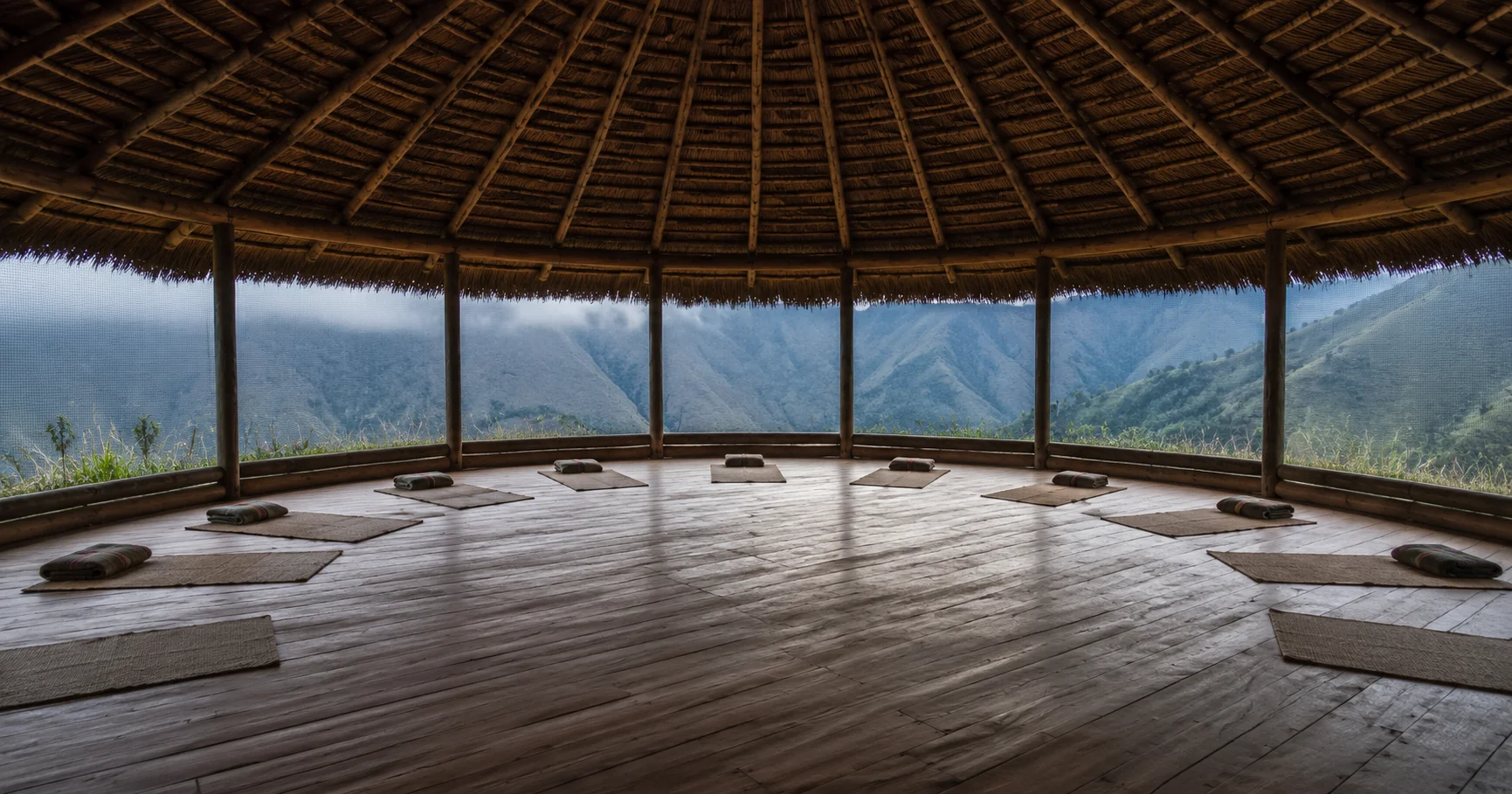
An ayahuasca retreat in Peru is 7 nights, not 1 night. At our center in the Sacred Valley the shape is fixed: 4 ceremonies spaced across 7 nights, 12 guests, 2 maestros, a physician on site every night, and 12 months of integration calls after you fly home. The ceremony itself runs from about 9:00 pm to first light. You will probably vomit. Roughly 1 application in 5 does not proceed. And the week begins at about 2,800 m above sea level, which changes how your body handles a fast, a purge and a long night in the dark.
Most of what is written about this describes the visions. This describes the room, the clock and the staffing, because that is what you will meet first.
What Happens at an Ayahuasca Retreat in Peru
An ayahuasca retreat in Peru is a multi-night stay where a brew of Banisteriopsis caapi vine and Psychotria viridis leaf is served in supervised ceremony by trained maestros. A typical Peruvian retreat runs 7 to 12 nights, holds 4 to 6 ceremonies with rest nights between, and adds a dietary protocol before arrival and integration afterward.
The week has 4 parts, and only 1 of them is the ceremony. Before you arrive there is the dieta, which is a pharmacological safety requirement rather than a wellness ritual, and the 3 weeks of food and medication rules that come before you fly matter more to how your night goes than anything you will do in the maloca. On arrival there is screening, orientation and a rest day. Then 4 ceremony nights with recovery days between them. Then a year of follow-up calls.
Guests who treat the ceremony as the whole product tend to leave disappointed. Guests who treat it as 1 night inside about 4 months of work tend not to.
The Ceremony Night in 2026, Hour by Hour
A ceremony night at our center runs about 8 hours 30 minutes from the cup to the closing icaro. Here is the clock we keep, every ceremony, in the Sacred Valley.
| Time | What happens |
|---|---|
| Late afternoon | Last light meal from the dieta kitchen. Nothing after this. |
| 8:00 pm | Doors. Shoes off, phones out, 12 mats with space between them, a blanket and a bucket at each one. |
| Around 9:00 pm | The cup, 1 guest at a time. The maestro sets your dose from what they have observed of you, not from what you ask for. |
| Around 9:40 pm | Onset. A slow physical wave, usually about 40 minutes after the cup. Lights out. First icaro. |
| 10:00 pm to 1:00 am | The strongest stretch. Maestros sing almost continuously and move between mats to work with individual guests. Most purging happens here. |
| Around 2:00 am | It loosens. Some guests sleep on their mat. Some sit up. |
| Around 5:30 am | Closing icaro. Guests walk back accompanied and usually sleep until mid-morning. |
2 things about that table surprise people. The first is the waiting. There is a 40-minute window between the cup and the onset where nothing happens and you lie in the dark wondering whether you have been given anything at all. Guests report that window as more uncomfortable than the ceremony. The second is that nights vary. A quiet first night isn’t a sign that anything has gone wrong.
If you want the shorter version of the same night, we wrote a plain description of a single night in the maloca as a standalone piece.
Will You Throw Up? Here Is the Number
Probably, and there is a real figure for it. The Global Ayahuasca Survey, published by Bouso and colleagues in PLOS Global Public Health in 2022, asked 8,216 people about physical effects and found vomiting or nausea in 5,097 of them, or 62.0%.
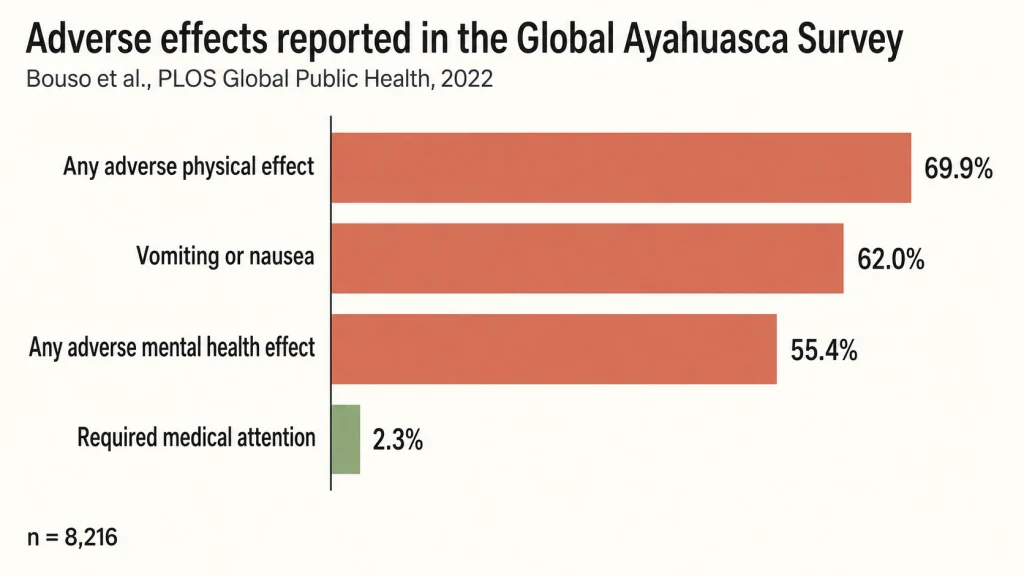
That same paper is the most useful safety document a first-timer can read, and almost nobody in this industry cites it. Across the sample, 69.9% reported an adverse physical effect on at least 1 occasion and 55.4% of 7,839 reported an adverse mental health effect. Those numbers sound alarming until you read the next one: only 132 people, 2.3% of the 5,775 who answered the question, reported a physical adverse effect that required medical attention.
The interesting finding is what predicted the bad outcomes. It was not the dose and it was not the strength of the brew. Among the predictors the authors identified were existing physical health conditions, a history of anxiety disorder, and drinking in a non-supervised context. Supervision is the variable you can control by choosing where you sit.
Purging is planned for, not endured. Every mat has a lined bucket. A facilitator replaces it without comment. Nobody in the room reacts to the sound, and by the third ceremony most guests have stopped noticing it.
How Altitude Changes an Ayahuasca Retreat in the Sacred Valley
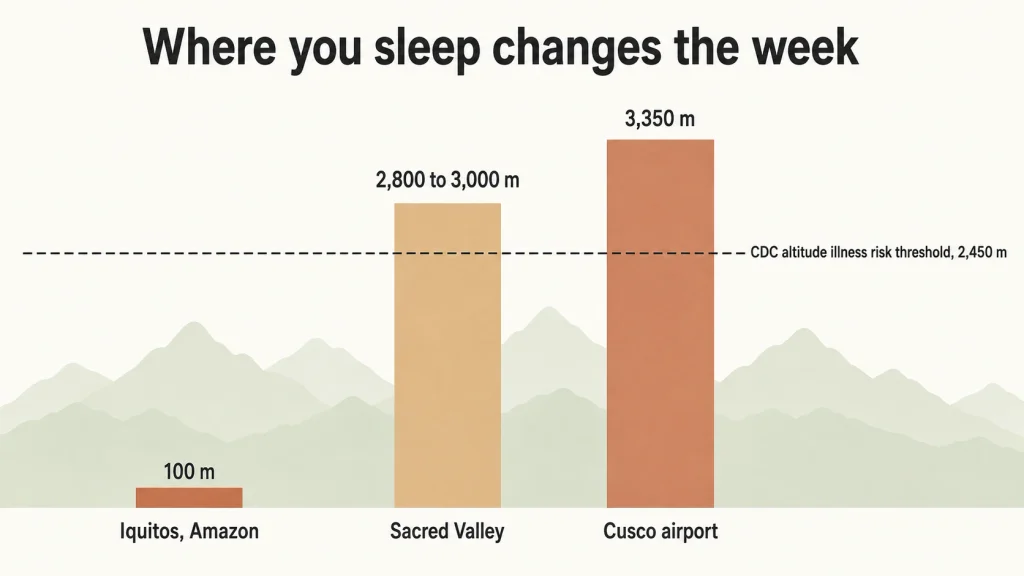
This is the part no ayahuasca guide covers, and it only applies in the Andes. The Sacred Valley floor sits at roughly 2,800 to 3,000 m. Ollantaytambo is at 2,792 m and Pisac at 2,972 m. The CDC’s guidance on high-altitude travel puts the risk threshold for altitude illness at a sleeping altitude of 2,450 m or higher, and reports acute mountain sickness in about 25% of visitors sleeping above that line in Colorado.
Stack that against a ceremony night. You have not eaten since late afternoon, you may vomit for an hour, and you are awake until 5:30 am. Dehydration and a short night are exactly the conditions that make an unacclimatized body feel worse at elevation, and a guest who cannot tell altitude symptoms from medicine effects will spend the night frightened for the wrong reason.
There is a practical upside to the Sacred Valley that most travelers miss. The CDC names Cusco at about 3,350 m and suggests arriving travelers descend below the airport to sleep for 1 or 2 nights. The Sacred Valley is that lower ground, 350 to 550 m below the airport you land at. Sleeping in the valley rather than in Cusco is the acclimatization step the CDC describes, and it happens to be where the retreat is.
What this means for your booking: land in Cusco at least 2 full days before your first ceremony, come down to the valley the same day you land, and do not schedule Machu Picchu or a Cusco city tour in the 48 hours before you drink. The CDC also advises avoiding alcohol for the first 48 hours at high altitude, which the dieta already requires of you.
Who Is Awake in the Room While You Are Not
12 guests, 2 maestros, facilitators, and a physician who is on site all 7 nights and awake until first light. That is the room, and the people who hold it are named. No retreat should be vague about this count, and if a center will not tell you it, that is your answer.
The maestros do the work of the ceremony. They sing icaros almost continuously, and they leave the front of the maloca to sit at individual mats. The facilitators handle the physical room: water, buckets, walking a guest to the bathroom, kneeling beside someone who has raised a hand. The physician does not sit in on the ceremony as a participant. She is awake, on the property, with oxygen and a defibrillator, for the hours you are least able to advocate for yourself.
The 2:00 am question is the one people are too embarrassed to ask. If you are frightened, you raise a hand and a facilitator is beside you in seconds. If a maestro judges that you need it, they will come and sing directly to you. Nobody is left alone in the dark to work it out.
The Days Between Ceremonies
Rest days are not filler and they are not an upsell. We run 4 ceremonies across 7 nights rather than 6 across 7 because the day after a ceremony is often harder than the ceremony, and it needs somewhere to go.
A rest day at our center means a late start, a group integration session, food from the dieta kitchen, plant baths, an optional kambo session, and long stretches of nothing. Guests who arrive from high-output jobs find the nothing harder than the medicine. Expect vivid dreams, emotions arriving without warning, and old memories showing up mid-afternoon. That is the medicine still working, and it is why a retreat that runs a ceremony every single night is selling you volume rather than depth.
Does Ayahuasca Activate DMT in Your Pineal Gland?
No, and it is worth knowing why, because this sentence appears on more retreat websites than any other claim in the industry. Even Conde Nast Traveler printed it in June 2026.
The pineal gland cannot do what the story says. In a 2018 paper in the Journal of Psychopharmacology, David Nichols set out the arithmetic: the adult pineal weighs less than 0.2 g, its job is producing about 30 micrograms of melatonin a day, and while DMT has been detected in brain tissue, the concentrations “are not sufficient to produce psychoactive effects.” A year later, Dean and colleagues in Scientific Reports removed the pineal gland from rats and measured brain DMT anyway. It did not drop. The cortex, not the pineal, was the source.
A retreat page is the right place to point this out. The pineal claim comes from the same copy deck as everything else on those sites. If a center explains the pharmacology of the thing it is about to put in your body with an anatomical myth, you have learned something about its screening, its medical protocols and its relationship with accuracy. Use it as a filter.
What the brew does do is well described: the caapi vine carries monoamine oxidase inhibitors that let the DMT in the chacruna leaf survive digestion. That is also why the medication rules before arrival are not negotiable, and it is the whole reason the dieta exists.
Why the US State Department Tells Americans Not to Do This
Because people have been hurt, and you should read the warning before you book rather than after. The State Department’s Peru country page says plainly: “U.S. travelers should not use Ayahuasca or Kambo because of the known dangers.” It goes further. “U.S. citizens have suffered serious illness and, in some cases, died after taking these drugs. They have also been sexually assaulted, injured, or robbed while under the influence of these substances.”
We are not going to argue with that, because the sentence that matters most in the department’s Peru guidance is the last one: “Facilities or groups offering ayahuasca/kambo are not regulated by the Peruvian government and may not follow health and safety laws or practices.”
That is accurate. There is no licensing body for ayahuasca centers in Peru. No inspector is coming. Every safety standard at every center in this country is self-imposed, which means the only thing standing between a guest and a bad outcome is what a particular center chose to do when nobody was checking. The advisory is not an argument against Peru. It is an argument against choosing a center on the strength of its photographs.
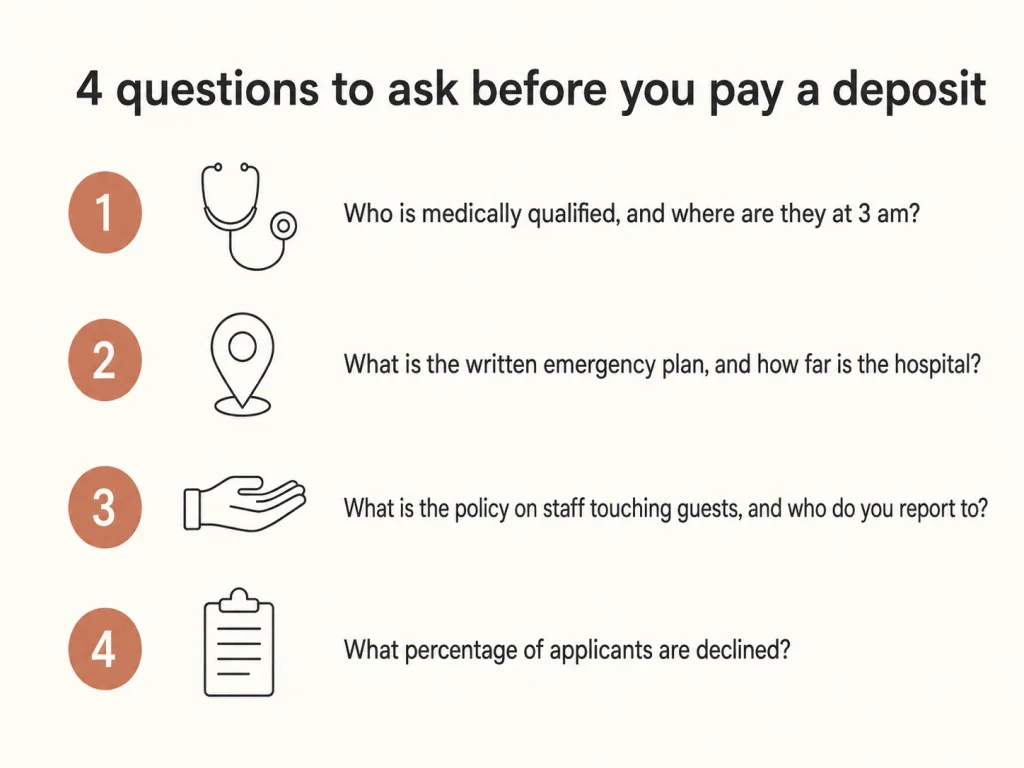
So ask hard questions and expect specific answers. Who is medically qualified and where are they at 3:00 am. What is the written emergency plan and how far is the nearest hospital. What is the policy on staff touching guests, and who do you report to if it is broken. What percentage of applicants get declined. A center that answers those with adjectives instead of numbers has told you what you need to know. Ours are set out on the Sacred Valley retreat page, in writing, before you pay anything.
Is Ayahuasca Legal in Peru?
Yes. Peru’s National Institute of Culture declared the traditional knowledge and use of ayahuasca part of the Cultural Heritage of the Nation in July 2008, under National Directoral Resolution 836/INC. Drinking in ceremony in Peru is not a crime and you are not smuggling anything by attending.
Read the resolution’s own wording, though, because it is sharper than the marketing that quotes it. It protects the traditional and sacred character of the ritual and draws a line between that and what it calls de-contextualized Western uses, consumerist and with commercial purposes. Peru protected the ceremony. It did not bless the retreat industry that grew up around it. Anyone selling you the 2008 declaration as a stamp of approval on their business has not read it.
The rules change the moment you fly home. DMT is a controlled substance in the United States and in most guests’ home countries, so nothing leaves Peru with you. We cover the detail in our breakdown of Peruvian ayahuasca law for US travelers.
Can You Be Turned Away After You Pay?
You can be turned away before you pay, and it happens to about 1 application in 5. There is no charge to apply. Every medical form is reviewed within 48 hours, and anyone declined gets the reason in writing along with a referral list.
People read a decline rate as a rejection. It is closer to the opposite. A center with no decline rate is a center that has decided your medical file is a formality, and the Global Ayahuasca Survey found existing physical health conditions and a history of anxiety disorder among the predictors of adverse effects. Screening is where that risk gets managed, and it only works if the answer is sometimes no.
The most common way people get hurt in this process is by editing their own intake form. Undisclosed SSRIs, an unmentioned cardiac history, a family psychiatric history that felt irrelevant. Tell the truth on the form. It is the only part of this you fully control.
Sacred Valley or the Amazon: Which Peru Retreat Fits You
Peru has 2 distinct ayahuasca regions and they produce different weeks. Neither is better. They suit different people, and the difference is mostly logistics and climate rather than medicine.
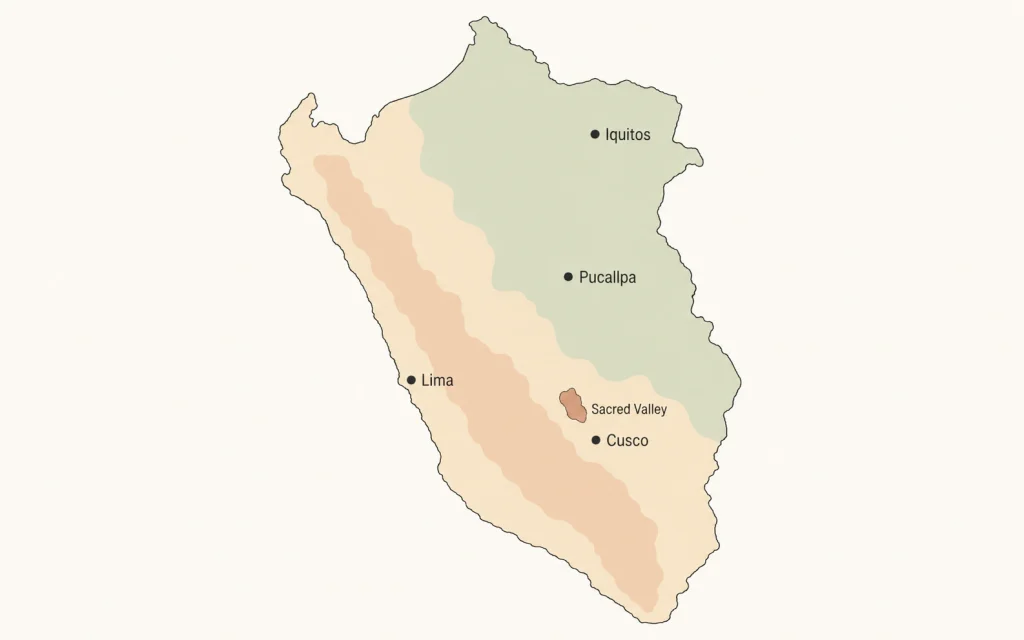
| Sacred Valley, Cusco region | Amazon Basin, Iquitos or Pucallpa | |
|---|---|---|
| Elevation | About 2,800 to 3,000 m | About 100 to 150 m |
| Getting there | Fly Lima to Cusco, then a road transfer | Fly Lima to Iquitos or Pucallpa, then a boat |
| Main physical factor | Altitude and cold nights | Heat, humidity, insects |
| Medical access | Road access to Cusco hospitals | Often boat access only |
| Combines with | Machu Picchu, after the retreat | Jungle travel |
The factor worth weighing above the rest is how far you are from a hospital if something goes wrong at 2:00 am. A jungle center 2 hours upriver is a different risk profile from a valley center 1 hour by road from Cusco, and no amount of atmosphere changes that arithmetic. Our own week runs 7 nights in the Sacred Valley with transfers from Cusco, and you can see how it compares with the other work we hold before you decide.
What Happens After You Fly Home
The hard part starts in week 2, not in the maloca. Every guest gets 12 months of integration calls, and the reason that period is a year rather than a month is that the difficulties do not arrive on schedule.
The pattern we see is consistent enough to warn you about. The first week home feels bright. Somewhere in weeks 2 to 6, the ordinary world reasserts itself and the gap between what you saw and the life you returned to becomes uncomfortable. Guests who do well in that window have usually made 1 concrete external change rather than only an internal one, and they have stayed in contact with someone who understands what they did. Guests who struggle are almost always the ones who went quiet.
None of this is medical treatment and we make no medical claims about it. What we can describe about an ayahuasca retreat in Peru is the structure, who is in the room, and what it costs. If you want the rest of the detail, or you have the awkward question you have not typed yet, send it to us directly. The awkward question is the one we are best at answering.
Frequently Asked Questions
How long does an ayahuasca ceremony last in Peru?
About 8 hours 30 minutes at our center, from the cup at roughly 9:00 pm to the closing icaro at about 5:30 am. Onset takes around 40 minutes and the strongest stretch usually falls between 10:00 pm and 1:00 am. Ceremony length varies by center, so ask for the actual clock rather than a range.
Does everyone throw up at an ayahuasca retreat?
No, but most people do. The Global Ayahuasca Survey of 8,216 participants, published in PLOS Global Public Health in 2022, recorded vomiting or nausea in 5,097 people, or 62.0%. Some guests never purge across 4 ceremonies. There is no relationship between how much you purge and how useful the night is.
What should I expect at an ayahuasca retreat in Peru if it is my first time?
Expect 7 nights rather than 1, a 3-week dietary protocol before you arrive, 4 ceremonies with rest days between them, and a first night that is often milder than you imagined. Expect to be screened, and expect roughly 1 application in 5 to be declined. Expect the days after each ceremony to be emotionally heavier than the ceremony.
Is an ayahuasca retreat in Peru safe?
Ayahuasca centers in Peru are not licensed or inspected by the government, so safety depends on the individual center and nothing else. The US State Department advises against use and cites illness, deaths, sexual assault and robbery. In the Global Ayahuasca Survey, 2.3% of respondents reported a physical adverse effect requiring medical attention, and drinking in a non-supervised context was among the predictors of adverse effects.
Does ayahuasca release DMT from your pineal gland?
No. David Nichols showed in the Journal of Psychopharmacology in 2018 that the adult pineal gland, at under 0.2 g, produces about 30 micrograms of melatonin a day and that detected brain DMT concentrations are not enough to be psychoactive. Dean and colleagues removed the pineal from rats in 2019 and brain DMT levels did not change.
How high is the Sacred Valley, and will altitude affect my ceremony?
The Sacred Valley floor sits at roughly 2,800 to 3,000 m, above the CDC’s 2,450 m threshold for altitude illness risk but 350 to 550 m below Cusco’s airport. Arrive at least 2 days early and sleep in the valley rather than in Cusco. Fasting, purging and a night without sleep all compound at elevation.