How Is Ayahuasca Prepared? Inside Our 2-Day Cook
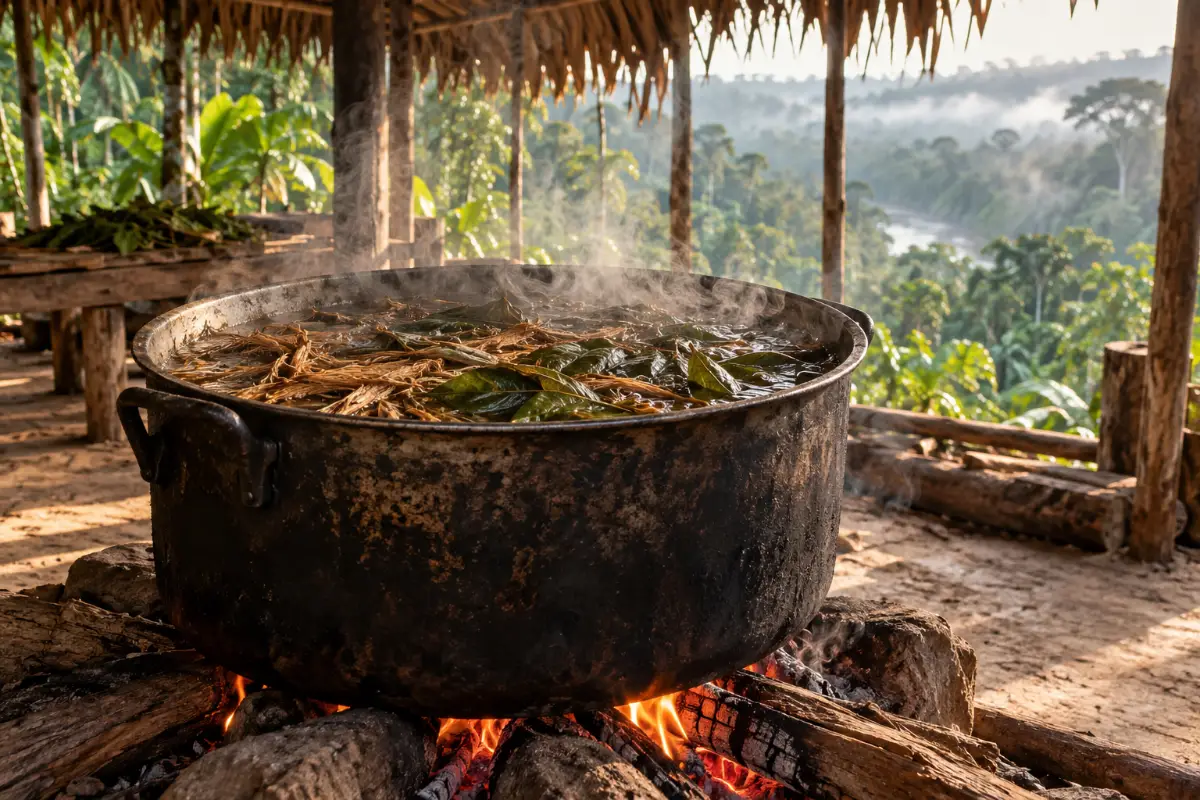
Ayahuasca is prepared by cleaning and pounding the Banisteriopsis caapi vine, layering it with chacruna leaves and boiling both in water. The cook pours the liquid off, boils the same plants again, then simmers the combined liquid until most of the water is gone. Our Shipibo maestros take 2 days over each batch, and they serve what they cook.
If you meant getting your body ready for a ceremony, that’s the dieta, and it has its own guide on how to prepare yourself. This page is about the brew itself, and you won’t find a recipe in it. Weights, ratios and doses belong to people trained to judge them.
On 28 October 2026 we read 5 pages that a web search returns for this question. Only 1 named the person who cooks the brew, and none linked a peer-reviewed study.
What Goes Into Ayahuasca?
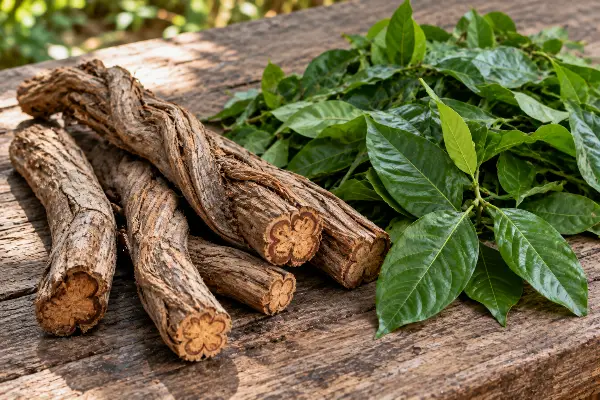
2 plants: the vine Banisteriopsis caapi and the leaves of chacruna, Psychotria viridis. Ours is vine and chacruna, with nothing added.
The leaf carries DMT, the brew’s main psychedelic compound. Swallowed on its own, DMT barely works, because an enzyme in the gut and liver called MAO-A breaks it down first. The vine changes that. A 1999 Journal of Ethnopharmacology study gave the brew to healthy volunteers. It describes the vine’s harmine and harmaline as reversible MAO-A blockers that let the DMT act. That same block makes some medicines and foods risky. It’s why a physician reads every guest’s file in our medical screening before we offer a place.
Neither plant is uniform. In 2005, researchers writing in the Journal of Psychoactive Drugs sampled 32 vines and 36 chacruna plants from 22 sites across Brazil. Alkaloid levels ranged widely, and some of the leaves had little or no DMT that the lab could detect.
Colombian brews often use chagropanga, the leaf of Diplopterys cabrerana, in place of chacruna. Some centers also add toé, a Brugmansia plant that contains scopolamine. We treat any added plant as a red flag.
How Is Ayahuasca Prepared, Step By Step?
In 5 steps: gather the plants, clean and pound the vine, boil, repeat the washes, then reduce. Most Amazonian kitchens follow that order. Cooks differ on timing and strength, and on what they let into the pot.
| Step | What happens | Why it matters |
|---|---|---|
| 1. Gather | Sections of vine are cut and chacruna leaves are picked | Alkaloid levels vary from plant to plant, and some leaves carry little or no DMT (2005 survey of 32 vines and 36 chacruna plants) |
| 2. Clean and pound | Dirt and moss come off, then a wooden mallet splits the woody stem into strands | Bark from large, mature stems held high levels of most of the vine’s main markers (2010 plant study) |
| 3. Boil | Vine and leaves go into a pot in layers, covered with water, over a fire | Cooking appears to turn some harmine into 2 related alkaloids (2020 study of 6 matched plant and brew pairs) |
| 4. Repeat the washes | The liquid is drained off and kept, and fresh water goes onto the same plants | Each round pulls more out of the plants, and the cook decides the number of rounds |
| 5. Reduce | The washes are combined and simmered down to a fraction of their volume | Strength varies widely from batch to batch, even within 1 kitchen (2005 analysis of 29 brews) |
Cleaning And Pounding The Vine
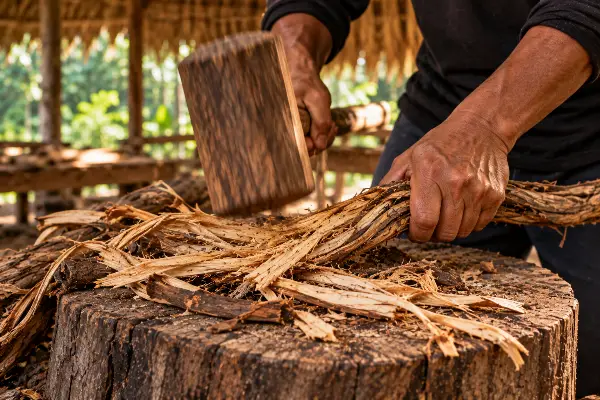
Pounding opens the wood so water can reach inside it. The cook beats each section with a heavy wooden mallet until it splits into strands. The 2005 plant survey describes ceremonial brews as made from these pounded woody parts of the vine.
Boiling The Plants In Washes
A wash is 1 round of boiling. The cook drains the liquid, keeps it, and puts fresh water on the same plants.
The pot changes the chemistry as well. A 2020 study in the journal Plants tested 159 vine samples and 33 brews. In 6 matched pairs of vine and finished brew, the ratio of harmaline to harmine was 1.3 to 2.2 times higher in the brew. The authors read that as cooking turning some harmine into harmaline and THH, another of the vine’s alkaloids.
Reducing The Brew
This is usually the longest stage. The cook combines the washes and keeps them at a simmer as the water cooks off, and that’s where a batch’s strength gets set. Batches still differ, which is why the maestro decides how much goes in each cup instead of letting guests choose.
Why We Don’t Publish A Recipe
A recipe leaves out the part that keeps people safe: who drinks, and who’s watching. The Global Ayahuasca Survey heard from 10,836 people between 2017 and 2019. PLOS Global Public Health published the results in 2022. 69.9% reported acute physical effects, mostly vomiting. Of the 5,775 who answered a follow-up question, 132, or 2.3%, said those effects needed medical attention. Drinking without supervision was 1 of the factors tied to physical effects. A home brew comes with no medical screening and nobody trained to set the dose.
Should The Bark Come Off The Vine?
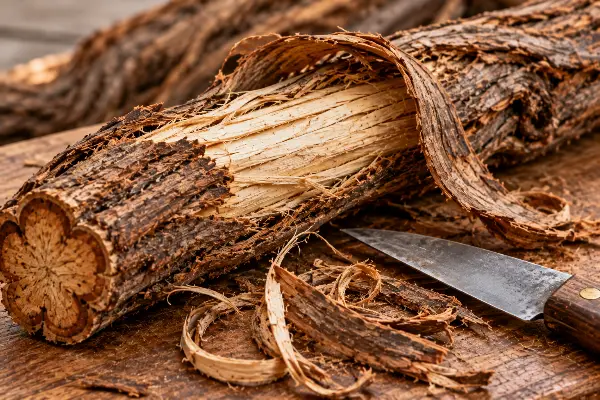
The best chemistry we found says keep it on. In a 2010 plant study, most of the vine’s main chemical markers showed up at high levels in the dried bark of large branches.
Some cooks scrape the bark away for a smoother, less bitter brew. That also strips out the layer where the study found those markers at high levels. The paper, from the Journal of Ethnopharmacology, compared leaves, stems and stem bark. It concluded that its results support the traditional use of bark from mature stems, and of whole mature stems.
It tested lab extracts of plant parts rather than ceremonial brews, so it can’t tell you how a scraped brew feels on the night. If a center tells you a bark-free brew is purer, ask what scraping does to its strength.
Where Our Brew Is Cooked
Where the plants grow, by the maestros who will serve it. We don’t buy brew from anyone, and we can tell you which harvest your cup came from.
At our Amazon houses, the vine and chacruna grow in the same region as the maloca, and the maestros cook the brew there. Neither plant grows in the Sacred Valley. The brew for our Sacred Valley retreat is cooked in the Ucayali lowlands and brought up to the valley. At our San Francisco house on Lake Yarinacocha, both plants grow on the property. The brew there cooks over 2 days, and that kitchen also supplies 2 of our other houses.
That’s the valley’s trade-off. At our Iquitos house, the plants are cut less than an hour away and cooked on the spot. If that matters more to you than the valley’s easier access, we’ll move your booking to the Amazon.
And we won’t plant a token vine at 2,800 m and pretend the valley grows its own.
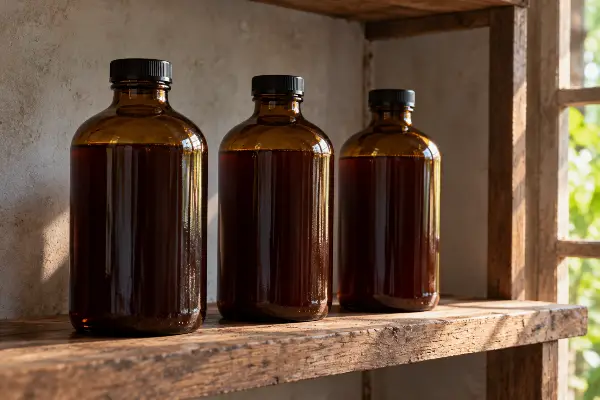
Does Ayahuasca Get Better With Age?
Not on any evidence we could find. In a year-long fridge test, DMT held steady while 2 of the vine’s alkaloids fell.
1 of the 5 brewing pages we read says aged ayahuasca improves like a fine wine. A 2020 stability study in the journal Molecules stored 3 ayahuasca samples in 3 ways and measured them over time.
| Storage | DMT | The vine’s alkaloids |
|---|---|---|
| 12 months in a fridge at 4 to 8 °C | Stable | Harmine held steady. Harmaline fell 23.7% and 37.9% in 2 samples, and THH fell by up to 67.9% |
| 7 days at 37 °C, to mimic shipping | Stable | Harmaline swung up and down, rising 40.8% in 1 sample. Harmine tended to fall, and THH held steady |
| 3 freeze and thaw cycles | Stable | Stable, with every change under 20% |
Glass and plastic bottles made no difference. The authors put the swings down to alkaloids breaking down, turning into one another, and leaching out of plant sediment in the bottle.
Brews ferment, too. A 2005 Journal of Psychoactive Drugs analysis of 29 brews left 1 sample at room temperature for 80 days. Its alkaloids barely changed, but after 50 days natural fermentation had neutralized its acidity. So a brew can keep, and it can also change. Nothing we read shows it getting better.
What Other Brewing Guides Leave Out
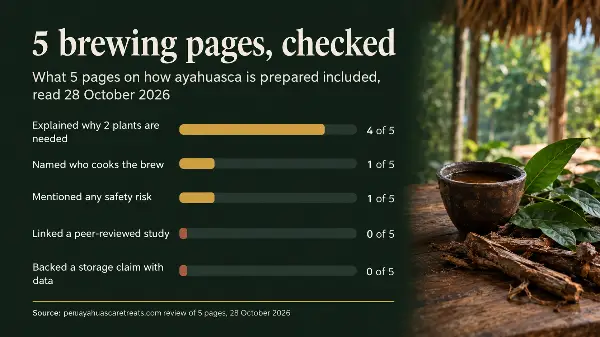
Mostly who cooks the brew, and any evidence for what they claim. On the 5 pages we read on 28 October 2026:
- 4 of the 5 explained why the brew needs 2 plants.
- Only 1 named the person who cooks.
- Safety came up on 1 page, in general terms.
- None linked a peer-reviewed study.
- 3 made storage claims with no data behind them, and 1 of those said the brew improves with age.
If a center won’t say who cooked your brew or what went into it, ask before you book.
Our Brew Rules In 2026
4 rules, and they hold at all of our ayahuasca retreats in Peru.
- Vine and chacruna only. Nothing else goes in the pot.
- The maestros who serve the brew are the ones who cook it, over 2 days.
- We never buy brew from a third party.
- The maestro sets your cup, and nobody is offered a second one they didn’t ask for.
Ayahuasca is why guests come, and we never combine it with our other 2 medicines on the same day. You can also read how ceremony nights run, hour by hour.
“How is ayahuasca prepared?” is a fair question to put to any center, ours included. Ask who cooked the brew and where the plants grew. Our list of 17 questions to ask covers the rest, with our own answers to each.
FAQs
How is ayahuasca prepared traditionally?
The vine is cleaned, pounded with a wooden mallet and layered with chacruna leaves in a pot of water. The cook boils it, pours the liquid off and boils the same plants again. Then the combined liquid simmers down to a fraction of its volume. Our maestros take 2 days over each batch.
How long does it take to prepare ayahuasca?
Ours cooks over 2 days. Other kitchens keep their own schedules, so ask any center how long its batches cook and who tends the fire.
What plants are in ayahuasca?
The Banisteriopsis caapi vine plus a leaf that contains DMT, usually chacruna in Peru and often chagropanga in Colombia. Ours is vine and chacruna with nothing added. Some centers add toé, a Brugmansia plant that contains scopolamine, and we’d treat that as a reason to look elsewhere.
Does ayahuasca expire?
It changes over time, and we found no study that sets an expiry date. In a 2020 study of 3 brews, DMT held up for a year in a fridge, but harmaline and THH fell in some samples. A 2005 analysis also found that 1 brew left at room temperature had fermented enough to lose its acidity after 50 days.
Can you make ayahuasca at home?
We don’t recommend it, and we don’t publish a recipe. The vine blocks the enzyme MAO-A, which makes some medicines and foods dangerous alongside it. In the Global Ayahuasca Survey of 10,836 people, drinking without supervision was linked to more physical side effects. 2.3% of those who answered a follow-up question said their effects needed medical attention.
Why does it matter if the bark is removed?
A 2010 study of the vine’s parts found most of its main chemical markers at high levels in the dried bark of large branches. Scraping the bark off may give a smoother taste, but it also throws that layer away.
How is ayahuasca prepared for your Sacred Valley retreat?
It’s cooked in Ucayali, because neither the vine nor chacruna grows in the Sacred Valley. The maestros who serve it cook it over 2 days in the lowlands, and it’s brought up to the valley from there.