Ayahuasca For Seniors: What Changes After 60
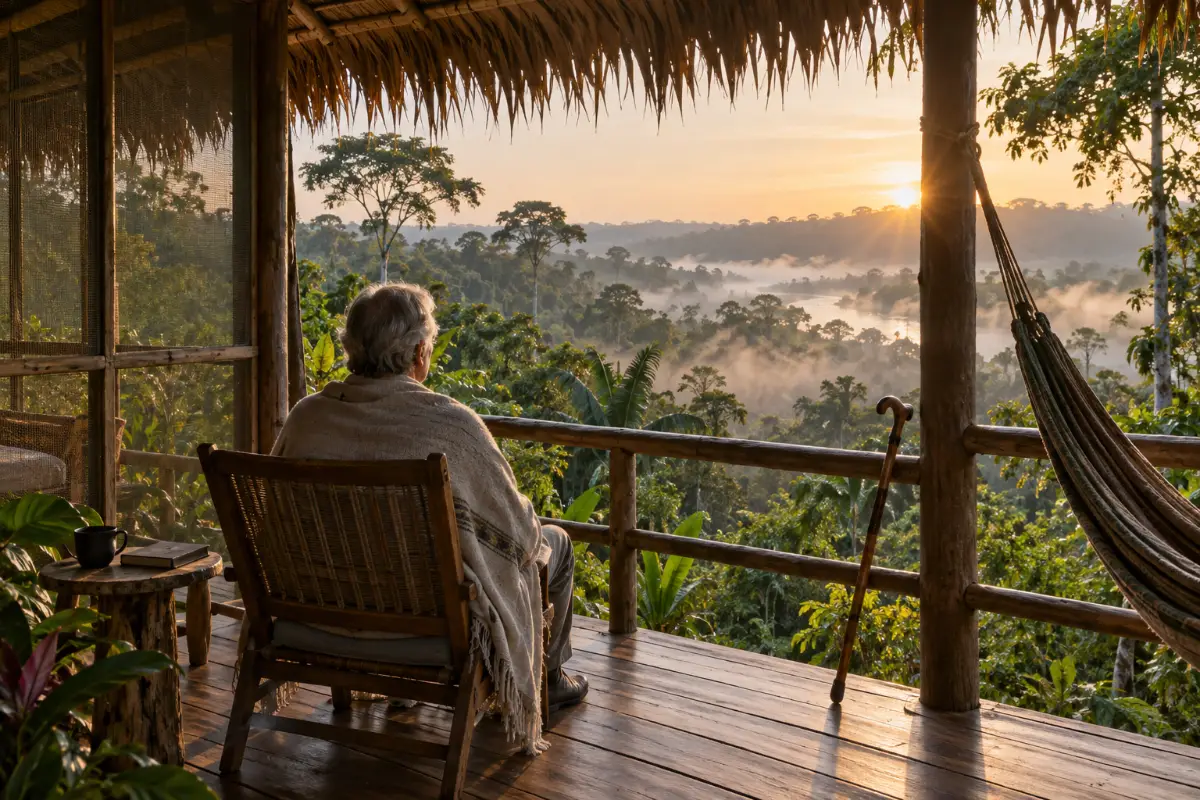
Yes, you can drink ayahuasca after 60. Our oldest guest so far was 72 and took part in the full retreat. But age does change the plan, and any center that tells you otherwise is skipping the evidence. At Peru Ayahuasca Retreats, the minimum age is 24 and there’s no fixed maximum. So ayahuasca for seniors comes down to 4 things: your heart tests, your medication list, your balance in the dark and your distance from a hospital.
Ayahuasca for seniors means the standard brew, the Banisteriopsis caapi vine cooked with chacruna leaf, taken by adults over 60 with added medical checks. At our center that means a recent ECG and bloodwork, plus a physician’s review of every pill and supplement you take. We also plan for falls and for the distance to a hospital.

Ayahuasca For Seniors: What The Research Says In 2026
Not much, because older adults barely appear in the studies. A 2024 systematic review in the Journal of Psychopharmacology counted 1,400 patients across 36 psychedelic therapy studies, and only 19 of them were 65 or older. That’s under 1.4%.
Detailed safety data existed for 10 of those 19 people. None had a serious adverse event. What did show up was short-lived and mild to moderate: anxiety, stomach upset and raised blood pressure during dosing sessions. The authors say the limited data suggest these therapies can be safe and well tolerated in older adults.
We’d put the weight on “limited.” Safety data from 10 people can’t settle the question for your age group. You’ll also read on retreat websites that age alone isn’t a deciding factor. We disagree. Age should change the screening, and a survey of more than 10,000 ayahuasca drinkers points the same way.
What The Global Ayahuasca Survey Found About Age
The Global Ayahuasca Survey, published in PLOS Global Public Health in 2022, drew on more than 10,000 drinkers in over 50 countries. Being older at first use was one of the factors linked to physical side effects, which were mostly vomiting. So were having a physical health condition and drinking without supervision.
Put those together and a 66-year-old first-timer with high blood pressure sits in 2 of the survey’s risk groups at once. That person isn’t ruled out. They need tougher screening, and they should never drink without medical staff nearby.
Do Older Adults Need A Smaller Dose?
There’s no age-based dosing chart, because the research holds too few older drinkers to build one. A 2024 study in the American Journal of Geriatric Psychiatry compared 62 psychedelic users aged 60 and older, some of whom took ayahuasca, with 62 matched younger users. The older group reported milder acute effects, and their well-being improved about as much.
Our lead healer doses every guest herself. She goes by your body weight and past experience, and by what she senses when she sits with you before serving. Every first night starts small. A second cup comes about 90 minutes after the first, and she turns down roughly 1 in 5 requests for one. Tell her if you’d rather stay at 1 cup. You can also sit out any ceremony with no pressure, and across our retreats guests skip 5 to 8% of ceremony seats.

What Our Medical Director Checks After 50 And After 60
Age adds tests. Every applicant fills in a long medical form that a physician reads, then does a 30 to 45 minute video call. Over 50, we add an ECG. Over 60, we add a full medical clearance.
| Applicant | What we ask for | Who reviews it |
|---|---|---|
| Every applicant | A medical form covering diagnoses, medications, surgeries and psychiatric history, plus a 30 to 45 minute video call | Our physician reads the form. A staff member with a master’s in clinical psychology runs the call |
| Over 50 | ECG documentation | Our physician |
| Any age, with a heart history | ECG documentation | Our physician |
| Over 60 | A recent medical clearance that includes an ECG and bloodwork | Our physician |
| Anyone tapering a medication | Your prescriber’s confirmation that the taper is done | Your prescriber and our physician, together |
About 11% of applicants are turned down outright. Another 5 to 7% are accepted on conditions they never meet, usually a medication taper. The full medical screening process takes 1 to 3 weeks, depending on how complicated your history is.
Blood pressure gets the closest look after 60, because by then high blood pressure is the norm. In a 2024 data brief, the National Center for Health Statistics found that 71.6% of Americans 60 and older have high blood pressure. Controlled pressure goes to physician review. Uncontrolled hypertension is an automatic no, and so are uncontrolled heart conditions such as arrhythmia, heart failure or a recent heart attack. Pills for pressure need their own check, and we’ve covered blood pressure medication class by class.
Is There An Upper Age Limit For Ayahuasca?
Not at our center. We set a minimum of 24 and look at every older applicant case by case. Our guests are getting older, too: the average age has gone from about 34 in our early years to close to 40. Our post on who shouldn’t drink ayahuasca covers the lower age limit and the other exclusions.
The top end depends on your test results and the length of your medication list. A fit 70-year-old can be a simpler file than a 61-year-old on a long list of prescriptions.
Which Medications Common After 60 Clash With Ayahuasca?
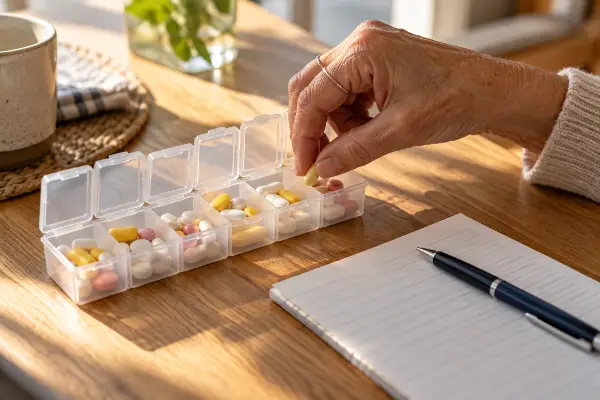
Mostly the ones that act on serotonin or on monoamine oxidase, the enzyme the ayahuasca vine blocks. Benzodiazepines are the other group to watch, because stopping them quickly is dangerous.
After 60 the list is often long. In CDC survey data from 2017 to March 2020, 43.0% of Americans 65 and older had used 5 or more prescription drugs in the past 30 days, up from 33.3% in 2001 to 2004.
We don’t ask anyone to stop a medication without their own doctor. Every taper is planned by your prescriber and checked by our physician, and if your doctor won’t support it, we don’t accept you for that retreat. Rushing an antidepressant taper is the highest-stakes preparation mistake we see, and ayahuasca and SSRIs explains the timing.
| Medication and common use | Why it matters | What we ask |
|---|---|---|
| Selegiline or rasagiline, for Parkinson’s | Both are MAO inhibitors themselves | Automatic no while you take them |
| Tramadol, for pain | Label: don’t take it with an MAO inhibitor or within 14 days of stopping one | Off for at least 2 weeks before ceremony |
| Sumatriptan and other triptans, for migraine | Sumatriptan’s prescribing information rules it out with MAO inhibitors and for 2 weeks after stopping one | Plan a migraine backup with your doctor, and tell our physician |
| Glipizide and other sulfonylureas, for diabetes | Pfizer’s glipizide label: MAO inhibitors may strengthen the blood-sugar-lowering effect | Physician review, plus a plan for ceremony-day meals |
| Furosemide and other water pills | Label: too much fluid loss can cause dehydration, “particularly in elderly patients” | Physician review. We hand out electrolyte drinks after purging |
| Benzodiazepines such as lorazepam or alprazolam, for sleep or anxiety | FDA safety communication (2020): stopping suddenly or cutting the dose too fast can cause withdrawal, including seizures | Case by case. Your prescriber must confirm a safe taper |
| SSRIs and SNRIs, for depression or anxiety | Combined with an MAO inhibitor, serotonin can build to dangerous levels | At least 6 weeks off, or 8 for fluoxetine |
Diabetes adds another step. On ceremony days the last meal is plain rice, plantains and vegetables at 4 PM, with no salt or oil, and nothing else until crackers and fruit after the ceremony closes around 3 AM. That’s about 11 hours without food, often with vomiting. Insulin or a sulfonylurea means planning that day with your own doctor before you fly. We keep a blood glucose monitor on site.
What A Ceremony Night Asks Of An Older Body
About 7 hours on a mat on a raised hardwood floor, in full darkness, from 8 PM to around 3 AM. Our 4 ceremonies are spread out, with at least 1 night off between them, so your body gets time to recover.
The maloka stays warm, usually 22 to 28°C (72 to 82°F) through the night, but the brew can bring on chills, so every guest gets a light blanket. The purge is mostly vomiting into a lined bucket by your mat, and a staff member swaps the bucket quietly. It usually lasts 30 to 90 minutes in the first half of the night and eases with each ceremony.
Know the basics before you book, too: composting toilets, cold bucket showers, no air conditioning and no wifi.
Standing Up After A Purge
This is the minute to plan for. When you stand after hours lying down, your blood pressure can drop and leave you dizzy. A meta-analysis in The Journals of Gerontology put orthostatic hypotension, the medical name for that drop, at 22.2% of adults over 60 living in the community. Falls are common at this age anyway: the CDC says 1 in 4 US adults 65 and older reports a fall each year.
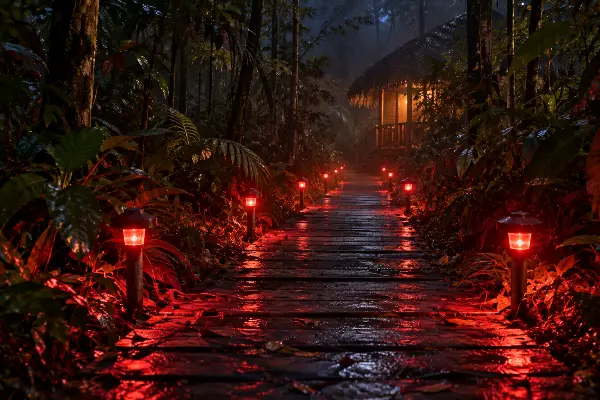
Add darkness and an empty stomach, and the walk to the toilet needs a system. Ours starts with a single rule: nobody leaves the maloka alone. Raise your hand and a staff member walks you to the toilet, 30 steps away, with a red-light headlamp. The path has red-filtered solar lights, which we added in 2019 after a guest tripped on a root walking back from ceremony. Nobody was hurt.
Sit up first and wait a minute before you stand. Pack rubber boots or waterproof shoes with grip, because sandals on a wet jungle path at 3 AM are how falls happen.
Mats, Hearing And The Walk From Your Tambo
7 hours on a mat is hard on older backs, so bring a firm pillow to sit on. Our tambos used to have thin foam sleeping pads, and older guests told us they hurt. We replaced them with proper mattresses in 2020.
Guests with a cane or with knee or hip trouble get the tambo closest to the maloka, about a 2-minute walk, and someone walks with them when they need it. The property isn’t wheelchair accessible. Paths are dirt and wooden planking with short slopes, and you need to walk on your own, because an emergency evacuation means walking to the dock.
Hearing loss doesn’t rule you out. We seat hard-of-hearing guests closer to the healers. Poor eyesight matters less than you’d expect, since the room is fully dark.
Getting To The Amazon After 60
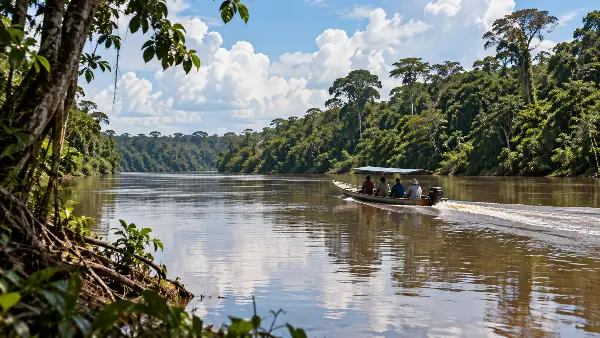
Plan the travel as carefully as the ceremonies, because it’s the part age makes harder. From Lima it’s a 1-hour flight to Pucallpa, a 20-minute drive to the river and a 45-minute boat ride to our center. There’s no road.
Fly into Lima a day before your Pucallpa flight, then reach Pucallpa at least 1 full day before the retreat starts. We work with a small hotel in town for that night, and our team meets you at the Pucallpa airport.
For a first visit we recommend the dry season, May to October. Nights run 22 to 26°C (72 to 79°F) and the paths stay dry, which matters more when your balance isn’t what it was. You’ll also see fewer mosquitoes. Rainy-season days reach 32°C (90°F), and the paths turn muddy. Travel insurance that covers medical evacuation is required before we confirm your spot.
How Far Is The Nearest Hospital?
25 minutes by fast launch from our dock to Hospital Regional de Pucallpa, the main hospital in Ucayali. The launch is on standby every ceremony night, and its driver sleeps at the dock. Our physician, who trained in emergency medicine, stays on the property for every ceremony block. The doctor is awake through each ceremony night and reaches the ceremony room within 2 to 3 minutes when called. Care beyond what Pucallpa offers means a flight of about 1 hour to Lima.
We’ve run a full medical evacuation 2 times in 10 years and about 2,400 guests, and both guests recovered fully. On site we keep an automated blood pressure monitor, 2 pulse oximeters, oxygen, IV fluids and a blood glucose monitor.
Know the official view before you go. The US State Department’s Peru travel advisory says US travelers should not use ayahuasca or kambo, and that US citizens have suffered serious illness and, in some cases, died after taking them. If you decide to go anyway, minutes to a hospital is the number to get from any center in writing.

Do You Need A Yellow Fever Shot Over 60?
Maybe, and it’s a call to make with a travel-medicine doctor, because the shot itself carries more risk after 60. The CDC recommends the vaccine for travelers to areas of Ucayali, the region around Pucallpa, that sit below 2,300 meters. It also lists age 60 and older as a precaution, since serious reactions to the vaccine are more common at that age. The UK’s medicines regulator, the MHRA, advises giving it to people 60 and up only when their risk of catching yellow fever is substantial and can’t be avoided.
Peru doesn’t require the vaccine for entry. If you and your doctor decide on it, get it at least 10 days before you fly. And if you’re adding the city of Cusco or Machu Picchu, the CDC doesn’t recommend the shot for those highland areas, though altitude sickness becomes the bigger question there.
Who Over 60 Should Wait, And Who Should Skip It
Wait if the problem can be fixed. Skip it if it can’t, or if it’s on our automatic-no list.
Wait until:
- your blood pressure is under control and your doctor has the readings to show it
- your prescriber has signed off on any taper, whether it’s an antidepressant, tramadol or a benzodiazepine
- you can walk on your own from a tambo to the dock
Skip it if:
- you take lithium, or an MAO inhibitor such as selegiline or rasagiline
- you’ve had psychosis from any cause, or you have bipolar I disorder
- a parent or sibling has schizophrenia or psychosis and you’ve never used psychedelics, a pattern we explain in psychosis risk
- your heart condition isn’t under control, including arrhythmia, heart failure or a recent heart attack
Seizure disorders get a case-by-case review with our physician.
5 Questions To Ask Before A Parent Books
If you’re researching for a parent, ask any center these 5 and expect numbers back.
- Is a doctor on the property every ceremony night, and how long does it take them to reach the ceremony room? Ours is on site and gets there in 2 to 3 minutes.
- How far is it, in minutes, to a hospital with an ICU, and by what transport at 2 AM? For us it’s 25 minutes by fast launch to Hospital Regional de Pucallpa.
- Who walks guests to the toilet in the dark, and is the path lit? Here a staff member with a red-light headlamp walks you along a red-lit path.
- Will your physician talk to my parent’s doctor about each medication, and who signs off on a taper? Ours will, and both doctors sign off.
- What tests do you require at 60, and what would make you say no? We need a recent ECG and bloodwork, and the automatic-no list above is where we stop.
Hold us to the same standard. You can start with our retreat services, and our longer list of questions for any retreat covers group size and integration. For the wider decision, read our guide to choosing a Peru retreat.
The best call on ayahuasca for seniors gets made on paper first: an ECG, bloodwork, a full medication list and a straight answer about your knees. If yours check out, the application is on our ayahuasca retreat page, and a physician reads every one.
FAQs
Is ayahuasca for seniors safe?
No one can promise that yet, because the research barely includes older adults. A 2024 review of 36 psychedelic therapy studies found only 19 participants aged 65 or older, and none of the 10 with detailed safety data had a serious adverse event. Safety after 60 depends on screening, your medications, your mobility and having a doctor on site.
What is the oldest age you can drink ayahuasca?
Each center sets its own age rule. Ours has a minimum of 24 and no fixed maximum, and our oldest guest so far was 72. Anyone over 60 needs a recent ECG and bloodwork, reviewed by our physician.
Which common medications rule out ayahuasca for seniors?
At our center, lithium and MAO inhibitors such as the Parkinson’s drugs selegiline and rasagiline are automatic no’s. SSRIs and SNRIs need at least 6 weeks off, or 8 for fluoxetine, and tramadol at least 2 weeks. Benzodiazepines, diabetes drugs, triptans and water pills go to physician review, and your own doctor plans any taper.
Do you need a yellow fever vaccine for an ayahuasca retreat after 60?
The CDC recommends the vaccine for areas of Ucayali below 2,300 meters, which includes the lowland around Pucallpa. It also lists age 60 and older as a precaution because serious reactions are more common. Decide with a travel-medicine doctor, and if you get it, do it at least 10 days before you fly.
Can you drink ayahuasca if you have diabetes?
Diabetes isn’t an automatic no, but your medication needs a plan. Pfizer’s glipizide label warns that MAO inhibitors may strengthen its blood-sugar-lowering effect, and ceremony days mean about 11 hours without food after a 4 PM meal. Plan the day with your own doctor, and know that we keep a blood glucose monitor on site.
Can you do an ayahuasca retreat with a cane or bad knees?
Yes, if you can walk on your own. We put guests with a cane or knee and hip trouble in the tambo closest to the ceremony room, about 2 minutes away, and a staff member walks with them when needed. You must be able to walk unaided to the dock, because that’s how an emergency evacuation works.
How far is the nearest hospital from your retreat?
Hospital Regional de Pucallpa is 25 minutes from our dock by fast launch, and the launch waits on standby every ceremony night. Our physician stays on the property through every ceremony block and can reach the ceremony room in 2 to 3 minutes. Higher-level care in Lima is about a 1-hour flight away.