Feeling Worse After Ayahuasca: What’s Normal

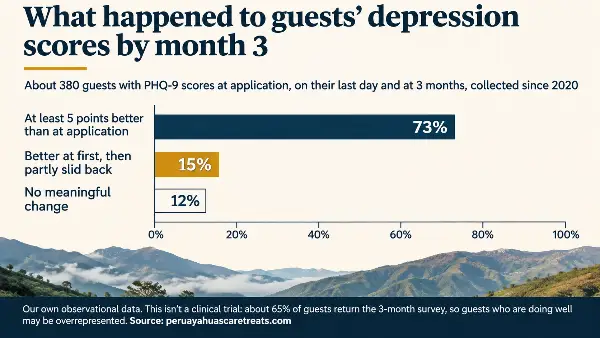
Feeling worse after ayahuasca is common, and for most people, most after-effects pass within a week. Some people slide later, and we track that. Of about 380 guests who sent us depression scores 3 months after their retreat, 15% had felt better at first and then partly slid back. Another 12% showed no meaningful change. If it isn’t easing, or it’s getting worse, see a clinician before you book another ceremony.
If you’re thinking about hurting yourself or can’t tell what’s real, don’t wait for a week to pass. In the US, call or text 988 now. Outside the US, call your local emergency number.
Feeling worse after ayahuasca means new or stronger anxiety, low mood, poor sleep, or a sense of being cut off or unreal after a ceremony. It can start the next morning or weeks later, and it’s usually short. It doesn’t prove the medicine worked or that something went wrong. How it changes over time tells you which.
We run a 12-guest retreat in Peru and check in with every guest for a year after they leave. 85% join the first video call, in week 1.
How Common Is Feeling Worse After Ayahuasca?
Having at least 1 hard after-effect is common, but depression or anxiety that ends up worse is not. The Global Ayahuasca Survey asked drinkers about 10 mental health effects that can follow ayahuasca. In its 2022 report, 4,341 of 7,839 (55.4%) had at least 1 of them.
The 2 most reported were seeing or hearing things other people didn’t (28.5%) and feeling disconnected or alone (21.0%). Most people didn’t count it as damage, and 87.6% saw the effect as part of growth or integration. But 11.9% of those with an effect reported needing a professional’s help. That’s about 1 in 8, and they’re the reason we track the weeks after so closely.
Worse mood problems are rarer. In a 2021 analysis from the same survey project, 2.7% of 1,571 drinkers who had depression when they drank said it got worse afterward. So did 4.5% of 1,125 with anxiety, while most in both groups said they improved. Neither survey had a comparison group, and people who liked their experience may have been keener to answer. Our post on 7 ayahuasca fears goes through the first survey effect by effect.
How Long Does It Last?
For most people it’s under a week, but for a smaller group it runs for months or longer. In the 2022 survey, 7 of the 10 effects were gone within 7 days for more than half the people who had them. For the other 3 effects, 44% to 49% said so.
The long tail is real. A 2023 study in PLOS ONE recruited 608 people whose problems after a psychedelic lasted more than a day. For about 1 in 3, those problems lasted more than a year, and for about 1 in 6, more than 3 years. For 10% of them, the drug was ayahuasca, and ayahuasca, DMT and LSD were linked with longer-lasting problems than the other drugs. Because the study only recruited people who had problems, it can’t say how often this happens, only how long it can last when it does.
On our calls, mild to moderate difficulty usually settles within 4 to 6 weeks, and we read those weeks like this.
| When | What’s common | What helps | See a doctor if |
|---|---|---|---|
| Days 1 to 3 | Tiredness, tears, vivid dreams, feeling far away | Sleep, simple meals, an empty calendar | Same day if you can’t sleep at all or can’t tell what’s real |
| Weeks 1 to 2 | Mood that swings, anxiety that comes and goes, flashes of the ceremony | A daily routine and 1 person you can be open with | It’s getting worse instead of easing, or low mood hasn’t lifted at all for 2 weeks |
| Weeks 3 to 6 | A dip as the early lift fades, friction at home or work | 1 small daily practice, a therapist if you want one | It’s stopping you from working, sleeping or looking after yourself |
| After 6 weeks | Most mild to moderate difficulty has settled | Keep the practice and your later check-ins | It’s still there, so book a full assessment before any more ceremonies |
Our check-ins fall on the same points: week 1, week 3, then months 2, 3, 6 and 12.

Why Do You Feel Worse After Ayahuasca?
Usually it’s a mix of 4 things: what came up in ceremony, how hard the night was, lost sleep, and the life you came home to. Old pain surfacing gets most of the credit. But in a 2023 study of lasting problems, the night itself predicted how long they lasted, and a past diagnosis didn’t.
There’s a popular line in ceremony circles that there’s no such thing as a bad trip, that a hard night is only old pain coming up. Sometimes that’s true, but in the PLOS ONE study, how hard the trip was predicted how long the problems lasted. A past mental health diagnosis didn’t predict how long they lasted, or the range of problems people had. An unguided setting went with a wider range of problems. It’s 1 study of people who came forward with problems, so read it as a strong hint, not a rule. Still, a rough month isn’t proof the medicine is working, and it isn’t a verdict on you.
Sleep is the next piece. Ceremonies run into the early hours, and a short night on its own can make the next day’s anxiety and mood worse. For the first 2 or 3 days, it’s hard to tell the medicine from sleep debt. That’s why it pays to plan the flight home around sleep. Guests also tell us the day after a ceremony can feel more intense than the night.
Then there’s home. On our calls, the most common pattern behind a serious crisis starts with a big shift in ceremony. Then the guest goes back to a high-stress job, a strained relationship or friends who don’t get it.
Medication is the quiet one. If you came off an antidepressant to attend, low mood now may be the old problem coming back. Call your prescriber about restarting, and do it on their plan.
Who Is More Likely To Feel Worse
People with an anxiety disorder report more after-effects, and so do people who drink outside a religious setting. In the 2022 survey, a stronger spiritual experience in ceremony also went with more after-effects, so a big night can bring a big week after.
Your history raises the odds of an after-effect, but in the 2023 study it didn’t decide how long one lasted. If you live with PTSD, our guide to trauma and PTSD covers what 7 studies found.
On every screening call, we ask applicants to describe the worst psychological experience of their life and what helped them come out of it. We also ask what they’ll do if the medicine shows them something they’re not ready to see. The answers show us how someone comes back from a hard stretch, which a list of diagnoses can’t. That call sits alongside our medical screening, where a physician reads every form.
When The Afterglow Fades
Feeling lighter for a while and then dipping is common, and the dip on its own doesn’t mean the work failed. In a 2021 study of 73 people at ayahuasca ceremonies, life satisfaction rose the day after and was back to its starting level 4 weeks later. Stress and anxiety ratings were still lower at 4 weeks, though depression scores didn’t change in that group.
Our numbers show the same shape. Since 2020, guests fill in the PHQ-9, a standard depression questionnaire, when they apply, on their last day and again 3 months later. Of about 380 guests with all 3 scores:
| At 3 months | Share of guests |
|---|---|
| At least 5 points better than when they applied | 73% |
| Better at first, then partly slid back | 15% |
| No meaningful change | 12% |
The 15% who slid back were most often guests who went home to high-stress lives with no ongoing support. These are our own observational numbers, not a trial. About 65% of guests send back the 3-month survey, and the ones doing well may be likelier to reply. One thing guests say they wish they’d known: coming home is harder than going.
Is There Such A Thing As A Bad Ayahuasca Trip?
Yes, though most hard nights aren’t bad ones, and a hard night that settles into something useful within a week is common. A night that leaves you worse for weeks is a different thing, and it deserves care.
The line that there’s no such thing as a bad trip helps in the moment, when fear is part of the work. It helps less 3 weeks later if it keeps someone from getting help.
In our ceremonies, someone from the team is always within arm’s reach, so a hard stretch gets company. Any guest can sit out a ceremony. Across our retreats, 5 to 8% of ceremony places go unused that way, most often after the 2nd or 3rd ceremony. If you want to see how a ceremony night runs from the first cup, we’ve written it out.

What Helps In The First 2 Weeks
In our experience, sleep, regular meals, a steady routine and 1 person you trust help most. Big decisions and another ceremony can wait.
Protect sleep first by keeping the same bedtime and keeping screens out of the bedroom for a week. Eat simple meals at set times, skip alcohol, and follow the food advice from your last consultation before you leave.
Tell 1 person what happened, in plain words. The guests who struggle most at home tend to be the ones who stop talking about it. After a while, the whole thing starts to feel like it happened to someone else.
Pick 1 daily practice and keep it small: 10 minutes of journaling, a walk outside, or slow breathing before bed. Which one matters less than doing it every day. The guests who do well also tend to make 1 real change within 3 months, like starting therapy or setting a boundary with family.
Don’t book another ceremony to fix how you feel. Going from retreat to retreat without doing the work at home is one of the patterns we see go worst.
When To See A Doctor
See a doctor the same day if you can’t tell what’s real, can’t sleep at all, or think about hurting yourself. See one this week if it’s getting worse after the first week, or if low mood hasn’t lifted at all for 2 weeks.
If you’re in danger right now, the US line is 988 by call or text, and other countries have their own emergency number. Psychosis and mania belong on the same-day list too. The signs to watch for are in our guide to ayahuasca psychosis.
When you go, bring the date of your last ceremony, what was in the brew if you know, and every medicine or supplement you’ve taken since. Ours is the vine and the chacruna leaf, nothing else.
Our integration team doesn’t replace a doctor or a therapist, and its job is to notice early and get you to one.

What We Do When A Guest Feels Worse At Home In 2026
We check in on a set schedule for a year and answer a messaging line within 4 hours during waking hours. When someone is struggling, we add support. Every guest at our retreat gets the same schedule, which starts before they leave with a group session on the first weeks home.
| When | What happens |
|---|---|
| Before you leave | A group session on the first weeks home |
| Week 1 | A 30-minute video call. 85% of guests join it |
| Week 3 | A 20-minute call on sleep, relationships, work and mood |
| Months 2 and 3 | Email check-ins, with a call if you want one. A short questionnaire goes out at month 3 |
| Months 6 and 12 | Email check-ins. About 40% still reply at month 6 |
| Any time | The messaging line, answered within 4 hours during waking hours |
When a message comes in, the reply depends on what’s going on. For confusion, mood swings, vivid dreams or tension at home, we set up a call within 24 to 48 hours and add check-ins. Some messages need more. For dissociation that won’t lift, panic attacks, not being able to work, or anything that looks like psychosis, our integration lead calls the same day. That call checks for safety, then connects the guest with a therapist near them. If someone is in danger, we get them to local emergency services. A 4-hour reply is too slow for an emergency, so for danger right now, call 988 or your local number first.
Our referral list has more than 30 therapists in 6 countries who work with psychedelic integration. Our integration lead has spoken with each one, and each is licensed where they practice. Guests in a hard stretch have had weekly calls for 4 to 6 weeks, at no extra charge. The check-ins are part of what our services include.
Since the line opened, 15 to 20 guests have used it during a serious crisis after going home. Each one settled with more support, and none needed psychiatric hospitalization. Support doesn’t always continue after a retreat. A 2023 analysis in the journal Psychoactives looked at written answers from 1,630 drinkers. Some who’d been to non-church retreats said support stopped when they left. The authors suggested about 6 months of longer-term support.
Feeling worse after ayahuasca deserves a plan as careful as the one for the ceremony night. That means check-ins on a schedule and a clear point where you call a doctor. If you’re comparing retreats, ask each one what happens in week 3 as well as on the night. Then see how our ayahuasca retreat handles the weeks after before you apply.
This guide to feeling worse after ayahuasca explains published research and our own practice. It isn’t medical advice.
FAQs
Is feeling worse after ayahuasca normal?
Yes, it’s common. In a 2022 survey of 7,839 drinkers, more than half had at least 1 of 10 mental health effects the survey asked about. Of those, 87.6% saw what happened as part of growth or integration. It’s time for a doctor when it’s getting worse instead of easing, or when it stops you looking after yourself.
Why does feeling worse after ayahuasca sometimes start weeks later?
Often because the early lift wears off. In a 2021 study of 73 ceremony attendants, life satisfaction rose the day after and was back to its starting level 4 weeks later. In our own 3-month surveys of about 380 guests, 15% felt better at first and then partly slid back, most often after going home to high-stress lives without ongoing support.
Can ayahuasca make depression or anxiety worse?
It can, though it’s uncommon. In a 2021 survey analysis, 2.7% of 1,571 drinkers with depression and 4.5% of 1,125 with anxiety said their symptoms got worse, while most said they improved. People with an anxiety disorder also report more after-effects of all kinds.
Why do I feel disconnected or unreal after ayahuasca?
It’s one of the most common after-effects. In a 2022 survey, 21.0% of drinkers felt disconnected or alone afterward, and 12.9% had trouble telling what was real. Lost sleep can add to it in the first days, but if you can’t tell what’s real, see a doctor the same day.
Should you drink ayahuasca again if you feel worse?
Not while you’re still struggling. Wait until it has settled, and talk it through with a clinician or your retreat’s integration team before you book. In our experience, booking ceremony after ceremony to fix the aftermath tends to make it worse.
When should you see a doctor after ayahuasca?
The same day if you can’t tell what’s real, can’t sleep at all, or have thoughts of hurting yourself. Within the week if it’s getting worse after the first week, or if low mood hasn’t lifted at all for 2 weeks. In an emergency, use 988 by phone or text in the US, or your local emergency number anywhere else.