Ayahuasca And SSRIs: The 2 Risks Nobody Names
You can’t drink ayahuasca while you’re still taking an SSRI. That part isn’t in dispute anywhere. What almost nobody in this industry tells you is why the 2 antidepressants most people are on, fluoxetine and paroxetine, are a different problem from the rest, and it isn’t the problem you’ve read about.
Ayahuasca and SSRIs interact by 2 routes, not 1. The serotonin route is the famous one. The second route runs through a liver enzyme, and a modelling study published in February 2026 predicts it roughly doubles how much DMT reaches your bloodstream. Same cup, twice the exposure.
I co-founded a retreat in Peru’s Ucayali region and I’ve been running it for 10 years. In 2017, before I understood any of this, I let a woman drink on sertraline. Some of this page is about that night.
What Happens When You Mix Ayahuasca And SSRIs?
There are 2 routes, and only 1 of them gets talked about.
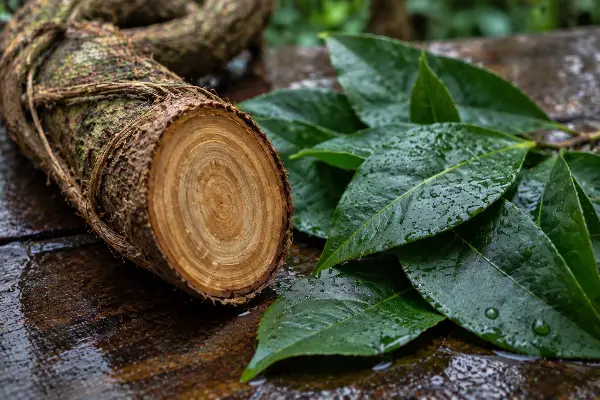
Ayahuasca contains harmala alkaloids from the Banisteriopsis caapi vine, and those alkaloids inhibit monoamine oxidase A. SSRIs block serotonin reuptake. Combining a reuptake blocker with an MAO inhibitor is the textbook setup for too much serotonin in the central nervous system, which is why every retreat asks you to stop.
That’s the route everyone describes. The second one they miss. Fluoxetine and paroxetine are also strong inhibitors of CYP2D6, a liver enzyme that helps clear harmine out of your body. Slow the clearance of harmine and you deepen the MAO-A blockade, and a deeper blockade means more DMT survives the trip through your gut and liver. The drug adds serotonin. It also makes the brew stronger.
The 1998 paper that started all of this was written by James Callaway and Charles Grob and published in the Journal of Psychoactive Drugs. Their warning was that the harmala alkaloids and the SSRI class together “may induce a serotonin syndrome with potentially grave outcome.” Grob has since described the 3 US cases behind it: agitation, confusion, heavy sweating, an apparent temperature spike, muscular rigidity. All 3 returned to baseline after the experience. Every medication rule at every center you’re looking at traces back to that 3-page paper, and hardly any of them cite it.
The Night In 2017 That Built Our Medical Protocol
A woman arrived on a low dose of sertraline. She’d disclosed it on her intake form. I had no doctor on site, no pharmacological training, and no real understanding of what MAO inhibition does to a reuptake blocker. She told me she’d “skip a few doses” before ceremony. I accepted that answer. She drank.
It was not a full serotonin syndrome. It was bad enough. Her heart rate stayed high for hours. She was agitated, she had tremors, and she sweated through everything she was wearing. I sat with her from midnight until the sky went grey, taking her pulse with 2 fingers on her wrist, because we didn’t own a pulse oximeter. I counted, waited a minute, and counted again. That was the entire medical capability of this retreat in 2017.
She recovered by morning. She didn’t need evacuating. She went home fine, and she was gracious about it in a way I did not deserve.
Read her symptoms against the 1998 case descriptions again. Agitation, sweating, raised vitals, resolution after the experience. I had reproduced a 19-year-old case report in my own maloca because I hadn’t read it.
Within 2 months I had recruited a physician, bought the medical equipment, and rebuilt the screening from scratch. The taper requirements below exist because of that night. So does the medical screening we run now. I’ve told this story on a podcast and I’m telling it here, because when a center says “we’ve never had a problem,” what they usually mean is that nothing has gone wrong yet and they have not thought about why.
Why Fluoxetine And Paroxetine Are Not Like Other SSRIs
Because they slow down the enzyme that clears the vine, and the US Food and Drug Administration already classifies them as the strong ones.
The FDA’s table of clinical index inhibitors lists exactly 2 antidepressants as strong CYP2D6 inhibitors: fluoxetine and paroxetine. Sertraline, citalopram and escitalopram are not in that table.
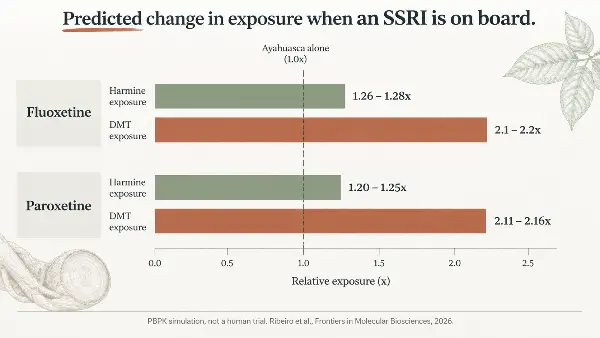
In February 2026, a team led by Gabriella Ribeiro at the University of Sao Paulo, working with the ayahuasca researchers Jaime Hallak and Rafael dos Santos, published physiologically based pharmacokinetic models of what that means in practice. Their simulations, in Frontiers in Molecular Biosciences, are the first quantitative answer anyone has given to this question.
| SSRI | Strong CYP2D6 inhibitor per the FDA | Predicted harmine exposure | Predicted DMT exposure | What we require before you drink |
|---|---|---|---|---|
| Fluoxetine (Prozac) | Yes | 1.26 to 1.28 times higher | 2.1 to 2.2 times higher | 8 weeks |
| Paroxetine (Paxil, Seroxat) | Yes | 1.20 to 1.25 times higher | 2.11 to 2.16 times higher | 6 weeks |
| Sertraline (Zoloft) | Not listed | Not modelled | Not modelled | 6 weeks |
| Escitalopram (Lexapro), citalopram (Celexa) | Not listed | Not modelled | Not modelled | 6 weeks |
Roughly double the DMT exposure from the same cup. That is what a simulated fluoxetine or paroxetine interaction looks like, and it explains something I’d watched for years without understanding: why some people have an overwhelming first night on a dose that is mild for everyone else in the room.
There are 3 caveats here, because this is a new paper and I’d rather you knew its limits than trusted me. It’s a computer model, not a study in people. The models were built on plasma data from 6 volunteers who drank ayahuasca in a controlled setting. And the authors write plainly that “definitive conclusions regarding the risk of serotonin toxicity cannot be drawn,” because nobody has established the link between DMT concentration in the brain and what that does to a person.
One more thing, and it matters. Sertraline, citalopram and escitalopram missing from the FDA’s table does not mean they’re safe with ayahuasca. It means they don’t add the second, pharmacokinetic problem. The serotonin problem applies to every drug in the class, without exception. The 2017 guest in my maloca was on sertraline.
Has Anyone Ever Had Serotonin Syndrome From Ayahuasca?
Not in the published literature, and I want to hand you that fact carefully, because it is the most misused sentence in this entire subject.
In 2024, Eleanor White, Tom Kennedy, Simon Ruffell, Daniel Perkins and Jerome Sarris published a systematic review of ayahuasca and DMT adverse events in the International Journal of Toxicology. They screened 78 relevant articles. Their finding, in their words: “no clear/confirmed cases of 5HT syndrome related to ayahuasca consumption have been found in the scientific literature.”
So the field has spent 28 years warning people about a syndrome that has never been confirmed in a journal. That’s true. Here is why it changes nothing about what you should do.
Never confirmed is not the same as never happened. Most ayahuasca is drunk in countries with no reporting system, by people who won’t tell a doctor what they took, at centers with no incentive to write anything up. Absence of case reports in that environment is weak evidence. Meanwhile the risk that is documented, in a peer-reviewed model published this year, is that 2 of the most commonly prescribed antidepressants roughly double your dose of the brew. And the second documented risk isn’t pharmacological at all: it’s what happens to you while you’re off a medication that was holding something together.
The correct conclusion is not that the interaction is overblown. It’s that the field has been frightening people with the wrong risk and ignoring the 2 real ones. That’s worse, not better, because it means the warnings people do get are the ones they’ve learned to discount.
The Warning Signs A Facilitator Watches For
Confusion and agitation, a rising temperature, raised blood pressure, muscular rigidity, and heavy sweating that isn’t explained by the room. Seizures at the severe end, and that risk is higher in anyone with a seizure history.
Those are the signs Callaway and Grob described in 1998, and they’re what I saw in 2017. In our maloca, a facilitator is circulating all night and our physician is awake on the property from the first cup until dawn, which is a different arrangement from the one I had that year. Anyone flagged at intake gets checked before ceremony and watched more closely during it.
The practical problem is that most of these signs look like an ordinary difficult ceremony from the outside. Sweating, distress and confusion are Tuesday night in an ayahuasca maloca. Here is how we separate them.
| What you see | Happens in an ordinary ceremony? | When it becomes a warning sign |
|---|---|---|
| Vomiting and nausea | Yes, expected | Almost never a warning on its own |
| Heavy sweating | Yes, common | Drenching, and paired with rigidity or a climbing temperature |
| Confusion, disorientation | Yes, common | Still there well after the peak has passed |
| Agitation, distress | Yes, common | Paired with a rising temperature or stiffness |
| Raised blood pressure | A modest rise is normal | It keeps climbing rather than levelling off |
| Muscular rigidity | No | On its own. Get a clinician |
| Temperature that keeps rising | No | On its own. Get a clinician now |
| Seizure | No | Emergency. Higher risk with any seizure history |
The bottom 3 rows are the ones that matter, and reading them at 2am in the dark is not something a facilitator with a weekend certificate can do. It’s the argument for having somebody medically trained in the building, and it’s the reason ours is here.
How Long Do You Have To Be Off An SSRI Before Ayahuasca?
Your prescriber decides how you come off. We decide how long you have to be clear before you can drink here. Those are 2 different questions and almost every center in this space blurs them into one.
Here is our half of it, which is a condition of being admitted, not medical advice:
| Medication | Minimum clear before ceremony |
|---|---|
| Fluoxetine (Prozac) | 8 weeks |
| Other SSRIs | 6 weeks |
| SNRIs (venlafaxine, duloxetine) | 6 weeks, often longer |
| Tramadol | 2 weeks |
| ADHD medication | 2 weeks |
| St John’s Wort | 2 weeks |
| 5-HTP | 1 week |
| Benzodiazepines | Case by case, prescriber confirms completion |
| Lithium and pharmaceutical MAOIs | Absolute stop, no retreat at any interval |
The fluoxetine number isn’t ours. The FDA’s own fluoxetine prescribing information states that at least 5 weeks should pass after stopping fluoxetine before starting an MAOI, because the drug’s elimination half-life runs 4 to 6 days and its active metabolite norfluoxetine runs 4 to 16 days. Ayahuasca is an MAO inhibitor. The label answered this question decades ago and I have never seen another center cite it. We add 3 weeks on top because the label’s 5 weeks assumes a monitored clinical setting, and a maloca in the Amazon is not one.
What we will never do is tell you to stop a psychiatric medication. Not once, not by implication, not by holding a bed and waiting. Your own doctor plans the taper. Our medical director confirms it with them directly before your place is held.
The Half Of This Decision Nobody Writes About
Coming off an antidepressant is itself the risk, and I’ve read every page ranking for this question without finding one that says so.
The most common preparation mistake we see isn’t someone hiding a drug. It’s someone whose doctor said “2 weeks should be fine,” who arrives with dizziness, brain zaps and a mood swinging around on them, and who then has to drink on top of that. They’re compromised before the cup reaches them. The nervous system that ayahuasca meets is already destabilised, and the night goes worse for it.
Then there’s the part that has nothing to do with chemistry. You’re proposing to stop a medication that may be doing real work, for 6 to 8 weeks, in the run-up to an emotionally demanding trip abroad that you’ve paid for and told people about. If the depression comes back at week 4, the honest move is to restart and rebook. The pressure not to do that is enormous and it’s mostly financial, which is why we don’t take your money until screening finishes and why a declined applicant is never charged.
Ask any center you’re considering what happens if you have to restart. If the answer involves losing a deposit, you’ve learned what that taper policy is protecting.
What If Your Doctor Says The Taper Is Not Safe?
Then you don’t come, and we say so plainly rather than moving you to a later week and hoping.
If your prescriber won’t support the taper or believes stopping is unsafe for you, we don’t accept you for that retreat cycle. That’s the policy in writing. It costs us bookings and I’d rather lose them than have a doctor overruled by somebody who wants your deposit.
About 11% of applicants are rejected outright here. Another 5 to 7% are conditionally accepted and never meet the conditions, and the most common reason in that second group is a medication taper they can’t or shouldn’t complete. Call it 16 to 18% of people who apply and never drink. Publishing that number costs us bookings too, and it’s the cheapest test you can run on any center: ask what proportion they decline, and what the top reason is. A center that doesn’t know its own number isn’t screening, it’s collecting forms.
If the answer is that you can’t safely come off your medication, that is a real answer and not a failure. Some people should stay on their antidepressant and not drink ayahuasca, and there’s nothing tragic about it. If you want a psychedelic that doesn’t carry the MAO inhibitor problem at all, the comparison between ayahuasca and psilocybin starts exactly there, though the SSRI question doesn’t disappear with it either.
SNRIs, Lithium And The Supplements People Leave Off The Form
The SSRI class isn’t the whole list, and the item that worries me most isn’t a prescription.
SNRIs such as venlafaxine and duloxetine work on serotonin reuptake too, and their discontinuation effects are often rougher than an SSRI’s, which is why our minimum is 6 weeks and frequently longer. Tricyclics, tramadol and triptans all belong in the same conversation with your prescriber.
Lithium is an absolute stop for us, and the evidence there is stronger than for anything else in this article. In 2021, Nayak and colleagues published an analysis in Pharmacopsychiatry of 96 online reports of classic psychedelic use alongside lithium or lamotrigine. Of the 62 lithium reports, 29 involved seizures. That’s 46.8%. Of the 34 lamotrigine reports, none did. Self-reported data from an online archive isn’t a clinical trial and the authors say so, but a seizure rate near half against zero in the comparison group isn’t a signal you review case by case in a building with no hospital next door.
One more, because people ask. If you’re weighing 5-MeO-DMT, whether the bufo session we offer or one somewhere else, it’s a serotonergic tryptamine and your medication list matters there too. Different molecule, same conversation with your prescriber.
The omission we see most often is supplements. St John’s Wort, 5-HTP, SAM-e and high-dose tryptophan all act on serotonin, and people leave them off the medical form because a capsule from a health shop doesn’t feel like a drug. Write them down, with the dose and how long you’ve been taking them. So does anyone who’s been prescribed something for migraine, nausea or pain in the last 3 months.
Who Reads Your File In 2026, And What Happens Next
A licensed physician reads it, within 72 hours, before a place is offered.
Our medical director trained at the Universidad Nacional Mayor de San Marcos in Lima, spent 20 years in emergency medicine, and has worked with ayahuasca centers for 12 of them. She reviews every medical form we receive. If you’re on something that needs tapering, she contacts your prescriber directly and signs off on the completed taper before your place is confirmed. She’s on the property for every ceremony night and awake until dawn, and the same review covers everything else we run, not just the brew.
After her review, our senior facilitator runs a video call with you that lasts 30 to 45 minutes and isn’t optional. Written forms miss things a conversation catches: whether you sound manic, whether the story matches the paperwork, whether you’re walking toward something or running from it. The whole process runs 1 to 3 weeks depending on how complicated your history is.
Across 10 years, roughly 195 retreats and more than 800 ceremonies, we’ve served about 2,400 guests, evacuated 2 of them, and had no deaths. Neither evacuation was a medication interaction. One was an undisclosed cardiac arrhythmia in 2018 and the other an acute psychotic episode in 2021, and both people recovered fully. Both changed our intake form afterwards. You can read what the rest of the week looks like in our account of a night in the maloca, and the food protocol that runs alongside the medical one in our guide to the dieta before a retreat.
What To Ask Any Center Before You Send Your Medication List
You’re about to hand a business in another country your full psychiatric and prescription history. Get something back first. Ask these 5 questions, in writing:
- What is your required clearance for my specific medication, and what is that number based on?
- Who reads my medical form, what is their licence, and where is it registered?
- Will you contact my prescriber directly, and will you accept it if my prescriber says no?
- What proportion of applicants do you decline, and what is the top reason?
- What happens to my money if I start the taper and have to restart the medication?
Specific answers pass. “It depends on the person” is not an answer to question 1 unless a number follows it. “We have experienced staff” fails question 2. If a center gives you a flat 2 weeks for every antidepressant, ask them about fluoxetine specifically, and see whether the number moves. We run the same test in more depth in our list of 17 questions to ask before you book, and the wider version of it in our guide to choosing a retreat in Peru. Nobody inspects these centers, which is worth knowing before you decide anything, and we cover why in our piece on whether ayahuasca is legal in Peru.
Nothing on this page is medical advice and none of these lists are exhaustive. Ayahuasca and SSRIs are a combination you plan your way out of months ahead, with the doctor who prescribed the medication, not a thing you improvise 3 days before a flight. If your history is complicated, send us the file and let a physician read it. Screening is free, it takes 1 to 3 weeks, and it ends with a real answer either way. You can start an application, look at how our ayahuasca retreats work, or read about the people who’d be in the room before you commit to anything.
FAQs
Can you take ayahuasca while on antidepressants?
No. Ayahuasca inhibits monoamine oxidase A and SSRIs block serotonin reuptake, and combining the 2 can produce a dangerous excess of serotonin. Callaway and Grob warned about this in the Journal of Psychoactive Drugs in 1998 after 3 US cases involving agitation, confusion, sweating and muscular rigidity. Any taper has to be planned by the doctor who prescribed the medication.
How long do you have to be off SSRIs before ayahuasca?
We require 6 weeks clear for most SSRIs and 8 weeks for fluoxetine before you can drink here. The fluoxetine figure follows the FDA label, which states that at least 5 weeks should pass after stopping fluoxetine before starting an MAOI, because its active metabolite norfluoxetine has a half-life of 4 to 16 days. How you taper is your prescriber’s decision, not ours.
Why is fluoxetine treated differently from other SSRIs?
There are 2 reasons. It stays in your system far longer than the rest, and the FDA lists it, along with paroxetine, as a strong CYP2D6 inhibitor. A 2026 modelling study in Frontiers in Molecular Biosciences predicted that fluoxetine raises DMT exposure by 2.1 to 2.2 times and paroxetine by 2.11 to 2.16 times, because slowing harmine clearance deepens the MAO-A blockade.
Does ayahuasca cause serotonin syndrome?
A 2024 systematic review in the International Journal of Toxicology screened 78 articles and found no clear or confirmed case of serotonin syndrome tied to ayahuasca in the scientific literature. That is not clearance to drink on an SSRI. Most ayahuasca is taken where nothing gets reported, and the risks that are documented, roughly doubled DMT exposure on fluoxetine or paroxetine and the effects of stopping your medication, are reason enough to take the rule seriously.
What are the symptoms of an ayahuasca and SSRI interaction?
Confusion, agitation, heavy sweating, a rising temperature, raised blood pressure and muscular rigidity, with seizures at the severe end and a higher risk in anyone with a seizure history. In the 3 cases Callaway and Grob described in 1998, all returned to baseline after the experience. Rigidity and a climbing temperature are the signs that separate an interaction from an ordinary difficult ceremony.
Can you take ayahuasca on lithium?
No, and this has the strongest evidence of any exclusion here. A 2021 analysis in Pharmacopsychiatry of reports involving classic psychedelics found seizures in 29 of 62 lithium reports, or 46.8%, against none of the 34 lamotrigine reports. Lithium is an absolute stop at our retreat at any interval, alongside pharmaceutical MAOIs.
What if my doctor will not approve stopping my antidepressant?
Then we don’t accept you for that retreat cycle, and we tell you so directly. About 11% of applicants are rejected outright and another 5 to 7% are conditionally accepted but never meet the conditions, most often because of a taper they can’t or shouldn’t complete. A declined applicant gets the reason in writing, along with a list of referrals.