Ayahuasca Fears: 7 Checked, And The One To Plan For
Most ayahuasca fears are about the ceremony night, and on the scariest ones, like losing your mind, the published research is calmer than the stories. The one worth planning for comes later. In a survey of 7,839 ayahuasca drinkers, 55.4% said they’d had at least 1 of 10 unwanted mental health effects in the weeks or months after their ceremonies, and for 7 of those 10, most said it lasted under a week.
I run our Sacred Valley retreat for no more than 12 guests at a time, and I’d rather hand you a number than a reassurance.
What Are Ayahuasca Fears?
Ayahuasca fears are the worries people carry into a first ceremony: losing control, losing their mind, facing hard memories, being seen purging or crying, feeling nothing, being changed, and feeling worse afterwards. The worst outcomes, like psychosis, are rare in the research. The common one, an unwanted effect in the weeks after, gets the least attention.
Being nervous before a first ceremony is ordinary, and researchers measure it as part of “set,” the state of mind you walk in with. Treat the fear as a list of questions nobody has answered for you yet. A fear with a specific answer is easier to carry than a vague one.
The 2026 Research Behind 7 Ayahuasca Fears
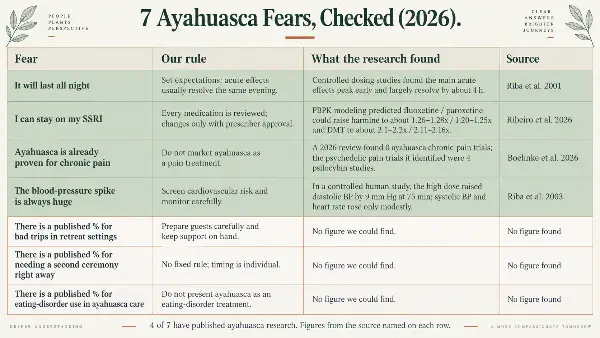
4 of the 7 fears have published ayahuasca research you can check. For the other 3, we couldn’t find a figure worth printing, so you get our rule instead of a number borrowed from a different drug.
| Fear | Our rule | What the research found | Source |
|---|---|---|---|
| Losing control | The maestro sets your dose. Nobody pours a second cup you didn’t ask for | No figure we could find | None |
| Losing your mind | Diagnosed schizophrenia and bipolar I are absolute stops. Our physician reviews family history case by case | Incidence “appears to be rare.” 1 Brazilian church: 13 to 24 possible cases in 5 years, over an estimated 25,000 to 250,000 servings | Therapeutic Advances in Psychopharmacology, 2017 |
| Hard memories and emotions | You can skip the next ceremony, and no one will push you on it | In a 36-person retreat study, challenging moments predicted more positive feelings in the days after | Psychopharmacology, 2025 |
| Being seen purging or crying | Partners are never put on neighboring mats. You sleep in your own room | No figure we could find | None |
| Feeling nothing | 4 ceremonies across the week | No figure we could find | None |
| Being changed | No medical claims, and no promise that you’ll change | In 256 retreat guests, neuroticism fell and was still lower 3 months later | Scientific Reports, 2021 |
| Feeling worse afterwards | 12 months of integration calls with the lead who reviewed your file | 55.4% of 7,839 had at least 1 unwanted mental health effect. 87.6% of them saw it as part of a positive process | PLOS Global Public Health, 2022 |
Who Decides What Happens To You During A Ceremony?
The maestro decides your dose, based on watching you. You decide whether to sit up, ask for help or leave the room with someone. Nobody decides how the medicine runs once you’ve drunk it: it runs its course over the night and can’t be stopped, so you ride it out. It doesn’t knock you out, though, which is why those choices stay open.
A second cup is never poured unless you ask for one. If it gets to be too much, raise a hand and someone from the team comes to you. How the night runs, hour by hour, is on our ayahuasca page.
The loss of control people picture, not knowing who or where you are, sounds more like toé, a Brugmansia plant containing scopolamine that some centers add to the brew, than like ayahuasca. Ours is vine and chacruna, nothing else. Here, anyone who needs to touch you asks first, each time, and we explain that rule in daylight before the first ceremony. What’s in the cup and who can touch you are 2 of our 17 questions for any center.
Between ceremonies, you can skip any ceremony or session, and no one will push you on it. You can also stop the week altogether and keep your room, meals and integration calls, and a medical withdrawal is refunded in full.
Almost no retreat I asked would say who stays with guests at 4 in the morning. Here it’s maestros and facilitators, plus a physician on site who is awake until each ceremony ends. Oxygen and a defibrillator are kept close by.

How Rare Is Psychosis After Ayahuasca?
Rare, on the published record. Ayahuasca has been linked to psychotic episodes, but a review of the cases found they appear to be rare, and its authors think screening lowers the risk.
A 2017 systematic review in Therapeutic Advances in Psychopharmacology gathered the published cases of psychosis linked to ayahuasca or DMT. For ayahuasca, it found 3 case series and 2 case reports. It concluded that the incidence of these episodes “appears to be rare in both the ritual and the recreational/noncontrolled settings,” and that the causal link “is not always clear.”
The review also cites records from a Brazilian ayahuasca church: over 5 years, 13 to 24 cases where ayahuasca “might have been a contributing factor in a psychotic incident.” Against an estimated 25,000 servings, that’s roughly 1 in every 1,000 to 2,000. A document from a US Supreme Court case put the servings at 250,000, which would make it closer to 1 in 10,000 to 20,000.
The cases included people with their own or a family history of psychosis or mania, people who had taken other drugs at the same time, and some with neither. The authors write that psychiatric screening before use in controlled settings “seems to significantly reduce” the chance of psychotic reactions. They also say anyone whose own or family history includes psychotic illness or mania “should avoid hallucinogen intake.”
That advice is stricter than our own screening. Here, diagnosed schizophrenia and bipolar I are absolute stops, and our physician reviews a family history of psychosis case by case. If either describes you, read who should wait before you apply.
The milder version of this fear, feeling unhinged for a while, has numbers too. Of 7,839 drinkers asked about the weeks or months after their ceremonies, 12.9% reported “difficulty knowing what is real and not real” and 28.5% reported “hearing or seeing things that others do not hear or see.” Of everyone who reported any of the survey’s 10 effects, 87.6% saw them as part of a positive process.
If dying is the fear, our screening page covers the published death cases.
What 1 Retreat Study Found About Hard Moments
A 2025 study of 36 retreat guests found that hard moments during ceremony predicted more positive feelings in the days after, though not fewer negative ones. So a hard memory coming up isn’t the same as the night going wrong.
The study, published in Psychopharmacology, followed guests through a 4-day ayahuasca retreat run in a modern, non-traditional format, with check-ins over 5 days soon after. No participants showed a clinically significant adverse response after the retreat, but 2 of the 36 showed some sign of possible worsening in mood.
It’s a small study, so read it as a hint rather than a promise. When something heavy surfaces here, a maestro can come and sing to you. If you’d rather not drink the next night, you don’t have to.

A Quiet First Night Isn’t A Failed One
A quiet first night doesn’t mean you did something wrong, and the week has 4 ceremonies, so 1 quiet night isn’t the whole story. We couldn’t find a published figure for how often it happens.
The dose is the maestro’s call, and after 2 nights of watching you, the maestros adjust how they work with you. Nothing you do on the mat counts as failing. You don’t have to see anything, and you don’t have to cry. Lying still and listening to the icaros is a whole ceremony too.
Being Seen By 11 Other Guests
It’s dark, and everyone in the room is busy with their own night. People purge, cry, laugh or lie still, and none of it is unusual in a ceremony room.
How often people purge is in our guide to the week. If you come with a partner, you won’t be put on neighboring mats, and outside ceremony you sleep in your own room. If the size of the group is what bothers you, read what group size changes at 2 in the morning.

Does Ayahuasca Change Your Personality?
In 1 study, personality scores shifted after a retreat, though with no comparison group it can’t show that ayahuasca caused the shift. Neuroticism, the trait tied to worry and low mood, dropped, and nothing in the data pointed to less drive. A 2021 study in Scientific Reports tracked 256 guests at 3 retreat centers in Peru and Costa Rica: before their ceremonies, within a week after, and 3 months later.
Neuroticism showed what the authors call the most pronounced change. It dropped by an effect size of -1.00 within a week of the retreat and was still down at 3 months, at -0.85. People who knew 110 of the guests rated them before the retreat and at 3 months, and they saw the drop too, at -0.62.
Conscientiousness, the trait closest to drive, went up. It slipped back between the first week and the 3-month check but stayed above where people started. The authors are careful here. They think expectations may have amplified the changes, the drop in neuroticism included, and without a comparison group the study can’t separate what ayahuasca did from what the retreat around it did.
So we won’t promise you’ll come home a different person. We make no medical claims, and we don’t offer ayahuasca as a treatment for any condition. What this study doesn’t show is a drop in drive.
What 7,839 Drinkers Said About The Weeks After
More than half reported at least 1 unwanted mental health effect afterwards, and for 7 of the 10 effects, most said it lasted under a week. It’s the part fear guides tend to skip.
In 2022, the Global Ayahuasca Survey team reported in PLOS Global Public Health on 7,839 drinkers asked about their mental health in the weeks and months after their ceremonies. The question covered everyone’s full history, not 1 retreat, and people who had drunk only once reported each effect less often.
| What the survey measured | Result | Out of |
|---|---|---|
| At least 1 of 10 unwanted mental health effects afterwards | 55.4% (4,341) | 7,839 who answered |
| Feeling disconnected or alone, 1 of the 10 | 21.0% | 7,839 who answered |
| Saw their effects as “part of a positive process of growth or integration” | 87.6%: 76.3% completely, 11.3% in part | Everyone with an effect |
| Effects that most people said lasted under a week | 7 of the 10 | Everyone who had each effect |
| Needed support from a psychiatrist, physician, therapist, counselor or alternative health practitioner | 11.9% | 4,315 with an effect who answered a follow-up |
| A physical effect that needed medical attention | 2.3% (132) | 5,775 with a physical effect who answered a follow-up |
The last row is the part fear guides spend most of their words on.
So if you’re going to spend your worry anywhere, spend it on the weeks after you get home. A rough patch that passes within a week is common. A hard month that keeps getting worse isn’t something to wait out, and it isn’t “the process.”
Here, integration runs 12 months: 4 calls across the first 3 months, then 1 a quarter, and every call is with the lead who reviewed your file before you came. We ask you to keep your first 2 days home free. We’re not an emergency service, and we can’t respond fast enough to a crisis. If you’re in the US and it’s an emergency, call or text 988, the Suicide and Crisis Lifeline, or call 911. Anywhere else, call your local emergency number.
If you can’t sleep, can’t work or can’t tell what’s real, and it isn’t easing, call a doctor, not a retreat. That includes us.

Calming Your Nerves Before You Fly
Preparation is the part of your state of mind you can change, and it’s the part the research ties to an easier night.
A 2018 study in Frontiers in Pharmacology followed 654 people who were already planning to take a psychedelic. Before the session, it scored their “set” with statements like “I feel well prepared for the upcoming experience,” “I feel comfortable about the upcoming experience” and “I feel anxious.” A better score predicted a less challenging experience. The catch: only 42 of the 379 who reported back the day after had taken ayahuasca, about 11%. Most had taken LSD or psilocybin.
The setting counts too. In a placebo-controlled study of 30 experienced drinkers at retreats in the Netherlands, Spain and Germany, published in Psychopharmacology in 2021, symptoms of depression, anxiety and stress had dropped by the next morning in the placebo group as well as in the ayahuasca group. Some of what helps is the room and the people in it, and you can check both before you book.
3 things to do before you fly:
- Get the answer in writing. Ask the question behind your fear, and ask for the answer by email. If a center won’t put it in writing, treat that as the answer.
- Tell someone at home. Our application asks who knows you’re going, because a person who can notice a change in you is part of the weeks after.
- Match the place to the fear. If the purging scares you most, compare ayahuasca with psilocybin before you choose. If it’s being far from help, ask for the drive time to the nearest hospital, and see Iquitos vs Sacred Valley for how the 2 regions compare. Ours is about an hour from a hospital in Cusco.
Ayahuasca fears are worth taking one at a time. Tell us the one that’s keeping you up at night, and a named person on our team will answer within 48 hours on weekdays. Send us the fear. This page isn’t medical advice.
FAQs
What are the most common ayahuasca fears?
Losing control, losing your mind, facing hard memories, being seen purging or crying, feeling nothing, being changed, and feeling worse afterwards. The worst outcomes, like psychosis, are rare in the research. The common one is the weeks after: in the Global Ayahuasca Survey, 55.4% of 7,839 drinkers reported at least 1 unwanted mental health effect after their ceremonies, and 87.6% of them saw it as part of a positive process.
Can ayahuasca cause psychosis in someone with no history?
It appears to be rare. In the published cases a 2017 review gathered, some people had their own or a family history of psychosis or mania, some had taken other drugs at the same time, and some had neither. The review, in Therapeutic Advances in Psychopharmacology, found the incidence of these episodes “appears to be rare in both the ritual and the recreational/noncontrolled settings,” and says the causal link “is not always clear.” Across all cases, it cites 13 to 24 possible cases over 5 years from 1 Brazilian church, against an estimated 25,000 to 250,000 servings.
Can you leave the room during an ayahuasca ceremony?
At our retreat, yes, with someone from the team, at any point in the night. You can’t stop the medicine once you’ve drunk it, but you can skip any later ceremony, and no one will push you on it.
Can ayahuasca take away your drive?
The research points the other way. In a 2021 Scientific Reports study of 256 retreat guests, conscientiousness, the trait closest to drive, rose after the ceremonies, while neuroticism fell and stayed lower 3 months later. The study had no comparison group, and the authors think expectations may have amplified the changes.
How long do bad feelings last after an ayahuasca retreat?
For most of the effects measured, under a week. In the Global Ayahuasca Survey, for 7 of the 10 unwanted mental health effects listed, most people who had them said they lasted less than a week. Of the 4,315 with an effect who answered a follow-up, 11.9% said they needed professional support, so if things are getting worse rather than easing, call a doctor, or 988 in the US in a crisis.
Do ayahuasca fears make the ceremony harder?
They can. In a 2018 study that followed people planning a psychedelic, those who scored higher on “set” the day before, a score that includes feeling prepared, comfortable and not anxious, had less challenging experiences. Only about 11% of the people who reported back took ayahuasca, so treat it as a lead, not proof. Getting your specific ayahuasca fears answered before you fly is the part you control.