Who Should Not Drink Ayahuasca? The Evidence Check
Nobody should drink ayahuasca while taking an MAOI, lithium, or an antidepressant they have not tapered off with their prescriber’s supervision. Nobody should drink it while pregnant or breastfeeding, or with diagnosed schizophrenia or bipolar I, uncontrolled hypertension, a cardiac event in the last 12 months, epilepsy, or severe liver disease. Those are our absolute stops, and about 1 application in 5 here does not proceed because of one of them.
That list is on every retreat website in Peru. What is not on any of them is where each item came from. So this page grades them. Nine exclusions, what evidence sits behind each one, and the one I could not find a published basis for at all.
Who Should Not Drink Ayahuasca, in One List
Ayahuasca contraindications are the medical conditions and medications that make drinking the brew unsafe. They exist for 1 reason: the vine contains monoamine oxidase inhibitors. That inhibition is what makes the brew work by mouth, and it is also what makes certain drugs, certain foods and a compromised heart dangerous in combination with it.
Everything below follows from that single fact. If a center cannot explain its own rules in those terms, it did not write them.
These are the published stops at the retreat we run, applied without exception:
- MAOI medication of any kind
- Lithium
- Diagnosed schizophrenia or bipolar I
- Uncontrolled hypertension
- A cardiac event within the last 12 months
- Epilepsy or severe liver disease
- Pregnancy or breastfeeding
SSRIs, SNRIs, tramadol, triptans, stimulants, blood pressure medication, benzodiazepines and a family history of psychosis are read individually by a physician. That is not a softer list. It means a licensed clinician reads your file and sometimes calls your own doctor before anyone answers you. The full process is in our breakdown of what an ayahuasca medical screening checks.
Why Most Exclusion Lists Are Copied, Not Clinical
Because copying one costs nothing and checking one costs weeks. Before Peru I spent years auditing pages for a living, and duplicated content has a signature you stop being able to unsee. I went through the exclusion lists on the pages currently ranking for this question and traced each item back to a source. Most of them do not have one.
Two things gave it away. The first is what appears on those lists that should not. Advanced multiple sclerosis turns up as a contraindication on several of them, and I could not find a single published paper, drug label or guideline behind it. The research that does exist on psychedelics and MS is looking at them as a possible treatment, not as a hazard. It reads like an item that got onto one list years ago and has been copied sideways ever since.
The second is what is missing. Lithium has better evidence behind it than almost anything else in this field, and it is absent from the page currently ranking first for this exact question. A list that excludes advanced MS while omitting lithium was not assembled from the literature.
None of this means the lists are too cautious. Read the table below and you will notice the correction runs both ways: 1 item comes off, 1 goes on, and several stay exactly where they are for reasons nobody had bothered to write down.
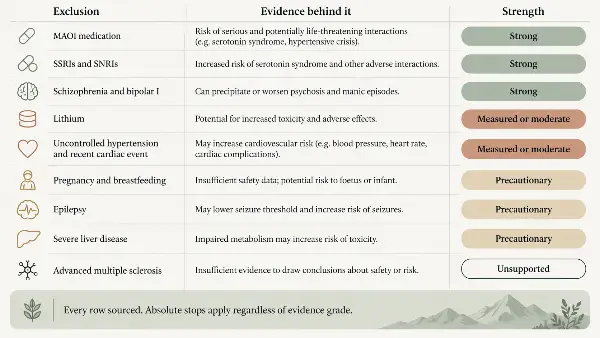
The Exclusion List, Graded by Evidence
Here is every exclusion with the evidence behind it and how strong that evidence actually is. I have not seen another center publish this, and I would like that to change.
| Exclusion | What sits behind it | Strength |
|---|---|---|
| MAOI medication | Direct pharmacology. Ayahuasca is itself an MAO inhibitor, so the effect is additive by definition | Strong, mechanistic |
| Lithium | Nayak 2021: seizures in 29 of 62 reports of lithium with a classic psychedelic, against 0 of 34 on lamotrigine | Moderate. Self-reported reports, not a trial, but a very large signal |
| SSRIs and SNRIs | FDA labelling on combining these with an MAOI. The fluoxetine label sets at least 5 weeks | Strong for the mechanism, drug-specific for the timing |
| Schizophrenia, bipolar I | Standard exclusion in every modern psychedelic trial protocol | Strong by clinical consensus. Direct ayahuasca data is thin and nobody will run the trial that would produce it |
| Uncontrolled hypertension, recent cardiac event | Measured. Diastolic blood pressure rose 9 mmHg at 75 minutes at the high dose in placebo-controlled testing | Measured and modest in healthy adults. It is the compromised heart that changes the arithmetic |
| Pregnancy and breastfeeding | 42 studies exist across 9 countries, ayahuasca appears in 2.4% of them, every outcome rated very low certainty | Precautionary. The evidence is absent, which is not the same as reassuring |
| Epilepsy, seizure history | Mechanistic concern about seizure threshold. Almost no direct data either way | Weak evidence, sensible caution |
| Severe liver disease | No study has measured ayahuasca in anyone who already has liver disease | Precautionary only, and we keep it as an absolute stop anyway |
| Advanced multiple sclerosis | I could not find a published basis for this one | Unsupported as far as I can trace it |
Read that last column carefully, because it is easy to misread. A weak evidence grade is not permission. Four of these stops rest on caution rather than measurement, and caution is the correct response to a gap in the record when the downside is a seizure at 2,870 metres with the nearest hospital an hour away. The point of grading them is so you can ask a center why a rule exists, and hear whether the answer is a reason or a shrug.
Antidepressants, and the Number the Whole Field Disagrees On
No, not while you are still taking them, and the taper belongs to the doctor who prescribed them. This is the single most common reason an application stalls here.
The mechanism is not in dispute. SSRIs and SNRIs block serotonin reuptake, ayahuasca inhibits the enzyme that clears it, and stacking those 2 is the textbook setup for too much serotonin. The timing is where the field falls apart. Four ranking centers give 4 different answers and none of them cites anything.
The number already exists. The FDA fluoxetine prescribing information states that at least 5 weeks should pass after stopping fluoxetine before starting an MAOI, because the drug has an elimination half-life of 4 to 6 days and its active metabolite norfluoxetine runs 4 to 16 days. A flat house rule of 2 weeks is roughly right for a short half-life SSRI and badly wrong for one of the most prescribed drugs in America. We set the whole field against that label, center by center, in the washout table on our screening page.
We publish no house washout number, deliberately. Yours is set by your prescriber and confirmed by our physician. If your doctor says the taper is unsafe for you, that is the end of it, and we will tell you so rather than moving you to a later week and hoping.
Lithium Is the Exclusion Most Lists Leave Out
Lithium is an absolute stop here, with no exceptions, and it has stronger evidence behind it than most of the conditions that appear on every list in this industry.
In 2021, Nayak and colleagues published an analysis in Pharmacopsychiatry of 96 reports describing classic psychedelic use alongside lithium or lamotrigine. Of the 62 lithium reports, 29 involved seizures. That is 46.8%. Of the 34 lamotrigine reports, none did. The authors’ conclusion is unusually direct for a journal: lithium, they wrote, should be considered a contraindication to psychedelic use.
It is not a controlled trial and they say so. But a seizure rate near half in 1 group and 0 in the comparison group is not a signal you review case by case in a room without a hospital next door.
Here is the practical use of that paragraph. If you take lithium and a retreat tells you it can be worked around, ask which paper they are relying on. There is 1, and it says the opposite.
Does Ayahuasca Actually Cause Serotonin Syndrome?
Not on the published record, and the accurate version of this answer is more useful than the scary one. A 2024 systematic review in the International Journal of Toxicology by White, Kennedy, Ruffell, Perkins and Sarris examined 78 articles on ayahuasca and DMT adverse events. It found no clear or confirmed case of serotonin syndrome tied to ayahuasca in the scientific literature, and no deaths in the literature it reviewed. It describes the risk as theoretical and extremely rare, arising in combination with drugs acting on the same receptors.
Most pages in this field state the opposite as settled fact. Combining ayahuasca with a serotonergic drug “causes serotonin syndrome, a life-threatening condition,” full stop, no source.
Why the correction matters: a reader who discovers the scary version was overstated tends to assume the whole list was overstated. The risk here is real, it is mechanistically obvious, and it is the reason the taper rules exist. It is also rare enough that a systematic review of 78 papers could not confirm a case. Both of those sentences are true, and you deserve to be given both.
Is Ayahuasca Safe During Pregnancy?
Pregnancy and breastfeeding are absolute stops here, and no ethical center in Peru will serve you. What is worth correcting is the reason every page gives for it.
The standard line is that no research exists. That is not quite true any more. A systematic review published in May 2026 pulled together 42 studies across 9 countries covering 251 women exposed to classic psychedelics during or before pregnancy, including the Santo Daime community in Brazil, who drink ayahuasca ritually. So the literature exists. It is just close to useless for this decision. LSD accounts for 90.5% of it and ayahuasca for 2.4%. Nearly 74% of the studies predate the year 2000. Every single outcome the authors assessed came back rated very low certainty, and they concluded that methodologically sound research is urgently needed.
That is a better answer than “no research exists,” because it is checkable and it tells you the shape of the gap. There is no evidence of safety here. There is a small, old, mostly unrelated literature that cannot support a decision either way, and a ceremony night that involves fasting, hours of purging and a sustained rise in blood pressure. That combination is enough on its own.
Does Ayahuasca Damage Your Liver?
Nobody knows what it does to a liver that is already damaged, which is exactly why severe liver disease stays on our absolute stop list.
The reasoning you will read elsewhere goes further than the evidence does. Pages in this field list cirrhosis, fibrosis, advanced fatty liver and chronic hepatitis, and explain that impaired liver function means the alkaloids build up and toxicity rises. It is a plausible mechanism. It has not been measured. The only study I can find that looked directly at this question, by Mello and colleagues in the Journal of Psychoactive Drugs in 2018, followed 22 long-term ritual users and found no significant change across their liver and kidney markers at 4, 24 and 168 hours after drinking.
That study is not a clearance for anybody, and reading it as one would be a serious mistake. Its subjects had healthy livers. It tells you that regular ceremonial use did not damage a working liver in a small sample. It tells you nothing at all about a liver with cirrhosis, which is the person actually asking this question.
So the honest position is the cautious one, stated honestly: we exclude severe liver disease because the drug is cleared hepatically and nobody has studied what happens when that clearance is impaired. Precaution in the absence of data. Not a measured risk, and not something we are going to dress up as one.
Heart Conditions, Epilepsy and Head Injuries
Cardiac exclusions are the best measured on the list, and the neurological ones are the least. They sit in the same section because people assume both are equally established, and they are not.
On the heart: ayahuasca raises blood pressure, modestly, for a few hours. Placebo-controlled testing measured a significant rise in diastolic pressure of 9 mmHg at 75 minutes on the higher dose, with systolic pressure and heart rate rising too but not to statistical significance. Nine points is unremarkable in a healthy adult. It is a different proposition with uncontrolled hypertension or a cardiac event this year.
Then add altitude, which is the variable no published exclusion list accounts for. A ceremony night in the Andes means no food since lunch, several hours of purging, a night without sleep, and all of it at about 2,870 metres at our Urubamba house on the Sacred Valley floor. Each of those raises cardiac demand on its own, which is why anyone over 60 or with any cardiac history is asked for recent bloodwork and an ECG before a physician signs off, and why altitude changes what a retreat asks of your body.
We also run a lowland house, and the gap between them is not cosmetic. Our Pucallpa center sits at roughly 150 metres in the Shipibo heartland, around 2,720 metres below the Urubamba property. Same medicine, same screening questions, different cardiac arithmetic.
The absolute stops do not move between the two. A cardiac event this year rules you out of both. But a borderline file that altitude tips over is a real category, and if that is you, the useful question is which house rather than whether ayahuasca. Almost nobody in this field will tell you that, because most centers only have one address.
On epilepsy and head injury, the case is thinner and I am not going to pretend otherwise. The concern is that changed neural excitation lowers the seizure threshold. There is almost no direct research on ayahuasca and epilepsy in either direction. We treat the absence as a reason for caution rather than a reason for confidence, because a seizure in a dark room an hour from a hospital is not a risk worth taking on a maybe.
How Old Do You Have to Be to Drink Ayahuasca?
Older than the legal minimum, at every center worth attending. Peru sets no age for ceremony, so each center writes its own rule, and the ones taking it seriously land between 18 and 21.
The reasoning is about the developing brain rather than the law. The regions handling impulse control and emotional regulation keep maturing into the mid twenties, and there is no research on what repeated psychedelic exposure does during that window. Nobody is going to run that study, so the gap is permanent.
There is a second reason that has nothing to do with neurology. The work that makes a ceremony useful happens in the year afterwards, at home, and it asks for a life stable enough to absorb it. That is a high bar at 19.
So ask any center for its minimum in writing, and ask what the number is based on. One that has never thought about it will not have an answer, and that tells you how the rest of the list was written.
When to Postpone Rather Than Cancel
Most people reading a contraindications page are not permanently excluded. They are temporarily in the wrong month, which is a completely different problem and nobody writes about it.
Postpone, do not cancel, if any of these are currently true.
| What is true right now | Why it predicts a harder week | What we do about it |
|---|---|---|
| You stopped a psychiatric medication in the last few weeks and can still feel it | Withdrawal effects stack on top of pre-ceremony nerves, so the medicine meets a nervous system that is already unsettled | Move you to a later cohort once your prescriber confirms you are through it |
| Acute grief, measured in weeks rather than months | A ceremony will make grief that raw louder, not easier | Hold your place and revisit in a few months |
| A crisis with a date on it: a filing, a diagnosis, a job ending | You will spend the week rehearsing the date instead of being in the room | Book for after the date, not before it |
| Physically unwell, or arriving straight off a red-eye | Fasting, purging and a sleepless night at altitude on an already depleted body | Recovery days built in before the first ceremony, or a later week |
| Nobody at home knows you are going | No one to call, and usually a sign you have not told yourself the truth about the trip either | Not a decline. We talk about it, and most people tell someone |
| You booked because somebody else did | Borrowed motivation does not survive the second ceremony | Your own week, or no week |
None of those is a medical contraindication. All of them predict a harder week and a worse year afterwards. We move people to later cohorts for these reasons regularly, and it is never treated as a failed application.
The 1 that surprises applicants is the last-minute medication taper. A person who stops an SSRI 3 weeks before flying arrives with withdrawal effects layered on top of pre-ceremony nerves, and the medicine meets a nervous system that is already unsettled. The taper being technically complete is not the same as your body having finished with it.
What to Do If You Are on the Borderline in 2026
Get the specific answer for your specific file, from someone with a licence, before you book anything. Here is the order that actually works.
- Write down every medication with its dose and how long you have taken it. Include supplements. St John’s Wort, 5-HTP, SAM-e and high-dose tryptophan all act on serotonin, and people leave them off because a supplement does not feel like a drug.
- Ask your own prescriber 1 question: is a supervised taper off this medication safe for me, and how long would it take. Not whether they approve of ayahuasca. The taper is the medical question and it is theirs to answer.
- Send the whole file to the center before you send money. If they will not read it before taking a deposit, you have learned what you needed to learn.
- Ask them what their rule is based on. A center that can name the label or the paper behind its own washout period is a center that wrote its own list. Our guide to the questions to ask an ayahuasca retreat has the rest of them.
- Ask what is in the room. Here it is 12 guests, 2 maestros and a physician on site all 7 nights and awake until first light, with oxygen and a defibrillator in the building, 20 minutes to a clinic and an hour to a Cusco hospital. You can read why the group size matters and what a ceremony night looks like hour by hour.
The reason to do all of this is that nobody else will. The US State Department states on its Peru information page that facilities offering ayahuasca “are not regulated by the Peruvian government and may not follow health and safety laws or practices.” Ayahuasca is legal here and has been protected as national cultural heritage since 2008, which we cover in our piece on whether ayahuasca is legal in Peru. Legal is not licensed. No agency inspects these centers or checks that the physician exists.
One last thing, because people mix the 2 up. The food rules are a separate protocol from the medical screening, they start 3 weeks before you fly, and they exist for the same reason the drug rules do: MAO inhibition and tyramine. We walk through it in our guide to the dieta before an ayahuasca retreat.
Nothing on this page is medical advice, and these lists are not exhaustive. Knowing who should not drink ayahuasca in the general case is not the same as knowing whether you should, and only a clinician reading your actual file can answer the second one. Our screening is free, takes about 2 weeks, and ends with a real answer either way. You can start an application, see how our Peru retreat works, look at our Sacred Valley center, or read about the people who would be in the room before you decide anything.
FAQs
Who should not drink ayahuasca?
Anyone taking an MAOI, lithium, or an untapered SSRI or SNRI, and anyone who is pregnant or breastfeeding or has diagnosed schizophrenia or bipolar I, uncontrolled hypertension, a cardiac event within 12 months, epilepsy or severe liver disease. Those are absolute stops at our Sacred Valley retreat and roughly 1 application in 5 here does not proceed. Tramadol, triptans, stimulants, blood pressure medication and a family history of psychosis are reviewed individually by a physician.
Does ayahuasca cause serotonin syndrome?
Rarely, if ever, on the published record. A 2024 systematic review in the International Journal of Toxicology examined 78 articles and found no clear or confirmed case of serotonin syndrome tied to ayahuasca, describing the risk as theoretical and extremely rare in combination with drugs acting on the same receptors. The mechanism is real and it is why the antidepressant taper rules exist, but the flat claim that mixing them causes serotonin syndrome overstates what the literature shows.
Can you drink ayahuasca while pregnant or breastfeeding?
No. A systematic review published in May 2026 found 42 studies covering 251 women exposed to classic psychedelics around pregnancy, but ayahuasca appears in only 2.4% of them and every outcome was rated very low certainty. There is no evidence of safety, only a gap in the record, and a ceremony night involves fasting, hours of purging and a sustained rise in blood pressure.
Is ayahuasca bad for your liver?
For a healthy liver, a 2018 study of 22 long-term ritual users found no significant change in liver or kidney markers at 4, 24 and 168 hours after drinking. For a damaged liver, nobody has measured it. That is why severe liver disease is an absolute stop here, as a precaution rather than a measured risk.
Who should not drink ayahuasca even after their doctor says yes?
Anyone who is still inside an acute crisis. Medical clearance answers whether the pharmacology is safe, not whether this is the right month. Recent psychiatric medication withdrawal, grief measured in weeks, a crisis with a date on it, or booking because somebody else did are all reasons to move to a later cohort rather than cancel. We reschedule people for these reasons regularly.
What is the minimum age for an ayahuasca retreat in Peru?
Peru sets no legal age for ceremony, so each center writes its own rule and the ones taking it seriously land between 18 and 21. The reasoning is that impulse control and emotional regulation keep developing into the mid twenties, and there is no research on what repeated psychedelic exposure does during that window. Ask any center for its minimum in writing, and ask what the number is based on.
Does a family history of psychosis rule you out of an ayahuasca retreat?
Not automatically. A first-degree family history of schizophrenia or psychosis is read individually by a physician here rather than treated as an absolute stop, and the answer turns on how close the relative is and what else sits in your own history. A diagnosis of schizophrenia or bipolar I in you is an absolute stop, with no exceptions. Disclose the family history either way, because a screening decision made without it is a decision made on the wrong file.