Ayahuasca Psychosis: Who’s At Risk, From 13 Cases

Ayahuasca psychosis is rare, and it isn’t random. A 2017 systematic review found 8 case reports and case series describing psychotic episodes after ayahuasca or DMT. 1 Brazilian church’s records suggest fewer than 1 case per 1,000 servings. The cases share a pattern. Of 13 gathered in a 2022 review, only 2 people had a relevant psychiatric history of their own. 5 had a relative with a severe mental illness, and 9 had used other drugs, most often cannabis.
So a screening form that asks only about your own diagnoses misses most of the people in the case record. We read the screening pages of 25 Peru retreat centers in October 2026 to see who asks about the rest. 24 said they screen for mental health. Only 4 asked about both family history and drug use, and none said what happens in a psychiatric crisis.
If someone is hearing voices, holding beliefs nobody can talk them out of, or going days without sleep after a ceremony, get them medical help the same day. If they might hurt themselves or anyone else, call emergency services.
Our own 7-night Sacred Valley retreats take up to 12 guests, with a physician awake until dawn on every ceremony night.

Can Ayahuasca Cause Psychosis, And How Often?
It appears to, rarely. Psychotic episodes after ayahuasca are on record, but they’re few, the link to the brew isn’t always clear, and most happened to people who were already vulnerable or had used other drugs.
Ayahuasca psychosis is a psychotic episode, such as hallucinations, fixed false beliefs or confused speech, that starts after drinking ayahuasca and lasts after the brew wears off. The brew’s effects fade within hours. The reviews below count only episodes that outlast the drug’s expected action, which separates psychosis from the visions people drink it for.
Therapeutic Advances in Psychopharmacology published the main count in 2017: a systematic review that searched the medical literature up to August 2016. It counted 3 case series and 5 case reports, 3 of them about DMT, the psychedelic compound in the brew. Its authors wrote that such episodes appear to be rare in ceremonial and recreational use alike.
Its only rate comes from 1 Brazilian ayahuasca church, which logged 13 to 24 cases in 5 years where the brew might have played a part in a psychotic episode. That was out of an estimated 25,000 servings, or 0.052% to 0.096%, under 1 in 1,000. A brief filed with the US Supreme Court in 2005 counted 8 to 13 “arguably psychotic incidents” in 250,000 servings, a rate about 17 times lower. Both estimates trace back to the same researcher, who co-signed the brief, and neither source says how the servings were counted.
Case reports can’t show that the brew caused an episode, only who it happened to. A September 2026 review in Industrial Psychiatry Journal also found such reactions uncommon in screened people at supervised ceremonies.
Who Is Most At Risk Of Ayahuasca Psychosis?
People whose relatives have a severe mental illness, people who use cannabis or other drugs, frequent users, and people with a psychotic or bipolar illness of their own. The first 2 groups outnumber the last in the published cases. That’s a count of cases, not of risk: people already diagnosed are the ones most often turned away before they drink, and larger studies still find more manic symptoms in them.
A 2022 systematic review in Revista de Neuro-Psiquiatría, a psychiatry journal published in Lima, gathered the published cases from before November 2021. It counted only cases where symptoms outlasted the drug, in English or Spanish: 12 from 11 articles, plus 1 new case of its own, a 21-year-old Spanish woman. 7 involved the brew, and 6 involved DMT taken on its own.
| What the person had | Cases, of 13 | Our rule |
|---|---|---|
| A relevant psychiatric history of their own | 2 | Schizophrenia, schizoaffective disorder, bipolar I or II, or any past psychotic episode is an absolute stop |
| A relative with a severe mental illness | 5 | Our physician reviews it, and a parent, sibling or child weighs most |
| Other drugs, most often cannabis | 9 | No cannabis or other recreational drugs from 3 weeks before until 1 week after, and the application asks what you use |
Look at the first row. A form that asks only about a schizophrenia or bipolar diagnosis would have flagged, at most, 2 of these 13 people. Drug use and family history turned up far more often, and those are the questions a form has to ask.
The 2017 review also describes cases in people with no psychiatric history in themselves or their family, so no screening catches everyone. Still, the cases show what a center’s screening should cover when you choose a retreat.
A Case From The Peruvian Amazon
One of the 13 came from Peru: a 2017 case report in the same journal describes a 40-year-old farmer from the Peruvian Amazon who drank ayahuasca for the first time at a ritual session. Within hours he was accusing his family of plotting to kill him. He had no psychiatric history on record, but a brother was being treated for chronic psychosis. He’d been ill for 20 days when he reached a hospital, and 14 days of treatment there left him free of symptoms.
When Psychosis Or Bipolar Disorder Runs In The Family
It’s the risk factor with the strictest research rules and the least settled evidence. Psychedelic trials turn you away for it, and studies disagree on how much it adds.
The 2008 safety guidelines for hallucinogen research appeared in the Journal of Psychopharmacology. They turn away volunteers whose relatives have schizophrenia, another psychotic disorder, or bipolar I or II. That covers first-degree relatives, such as parents, and second-degree ones, such as grandparents, aunts, uncles and half-siblings. The 2017 review goes further, telling anyone with psychotic illness or mania in themselves or their family to avoid hallucinogens.
Population studies split. A 2023 snapshot survey of 2,822 US adults, in Psychopharmacology, looked at recent psychotic symptoms. They were highest among psychedelic users with a family history of psychotic or bipolar disorders. A 2025 study in Psychological Medicine, which followed 12,345 US adults aged 18 to 50 for about 2 months, found no clear difference from a first- or second-degree family history.
We don’t treat a family history as an automatic no. Our physician reads each one, and a parent, sibling or child counts for more than a grandparent or an aunt. Your own history counts too, cannabis use included. That’s looser than the trial standard, and you should hear it from us before you apply. Family psychiatric history, bipolar disorder included, is part of a medical screening here. Before we offer anyone a place, their application goes to a licensed physician. About 1 in 5 doesn’t go ahead, and anyone we turn down gets the reason in writing.
Can You Drink Ayahuasca With Bipolar 1 Or Bipolar 2?
Not at our retreat. Bipolar I and bipolar II are both absolute stops here, and so is lithium, a standard treatment for bipolar disorder.
With bipolar disorder, the risk is mania as much as psychosis. By our count, the 2022 review describes 4 of the 13 cases as manic or manic-like: 3 in its case table and 1 more in its discussion. In a 2015 case report in the International Journal of Bipolar Disorders, a 30-year-old man joined a 4-day ayahuasca ritual in Brazil. His father had bipolar I. He had no diagnosis himself, though he said he’d had milder highs before. 2 days later he had paranoid and mystical delusions, racing thoughts and euphoria, and it took a month in hospital to clear. The authors blamed the brew’s antidepressant-like action, which can tip bipolar disorder into mania.
The 2022 review’s own case was a 21-year-old woman with no psychiatric history in herself or her family, who used cannabis now and then. A week after her first ayahuasca, at a weekend retreat, she reached an emergency room in a manic episode with psychotic symptoms. A month on medication cleared it.
Larger studies point the same way. The 2025 study found bigger rises in manic symptoms, though not psychotic ones, in psychedelic users who had schizophrenia or bipolar I themselves. A 2024 JAMA Psychiatry study of 16,255 Swedish teenage twins linked psychedelic use to more manic symptoms in teens at higher genetic risk of either illness. The same study found fewer psychotic symptoms in teens who’d used psychedelics, once other drug use was accounted for. Bipolar II is excluded by the 2008 guidelines too, and by us.
Lithium is a second, separate reason. A 2021 Pharmacopsychiatry analysis read online accounts from people who mixed lithium with a classic psychedelic, the drug class DMT belongs to. 47% of the 62 lithium reports involved seizures, against none of 34 reports with lamotrigine, another mood stabilizer. It’s on our exclusion list for that reason, not for psychosis.
Cannabis Is The Drug That Keeps Showing Up
Cannabis came up in the published cases more than any other drug, and a past psychosis on cannabis is one of the strongest predictors of later schizophrenia or bipolar disorder on record. Our rule is no cannabis from 3 weeks before the retreat until 1 week after.
9 of the 13 people in the 2022 review had used other drugs, cannabis most often. What follows a drug-induced psychosis shows why it matters. A 2018 American Journal of Psychiatry study followed all 6,788 people diagnosed with a substance-induced psychosis in Denmark from 1994 to 2014. Within 20 years, an estimated 32.2% had developed schizophrenia or bipolar disorder. After a cannabis-induced psychosis, it was 47.4%, the highest of any drug. After a hallucinogen-induced one, 27.8%.
That’s why a past psychotic episode is an absolute stop here, even one you were told was only the drugs.
How often you use counts too. 2 of the 3 DMT cases in the 2017 review seemed linked to using more often or for longer. In the 2025 study, the rise in psychotic symptoms appeared to grow with how often people used and how hard their experiences were. It showed up only in illegal settings, but the 33 people who used in legal or decriminalized settings were too few to compare. Neither study says whether 4 ceremonies in 7 nights counts as frequent. Our dieta rules bar cannabis along with every other recreational drug.
What 25 Peru Retreats Ask About Psychosis In 2026
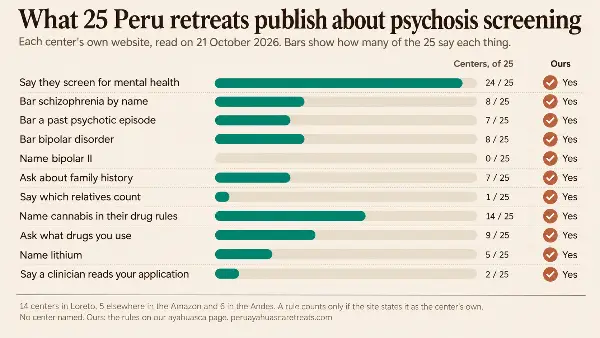
Nearly all of them say they screen for mental health, but few ask about the risks that turned up most in the case record. Of the 25 Peru centers we read in October 2026, 24 said they screen for some mental health condition. Only 7 ask about family history, 9 ask what drugs you use, and 4 ask both.
| What the center’s own site says | Centers, of 25 | Ours |
|---|---|---|
| Bars schizophrenia by name | 8 | Yes |
| Bars a past psychotic episode | 7 | Yes |
| Bars bipolar disorder | 8 | Yes, I and II |
| Names bipolar II | 0 | Yes |
| Asks about family history | 7 | Yes |
| Says which relatives count | 1 | Yes |
| Names cannabis in its drug rules | 14 | Yes, from 3 weeks before |
| Asks what drugs you use | 9 | Yes |
| Names lithium | 5 | Yes, as a stop |
| Says a clinician reads your application | 2 | Yes, a licensed physician |
The gaps sit where the case record is busiest. 14 name cannabis in their drug rules, most often with 2 weeks clear beforehand, but only 9 ask what you use. Only 1 says which relatives count, and none names bipolar II. None says what happens if a guest has a psychiatric crisis.
A rule missing from a website doesn’t mean a center lacks it, but a published page is the part you can check before booking. Our questions to ask any center start there.
Visions Fade By Morning, Psychosis Doesn’t
Ceremony visions are the brew doing what it does, and they end when it wears off. The warning sign is anything that’s still there days later, or getting worse.
Some strangeness afterward is common. In 2022, PLOS Global Public Health published the Global Ayahuasca Survey’s findings on side effects. Of the 7,839 drinkers who completed its mental health questions, 28.5% said they’d heard or seen things others didn’t after their ceremonies, the most common of its 10 effects. 12.9% had more trouble knowing what was real, the least common. For 7 of the 10, most people who had one said it was gone within a week.
Psychosis is different. The US National Institute of Mental Health describes it as some loss of contact with reality. It usually brings delusions, which are false beliefs, and hallucinations, such as hearing voices.
| Common in the first days | Get help the same day |
|---|---|
| Vivid dreams and strong emotions | Hearing voices or seeing things, and believing they’re real |
| Feeling spacey or detached | Fixed beliefs that you’re being watched, chosen, poisoned or sent messages |
| Seeing or hearing things others don’t, while knowing they aren’t real | 2 or more nights in a row with little or no sleep, and energy to spare |
| A short or broken night’s sleep, or wanting time alone | Racing thoughts, fast talk, big plans, or speech that doesn’t make sense |
Pulling away from people and broken sleep are also on the National Institute of Mental Health’s list of early warning signs for psychosis. If anything in the left column gets worse, or hasn’t eased within a week, see a doctor.
What If Symptoms Start During Or After A Retreat?
Act early. During a retreat, tell the staff at once. At home, get medical help the same day rather than waiting it out.
In The Ceremony Room
Psychosis can start before the visions do. In the 2017 review’s weekend-retreat case, a 40-year-old woman turned paranoid and incoherent 10 to 15 minutes after drinking. The brew hadn’t even taken effect. She stayed that way for more than a day. A psychologist at the ceremony suggested an antipsychotic, and it cleared her symptoms within 30 minutes. But they came back after she slept and lasted 2 more days before she reached a hospital. A year later, they hadn’t returned.
Here, our physician stays up until first light every ceremony night and, before each ceremony, checks in with anyone flagged during screening. The maestro sets each dose, and a second cup comes only if you ask for it. We rehearse our emergency protocol every month. A clinic sits 20 minutes from the house, and the hospital we’ve arranged care with is in Cusco, about an hour’s drive.
After You Get Home
If warning signs grow or don’t go away, the National Institute of Mental Health’s advice is to reach out to a health care provider. In a US crisis, the Suicide and Crisis Lifeline answers calls and texts at 988, and 911 is for a life in danger. Elsewhere, use your local emergency number. Tell the doctors what you drank, when, and anything else you took, cannabis included.
We keep up integration calls for 12 months, but a call isn’t emergency care. Our 7 ayahuasca fears post covers the weeks after in more detail.
The published cases of ayahuasca psychosis keep pointing at the same 4 risks: your own history, a relative’s, cannabis and other drugs, and frequent use. It’s rare, and if any of those describes you, say so when you apply. Our ayahuasca page lists who we turn away, and our services page sets out what every week includes.
FAQs
How common is ayahuasca psychosis?
Rare. In 2017, a systematic review counted 8 reports describing psychotic episodes after ayahuasca or DMT, from single cases to case series. 1 Brazilian ayahuasca church logged 13 to 24 cases where the brew may have played a part, against roughly 25,000 servings: 0.052% to 0.096%. The review’s second estimate was lower.
How long does ayahuasca psychosis last?
Longer than the brew, whose effects had worn off by the 4-hour mark in a small 2001 lab study. Where the published cases report an outcome, most people recovered within days to weeks, usually on antipsychotic medicine, though 1 took 2.5 months.
Can ayahuasca cause schizophrenia?
Nobody has shown that it does. A JAMA Psychiatry study of 9.2 million people in Ontario found that 3.99% of those with an emergency visit involving a hallucinogen had a schizophrenia spectrum diagnosis within 3 years, against 0.15% of everyone else. Its codes can’t single out ayahuasca, and its authors say the link isn’t proof of cause.
Is smoked DMT riskier than ayahuasca for psychosis?
No study has compared them directly. By our count of the 2022 review’s case table, 6 of the 13 cases involved DMT rather than the brew, and at least 3 of those were smoked. In 2 of the 3 DMT cases in the 2017 review, the episode seemed linked to using DMT more often or for longer.
Can ayahuasca treat schizophrenia?
No trial has shown that it can. The 2008 safety guidelines for psychedelic research exclude anyone with a current or past diagnosis of schizophrenia, so trials that follow them leave those patients out. We turn away anyone with diagnosed schizophrenia.
How long should you stop cannabis before ayahuasca?
We ask for no cannabis from 3 weeks before the retreat until 1 week after. No study we’ve found sets a safe gap. The rule follows the case record: in a 2022 review of 13 published cases, 9 people had used other drugs, and cannabis came up most often.