Kambo Cleanse: The Hunting Ritual Sold As A Detox
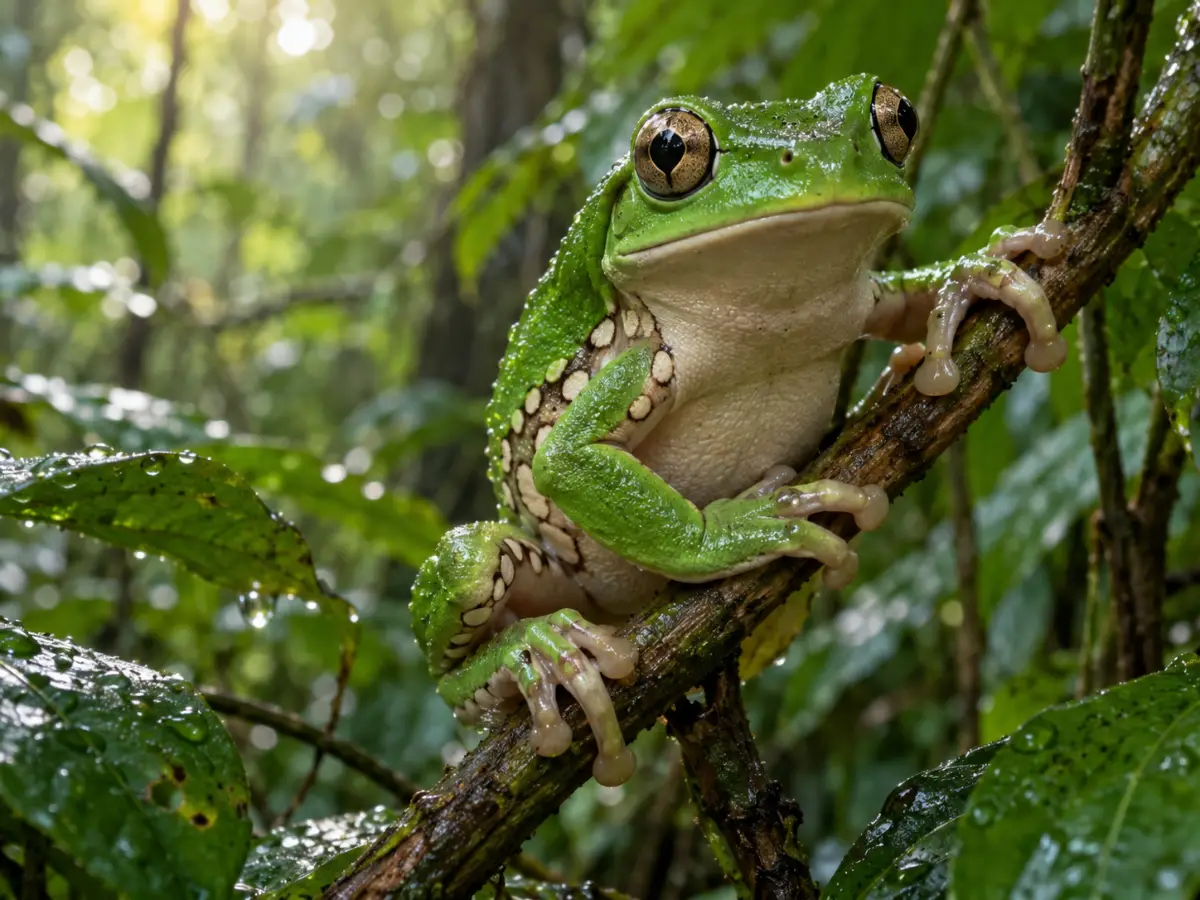
A kambo cleanse doesn’t clean anything that anyone has measured. Kambo is a dried secretion from the giant monkey frog, dabbed onto small burns on the skin. In the largest survey of kambo users we could find, 86.53% vomited and 67.10% felt their heart race. That’s the secretion acting on the gut and the blood vessels. It isn’t toxins leaving the body, and no clinical study has shown that kambo treats anything.
The cleanse isn’t the tradition, either. The Amazon peoples kambo comes from took it to hunt: for stamina, for sharper senses and as a remedy for panema, bad luck in the hunt. The healing and detox pitch grew up after it reached the cities.
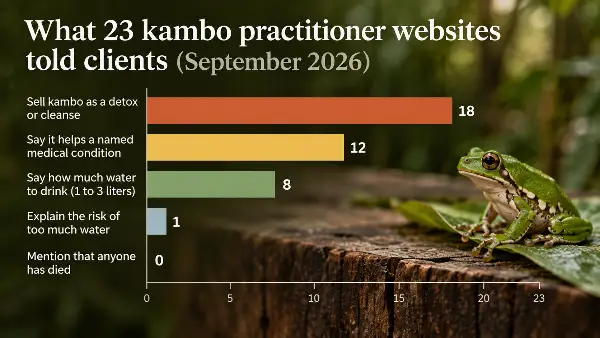
Kambo is an optional part of the week at the retreat we run in Peru’s Sacred Valley, included at no extra charge, and we don’t sell it as a detox. In September 2026 we read the websites of 23 kambo practitioners, and 18 of them sold it as a detox or a cleanse.
What Is A Kambo Cleanse?
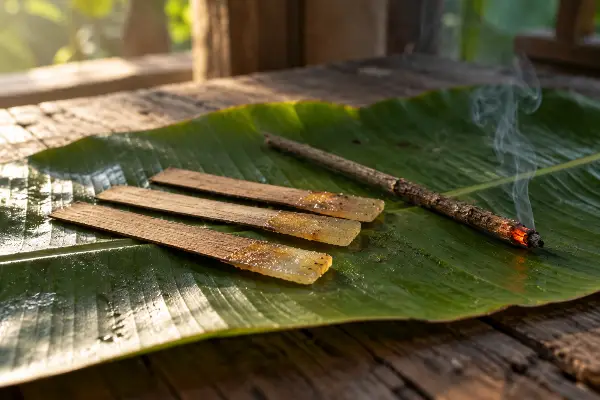
A kambo cleanse is a session in which a practitioner burns small points into the top layer of the skin and dabs on kambo, the dried secretion of Phyllomedusa bicolor, the giant monkey frog. Within minutes most people vomit, flush and feel their heart pound. It’s sold as a detox, and no clinical study backs that claim.
The active part of the secretion is a mix of peptides, small protein fragments that act on the body fast. A 1993 study in the journal Toxicon found that peptides make up as much as 7% of its weight. It describes “violent peripheral gastrointestinal and cardiovascular effects” soon after the secretion goes on. We tell guests to expect 20 to 40 minutes from the first point to the end.
The biggest user survey puts numbers on it. In a 2021 study of 386 users in the Journal of Psychopharmacology, 86.53% vomited, 67.10% felt their heart race and 55.18% had a swollen face. Afterward, 2.85% reported a lasting physical health problem and 1.81% a lasting mental one.
What Does Kambo Cleanse?
Nothing that has been measured. The vomiting is the secretion acting on your gut, and your liver and kidneys clear waste whether or not you take kambo.
The research says so plainly. The authors of the 386-user survey wrote in 2021 that “to date no clinical studies have been carried out with Kambô.” A 2022 review in Frontiers in Pharmacology says its benefits “have not been demonstrated in the literature.” A 2014 review in the Journal of Venomous Animals and Toxins says the claimed healing effect “may be just a placebo effect.”
Most users believe the detox story anyway. The same 2021 survey found that 62.18% named “physical detoxification” as a reason they took kambo.
The people selling it tell the same story. Our review covered 23 kambo practitioner websites, 13 in the US, 6 in the UK and 4 in Bali, read in September 2026 in the order search results listed them. 18 of the 23 say kambo detoxifies, cleanses, purifies or removes toxins, and 4 put detox or cleanse in the business name. 12 say it helps a named medical condition. Addiction comes up on 6 sites, fertility on 5 and cancer on 2.
It Was A Hunting Medicine First
Kambo began as a hunting medicine. The Amazon groups researchers have studied took it for strength, sharper senses and luck in the hunt, and the city version added the cures.
A 1993 study in Toxicon describes the Matsés of northern Peru using the secretion “in shamanic rites mainly designed to improve luck in hunting.” The effects it lists would help any hunter: “increase in physical strength, heightening of senses, resistance to hunger and thirst.”
Across the southwestern Amazon, a 2007 study in the Brazilian journal Campos records the Katukina, Yawanawá and Kaxinawá using kambo as a stimulant for the hunt and against panema, “a condition of bad luck in hunting.” A Kaxinawá man who gives kambo in cities put the change in 1 line: in the villages it’s used for panema, but “in the city it is to cure diseases” (our translation). The same study dates the first sessions in a big city to São Paulo in 1994.
You’ll read that women take kambo on their legs to boost fertility. The body sites are real: among the Katukina, women and older men take it on the calf, and young men on the chest and arms. We found no source that gives fertility as the reason.
It’s a wide tradition. The same 2022 review counts more than 15 native groups that use kambo, across 5 language families. None of the sources we read mention the Shipibo-Konibo, the people our maestros come from, so we don’t present kambo as part of their tradition.

Kambo Cleanse Timeline, 1993 To 2026
The dated record runs from a 1993 study of Matsés hunting rites to a US travel warning issued in September 2026. Read top to bottom, it follows kambo from hunting rites to city sessions to government warnings.
| Year | What happened | Source |
|---|---|---|
| 1993 | The Matsés of northern Peru use kambo in rites “mainly designed to improve luck in hunting” | Toxicon |
| 1994 | The first kambo sessions in a big city, São Paulo | Campos, 2007 |
| 2004 | Brazil’s health regulator, ANVISA, bans the advertising of kambo | Campos, 2007 |
| 2007 | A Kaxinawá practitioner says that in the city, kambo “is to cure diseases” (our translation) | Campos |
| 2021 | 62.18% of 386 users cite physical detoxification as a motive | Journal of Psychopharmacology |
| 2021 | Australia bans the supply and use of kambo from 1 October | Victorian Government health advice |
| 2022 | Low blood sodium is the most common complication in a review of 11 poisoning cases | Toxicology Reports |
| 2023 | New Zealand’s medicines regulator calls it “not an approved medicine” | Medsafe |
| 2025 | “The first documented case of brain death associated with Kambô toxicity” | Cureus |
| 2026 | The US advises travelers in Peru against ayahuasca and kambo, citing “the known dangers” | US State Department, 4 September |
| 2026 | 18 of 23 practitioner websites sell kambo as a detox, and 1 explains the water risk | Our review, September |
The Water Is The Risky Part Of The Cleanse
The water practitioners hand out before a session is the risky part. On top of kambo, liters of it can drop the sodium in your blood to dangerous levels, and the secretion itself may make your body hold on to that water.
Of the 23 practitioner websites we read, 8 told clients how much to drink, and 1 explained why too much is dangerous.
| What the website told clients about water | Websites, of 23 |
|---|---|
| Drink 1 to 3 liters, most often 1.5 to 2 | 8 |
| Bring 3 liters, or a gallon, with no amount to drink | 2 |
| Follow the practitioner’s water rules, with no amount given | 1 |
| Limit fluids in the hours before | 1 |
| No water advice on the pages we read | 11 |
Of the 8 that named an amount, 1 made 2 liters the minimum rather than the maximum. Another capped the total at 4 liters, and it was the only site of the 23 to explain that too much water can dilute the sodium in your blood.
The case reports show why that matters. A 2022 review of 11 poisoning cases in Toxicology Reports found low blood sodium was the most common complication. It came from SIADH, a condition in which the body holds on to water. Where the cases record how much people drank, it was 3.5 to 6 liters. Researchers cited in the review suspect the peptides themselves trigger the water retention, and that drinking makes it worse.
Doctors writing in Cureus in 2025 describe a patient declared brain dead after kambo, the first documented case of its kind. They put the severe low sodium down to “excessive water intake, peptide-induced emesis with sodium loss, and suspected SIADH.”
So the step sold as flushing the body out is the step the case reports tie to low sodium. 2 medically reviewed health pages that rank for this search still say water helps “flush out” toxins. Our rule is roughly 1 liter, measured, and no more. That’s the bottom of the range we found, and it lowers the risk without removing it.
If you’ve had kambo at home and feel worse hours later, with a headache that builds, confusion or vomiting that comes back, treat it as urgent. In the US, call 911, or the Poison Help line at 1-800-222-1222, which is funded by the federal Health Resources and Services Administration and is free and open 24/7.
Has Anyone Died After Kambo?
Yes, though the published record is small. A 2025 systematic review of kambo and sudden death, also in Cureus, flags 2 dangers: sudden cardiac death and a torn esophagus.
A 2018 report in the Journal of Forensic Sciences describes what its authors call “the first forensic case of death associated with Kambo administration.” A 42-year-old man who used kambo regularly was found dead at home, and the autopsy found a thickened heart wall that his medical history hadn’t recorded. With the 2025 brain-death case above, that’s 2 deaths described in detail in the medical literature we read.
None of the 23 practitioner websites we read mentioned that anyone has died.
Kambo loads the heart. That’s why any heart condition or arrhythmia is an automatic no on our kambo clearance list, along with low blood pressure, pregnancy and 4 other conditions.
Kambo Isn’t A Psychedelic, And Australia Has Banned It
Kambo doesn’t work like a psychedelic, and Australia has banned it. Washington still groups it with ayahuasca in its warnings to travelers in Peru.
A 2020 study in Scientific Reports asked 22 users about the experience and found “no psychedelic-type distortions of perception or thinking.” The body’s reaction dominated what they reported.
The US State Department’s Peru travel advisory, issued 4 September 2026, warns US travelers off ayahuasca and kambo, citing “the known dangers.” It lists both among “traditional hallucinogens” and says they’re “often marketed to travelers as ‘ceremonial’ or ‘spiritual cleansers.'” The label doesn’t fit the research. The warning about danger stands. Peru doesn’t license the people who give kambo, so vetting the retreat falls to you.
Other governments have gone further. Australia has banned the supply and use of kambo since 1 October 2021, after its national medicines regulator judged it a danger to health, according to the Victorian Government’s health advice. Brazil’s health regulator banned the advertising of kambo in 2004, and New Zealand’s regulator calls the secretion “not an approved medicine.”
How We Run Kambo In 2026, And Who We Tell To Skip It
Kambo is a separate, optional session in our week, with its own medical clearance. If you want it as a detox, or as a fix for 1 particular problem, we’ll steer you away from it.
Our physician clears kambo on its own list, separate from the list for who shouldn’t drink ayahuasca, and takes your blood pressure again the day before. Your water is measured at roughly 1 liter beforehand. 1 practitioner works with 1 guest, in daylight, on a rest day, with your blood pressure taken before and after.
Our house sits at altitude, where we treat heart strain and dehydration as bigger risks, so we screen harder and cancel on marginal days. We don’t charge for kambo, because a fee would give us a motive to push it.
Leave kambo for a later trip if the ayahuasca ceremonies already make you nervous.
If you came looking for a kambo cleanse to flush something out, it won’t, and the water that comes with it carries a real risk. To try kambo anyway, send your medical file and ask our physician whether you’re cleared.
FAQs
Where did the idea of a kambo cleanse come from?
From cities, not villages. People in the Amazon villages kambo comes from took it for stamina in the hunt and to lift panema, bad luck in hunting, and a 2007 study dates the first city sessions to São Paulo in 1994. By 2021, 62.18% of 386 users in a survey named physical detoxification as a reason they took it.
How much water do practitioners tell you to drink before a kambo cleanse?
It varies, and few explain the risk. Of 23 kambo practitioner websites we read in September 2026, 8 gave an amount, from 1 to 3 liters, and 11 gave no water advice on the pages we read. Only 1 warned that drinking too much can dilute your blood sodium. We cap it at roughly 1 liter, measured.
Has any study shown that kambo works?
No. The team behind the largest user survey wrote in 2021 that no clinical studies had been carried out, and papers in 2014, 2019, 2022 and 2025 found no proven benefit. In that survey 87.31% reported greater well-being, but that’s self-reported by people who chose to take it.
Which peoples use kambo, and what for?
More than 15 native groups in 5 language families use it, according to a 2022 review, including the Matsés, Katukina, Yawanawá and Kaxinawá. The studies we read record 2 uses: stamina and sharper senses for hunting, and lifting panema, bad luck in the hunt.
Is kambo a psychedelic like ayahuasca?
No. A 2020 study of 22 users in Scientific Reports found “no psychedelic-type distortions of perception or thinking,” and users described a mostly physical experience. The US State Department still lists it with ayahuasca among “traditional hallucinogens” and tells US travelers in Peru not to use it.
Is kambo part of Shipibo ayahuasca tradition?
Not in any source we read. The research names Amazon peoples such as the Matsés and Kaxinawá, and none of it mentions the Shipibo-Konibo, whose communities our maestros come from. We offer kambo as a separate, optional session on a rest day, not as part of the maestros’ ceremonies.