What Is A Maloka (Maloca)? Origins, Shape And Size
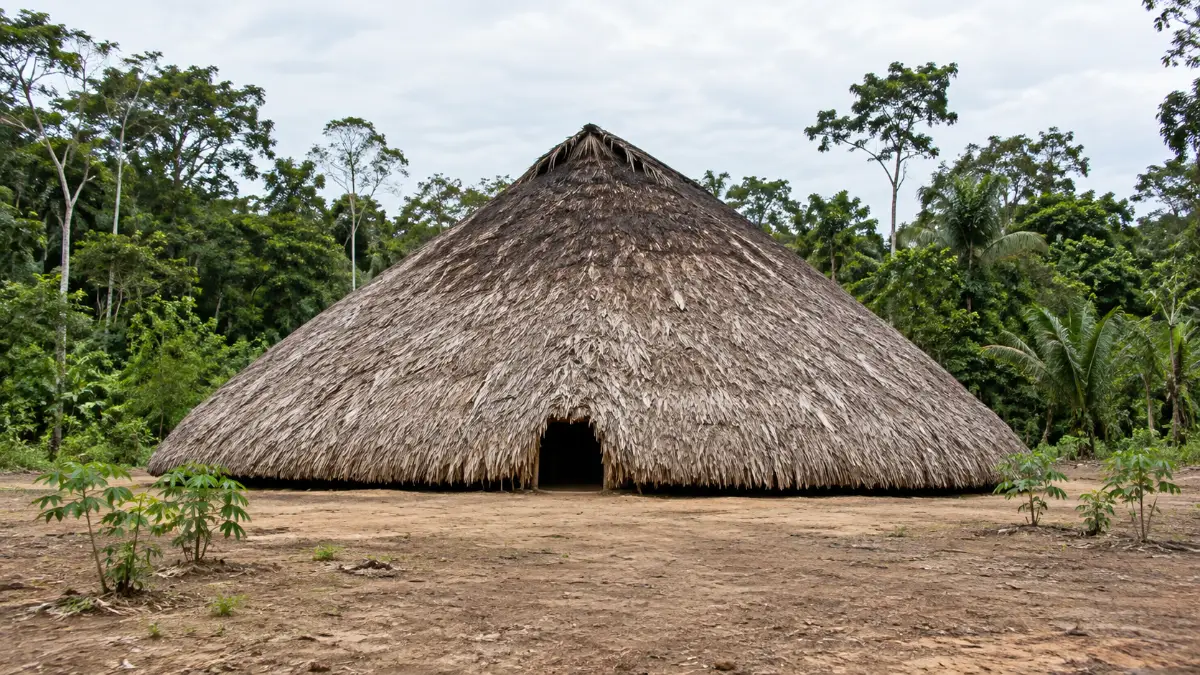
A maloka, more often spelled maloca, is a large communal house built by Indigenous peoples of the Amazon, mostly in Colombia and Brazil. At ayahuasca retreats in Peru, the word now means the ceremony house where you drink. They aren’t the same building. Most of the old houses were closed in and dark inside, and the round ceremony halls at retreat centers spread with tourism after 1986.
Ours stands at the house we opened in July 2026, in Peru’s Sacred Valley, about 2,800 m up. It’s round, with windows and a door, and it holds 12 mats. The valley gets cold at night, and the room stays closed. That puts it closer to the old houses than to the open-sided halls of the lowlands.
What Is A Maloka?
A maloka, or maloca, is a large house built on posts under a palm-thatch roof by Indigenous peoples of the northwest Amazon, mostly in Colombia and Brazil. Each house sheltered a lineage of related families and was also their place for ritual. At ayahuasca retreats, the word means the ceremony house.
How many people shared a house depended on who built it. A 1982 paper on Barasana cosmology, in the Annals of the New York Academy of Sciences, puts 20 to 30 people in each house on Colombia’s Pirá-Paraná river. Among the Makuna, a 2020 study in the Journal of Material Culture puts the recent average at 15 people per house.
The house is also a map of the world. For the Barasana, the roof is the sky, the posts are mountains, and the middle of the floor, kept for men and public ritual, is the center of the world. For the Ufaina, says a 1983 study in the Colombian journal Maguaré, building a maloca means building a model of the cosmos.
Maloka Or Maloca: The Word First Meant A Raid
Maloca is the dictionary spelling, and the word didn’t start in the Amazon. The Royal Spanish Academy traces it to malocán, from Mapudungun, the Mapuche language of Chile and Argentina. Both meanings in its dictionary are raids.
Its house meaning took hold farther north. A dictionary of Latin American Spanish lists it for Colombia and Peru. Portuguese dictionaries mark the word as Brazilian and put an Indigenous house or village first, then slang meanings: a poor shack, a criminals’ hideout. 1 Portuguese dictionary offers a Tupi root as an alternative, and another calls the origin doubtful. By 1852 and 1853, English travelers on the Uaupés river were using the word for the houses there.
Maloka with a k isn’t in the Academy’s dictionary, but it isn’t a retreat invention either. A 1915 English-language account of the Witoto and Boro peoples spells it with a k, so does the 1982 Barasana paper, and so does Bogotá’s science museum, Maloka, which opened in 1998.
The peoples who build these houses have their own words for them. The Makuna say wiri, and Brazil’s Yanomami say yano or xapono. We spell it maloca, like the dictionaries.
Most Old Malocas Were Closed And Dark
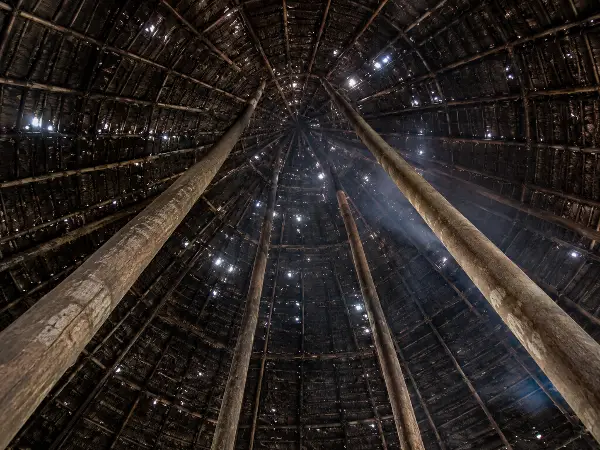
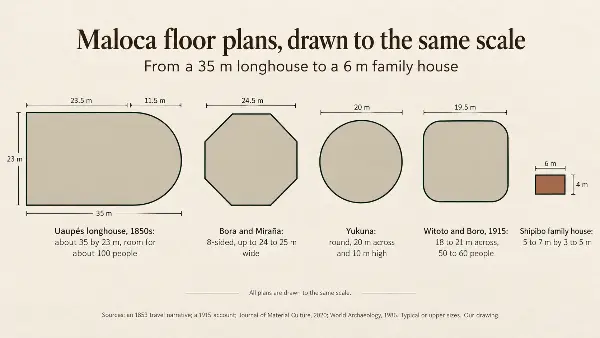
Most accounts of the old houses describe low walls that met the roof, doors kept shut and a dark interior. The shape changed from people to people: round, 8-sided, or long with 1 rounded end.
A 1915 account of the Witoto and Boro, by a British cavalry officer, describes houses 60 to 70 feet across, about 18 to 21 m, and about 30 feet high. The wall stood about 3 feet tall and ran into the roof. The houses had “no windows,” the entrance was “invariably kept closed,” and the interiors were “nearly as dark by day as by night.” 50 to 60 people lived in each, and up to 200 crowded in for a feast.
The Ufaina built round houses on 4 central posts about 10 m tall, the 1983 Maguaré study records. A fence about 1.6 m high ran from the ground to the roof and closed the whole circle. About 50 to 80 people depended on each house.
The 2020 study found a wide range of shapes across the region. Yukuna houses are round, with a 10 m radius and a 10 m height. Bora and Miraña houses stand on an 8-sided base up to 24 to 25 m wide. In the Yukuna, Bora and Miraña designs, the roof comes down to form the wall.
| People and place | Plan | Size | Walls and light | Who lived there | Source |
|---|---|---|---|---|---|
| Witoto and Boro | Rough rectangle or square with rounded corners; round on the lower Apaporis | 18 to 21 m across, about 9 m high | Wall about 1 m, roof down to it, no windows, door kept shut, dark by day | 50 to 60 people, up to 200 at feasts | A 1915 account |
| Peoples of the Uaupés, Brazil | Long, with 1 rounded end | Up to about 35 by 23 m, 8 to 9 m high | Low walls, eaves almost to the ground | Room for about 12 families, near 100 people; 300 to 400 at feasts | An 1853 travel narrative |
| Barasana, Colombia | Not given | Not given | Walls, an earth floor, a men’s door east and a women’s door west | 20 to 30 people | Annals of the New York Academy of Sciences, 1982 |
| Ufaina, Colombia | Round | 4 central posts about 10 m high | A 1.6 m fence closes the circle, ground to roof | 50 to 80 people depend on 1 house | Maguaré, 1983 |
| Yukuna, Colombia | Round | 10 m radius, 10 m high | Roof forms the wall | 3 or 4 brothers and their families | Journal of Material Culture, 2020 |
| Bora and Miraña, Colombia | 8-sided | Up to 24 to 25 m wide | Roof forms the wall | Not given | Journal of Material Culture, 2020 |
| Shipibo, Ucayali, Peru | Family houses | 5 to 7 m by 3 to 5 m, floor raised 50 to 100 cm | Work huts have no walls | 1 family per house | World Archaeology, 1986 |
| Retreat malocas, Peru, 1990s on | Usually round | Varies | Varies | Guests on mattresses in a circle | Durham University thesis, 2024 |
Ayahuasca Was Drunk In Some Malocas, Not All
Some peoples who built malocas drank ayahuasca in them, and others didn’t drink it at all.
In November 1852, an English botanist went to a feast in a maloca above the first falls of the Uaupés, a river that runs from Colombia into Brazil. Through the night, he wrote, the young men drank caapi, the vine, 5 or 6 times between dances, and no woman could touch it. An 1853 travel narrative from the same river describes a pot of it set down in the middle of the house during a feast.
The Ufaina are an exception. The 1983 study lists “no tomar caapi,” not drinking the vine, among the traits that set them apart from their Eastern Tukano neighbors. Their rituals in the maloca use coca and tobacco.
So the house came first, and for some of its builders, ayahuasca was 1 of the rituals held inside it.
Did The Shipibo Build Malocas For Ceremony?
Not in any source we found. Shipibo families lived in small raised houses, and healers worked in their own homes.
Shipibo family houses ran 5 to 7 m long and 3 to 5 m wide, with floors raised 50 to 100 cm off the ground, a 1986 study in World Archaeology records. Smaller work huts had neither walls nor floors. The study reads these houses as what’s left of an older communal house, also called a maloca, that held extended families. That was a home, not a ceremony hall.
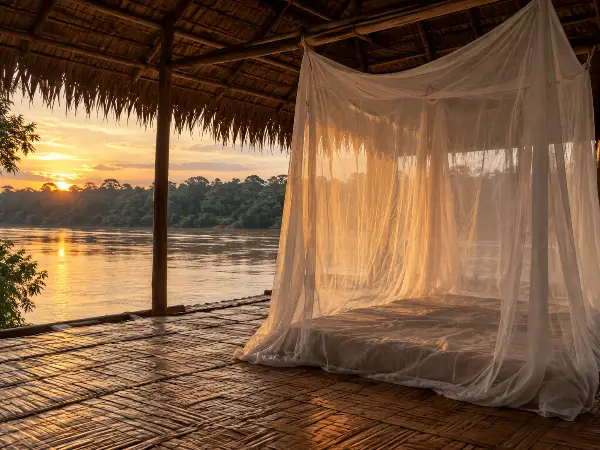
Sessions happened at home too. A 2011 book chapter on the history of ayahuasca use describes the common picture: the healer stayed inside a mosquito net while patients and onlookers sat outside, and only the healer drank. A Shipibo healer told 1 researcher that each healer works in their own house, with a small group (Anthropologica, 2025).
The maestros who sing in our maloca come from Shipibo villages along the Ucayali, and they travel up to a Quechua valley to work. The round room isn’t a Shipibo design, and we don’t market it as one.
How The Round Retreat Maloca Took Over
Round ceremony halls spread with ayahuasca tourism, which took off near Iquitos in the late 1980s. A 2024 Durham University thesis describes the retreat maloca as a ceremonial house imagined as traditional, usually round and inspired by the collective houses of the northern and central Amazon.
| When | What the record shows | Source |
|---|---|---|
| 1852 | Caapi served at a feast inside a maloca on the Uaupés | An English botanist’s notes, published 1908 |
| 1970 | Iquitos healers hold sessions “in jungle clearings at the edge of the city,” where patients drink too | Economic Botany, 1970 |
| 1986 | Months after a journalist’s cover story on ayahuasca, ecolodges near Iquitos start offering ceremonies | Cambridge MPhil dissertation, 2015 |
| 1990s | “Ceremonies” becomes the word for sessions held for visitors | Frontiers in Psychology, 2021 |
| 2000s | Purpose-built ayahuasca retreats appear | Cambridge MPhil dissertation, 2015 |
| 2024 | A doctoral thesis describes the retreat maloca as a house imagined as traditional, usually round | Durham University, 2024 |
Open sides suit the lowlands, where nights stay warm and the air needs to move. They aren’t a rule handed down from the old houses, which mostly kept the night out.
You’ll read on retreat websites that a maloca must be open to the forest, or that its round shape holds energy. We haven’t seen either claim come with a source, and the houses the word first named don’t back the first one.
Our Maloca At 2,800 m, Closed For The Night (2026)
Ours is a round room for 12 mats, with windows and a door, and it stays closed through the ceremony, which matters at this altitude.
We’re at about 2,800 m. At SENAMHI’s weather station in Urubamba, 2,863 m up the same valley, June to August nights averaged a low of 2.4°C from 1965 to 2000, Peru’s national weather service reports. Lows bottom out in July.
So the room is ready for a cold night: the mats lie with space between them, and each gets a blanket and a lined bucket. You hand in your phone before the cup, which comes around 9 pm. About 40 minutes later, the candles go out.
2 Shipibo maestros sing through the night to a room of up to 12 guests. Our physician stays up all night in the room, with oxygen and a defibrillator close by. The closing song ends near 5:30 am, and then the room is opened. You can hear the river from inside.
We walk through a ceremony night in a separate guide.
What Should You Ask About A Retreat’s Maloca?
Ask about the room at 3 am, when you’ll be lying in it. 5 questions cover what matters:
- Is it closed at night, and how cold does it get by morning?
- How far is the bathroom, and who walks you there in the dark?
- Who stays awake in the room all night, and what do they keep on hand?
- How many mats are there, and how much space is between them?
- If they call it Shipibo, traditional or ancient, who built it, and when?
A handsome maloca isn’t a safety plan. The risks that matter more sit with the people in the room.
Whatever a retreat calls its maloka, judge the room by the night it gives you. If you’re choosing a retreat in Peru, send each center these 5 questions in writing. The maloca is where you’ll spend 4 nights, and you can see the rest of the week before you apply.
FAQs
What does maloka mean?
Maloka is another spelling of maloca, a large communal house of Indigenous peoples in the Colombian and Brazilian Amazon. The Royal Spanish Academy traces the word to Mapudungun, a language of Chile and Argentina, and its dictionary lists only raid meanings. At ayahuasca retreats, a maloka is the ceremony house.
What is a maloka used for at an ayahuasca retreat?
It’s the room where ceremonies happen. Guests lie on mats around the room while the healers sing through the night. In ours, 12 mats are set with space between them, each with a blanket and a lined bucket, and our physician stays up through the night in the room.
Did the Shipibo build malocas?
Not as ceremony halls, in any source we found. A 1986 study describes Shipibo family houses 5 to 7 m long and 3 to 5 m wide, with floors raised 50 to 100 cm, and an older communal house that held extended families. Healers worked in their own homes.
How big is a maloca?
It depends on who built it. A 1915 account gives Witoto and Boro houses 18 to 21 m across and about 9 m high, home to 50 to 60 people. A 2020 study puts Yukuna houses at a 10 m radius and 10 m high.
Are all malocas round?
No. Peoples of the Uaupés built long houses with 1 rounded end, Bora and Miraña houses sit on an 8-sided base, and Yukuna and Ufaina houses are round. Retreat malocas are usually round, a design a 2024 thesis traces to collective houses of the northern and central Amazon.
Were malocas open-sided?
The old ones mostly weren’t. A 1915 account describes walls about 1 m high that met the roof, no windows and a door kept shut, with the inside nearly as dark by day as by night. Open-sided halls came later, with the retreats.