Altitude Sickness In Peru: What Cusco’s Numbers Say
Altitude sickness in Peru is common. In 3 studies of travelers in Cusco, 37% to 48.5% got it, usually as a headache with nausea, tiredness or dizziness in the first 2 days. Fitness won’t protect you. What helps is sleeping lower than Cusco for your first nights, skipping alcohol for 48 hours and, for some travelers, a prescription drug called acetazolamide.
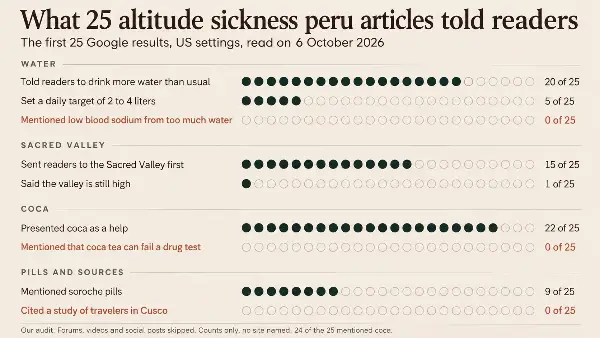
The usual advice is to start in the Sacred Valley because it’s lower. It is, by about 430 to 600 m. But every valley town still sits above the CDC’s line for a first night’s sleep. On 6 October 2026 we read the first 25 articles Google showed for this search. 15 sent readers to the valley first, and 1 said the valley is still high. None cited a study of travelers in Cusco.
We run a retreat at altitude on the Sacred Valley floor, about 2,800 m up, so our own beds sit above that line too. We plan every guest’s first 2 days around it.
What Is Altitude Sickness In Peru?
Altitude sickness in Peru, called soroche, is acute mountain sickness: a hangover-like headache with nausea, tiredness, dizziness or poor appetite. It can hit anyone who hasn’t adjusted and sleeps at 2,450 m or higher (and sometimes lower), usually within 2 to 12 hours of arriving. Cusco sits at 3,399 m. Most cases pass in 1 to 3 days.
Cusco’s air holds the same 21% oxygen as Lima’s, at lower pressure, so each breath pulls in less. At about 3,050 m, the oxygen pressure you breathe in is only 69% of the sea-level figure, according to the CDC’s chapter on high-altitude travel. Your body answers by breathing more, and that takes days.
How Common Is Altitude Sickness In Cusco?
About 2 in 5 travelers get it, going by 3 published studies in Cusco, with rates from 37% to 48.5%.
| Study | Who took part | Got altitude sickness | Also found |
|---|---|---|---|
| Journal of Travel Medicine, 2012 | 991 travelers at Cusco’s airport, June 2010 | 48.5%, and 17.1% had a severe case | 1 in 5 who got it changed their travel plans |
| Travel Medicine and Infectious Disease, 2020 | 1,274 travelers leaving Cusco’s airport, 2017 | 37% in their first 2 days | 38% of those cases were moderate to severe |
| Journal of Travel Medicine, 2022 | 142 language students in Cusco | 39% | Drinking coca tea didn’t lower the risk |
That’s well above the CDC’s figure for Colorado: about 25% of visitors who sleep above 2,450 m there get it.
Only 29.1% of travelers in the 2012 airport survey got altitude advice from a doctor. Among those who got sick in the 2020 study, 69% drank coca tea to treat it and 24% took acetazolamide.
Being Fit Won’t Protect You
Your training doesn’t change your odds. The CDC’s chapter says “training and physical fitness do not affect risk” and “children are as susceptible as adults,” while people over 50 have slightly less risk.
The Cusco studies point to other factors. The 2020 study found higher odds in younger travelers, women and people who hadn’t visited a city above 2,500 m before Cusco. The 2022 study linked obesity and female sex to higher risk. Read those 2 with care: the 2022 group was 142 language students with a median age of 21, and the CDC says a traveler’s sex “plays a minimal role, if any.”
Some people need a doctor’s view before booking anything in the Andes. The CDC names coronary artery disease, any chronic lung disease, obstructive sleep apnea and sickle cell trait, even when they’re well controlled. It also says doctors might advise pregnant women not to sleep above 3,050 m, which would rule out a night in Cusco, and it lists a high-risk pregnancy as a reason not to go. If you’re planning a retreat and 1 of those applies, put the medical setup at the top of your list when you weigh retreat centers.
The First-Night Map: Peru’s Stops On The CDC’s Lines
The CDC draws 3 altitude lines for where you sleep: 1 in its chapter text and 2 in its risk table. Every Sacred Valley town sits above the middle one, in the same band as Cusco.
- 2,450 m: from this sleeping altitude up, and sometimes lower, any traveler who hasn’t adjusted is at risk.
- 2,750 m: the table’s line between low and medium risk for a first night. Separately, the CDC advises against going from below 1,200 m to a bed above it in 1 day.
- 3,400 m: a first night above this puts you in the table’s high band.
The table below assumes you start below 1,200 m. Its last column uses only the CDC’s first-night row, though the CDC also weighs past altitude illness and how fast you climb.
| Stop | Altitude | CDC lines crossed on night 1 | CDC band for a first night |
|---|---|---|---|
| Lima | Near sea level | None | Low |
| Aguas Calientes, the town below Machu Picchu | About 2,040 to 2,060 m | None | Low |
| Machu Picchu citadel | 2,430 m | Day visit | Not a night stop |
| Ollantaytambo | 2,846 m, often listed as 2,792 m | 2,450 and 2,750 | Medium |
| Our house, on the valley floor | About 2,800 m | 2,450 and 2,750 | Medium |
| Urubamba | 2,871 m | 2,450 and 2,750 | Medium |
| Calca | 2,928 m | 2,450 and 2,750 | Medium |
| Pisac | 2,972 m | 2,450 and 2,750 | Medium |
| Cusco airport | 3,310 m | Where you land | Not a night stop |
| Cusco | 3,399 m, or about 3,350 m in the CDC’s chapter | 2,450 and 2,750 | Medium, at the top of the band |
| Puno, on Lake Titicaca | 3,810 m at the lake’s surface | All 3 | High |
| Rainbow Mountain (Vinicunca) | 5,200 m at the top | Day hike | Not a night stop |
Town altitudes come from INEI, Peru’s statistics office, plus the lower figures travel sources give for Ollantaytambo and Aguas Calientes. The airport figure is CORPAC’s, the citadel’s is UNESCO’s, the lake’s is Britannica’s and Vinicunca’s is from Andina, Peru’s state news agency.
On that row, every common first night from Ollantaytambo to Cusco lands in the medium band, ours included. The valley is lower than Cusco. It still isn’t low. 1 article we read called it “low altitude,” and 2 more put it below 2,750 m with the wrong figures.
The valley still helps. Cusco and La Paz are the CDC’s examples of places where travelers can sleep below the airport’s altitude for 1 to 2 nights, “perhaps obviating the need for medication.” A step it calls “markedly protective” is at least 2 to 3 nights at roughly 2,450 to 2,750 m before you go higher. No stop in the table sits squarely in that range: Aguas Calientes is below it, and Ollantaytambo is 42 to 96 m above its top.
Once you land in Cusco, only Aguas Calientes gives you a first night under 2,450 m. It means a drive to Ollantaytambo and a train down the gorge that day.
Whatever you pick, the CDC says to skip alcohol for your first 48 hours at altitude. Its checklist for travelers also says daily coffee drinkers should keep drinking it, so a withdrawal headache isn’t confused with an altitude headache.
Save Lake Titicaca for after Cusco, since a first night in Puno puts you in the high band. Rainbow Mountain tops out about 1,800 m above Cusco, so leave it for late in the trip. When you compare Andean retreats, ask how high the house sits and how many days you get before the first cup. Both are on our pre-booking checklist.
What Does Altitude Sickness Feel Like, And When Should You Go Down?
Like a hangover, the CDC says: a headache, usually with nausea, tiredness, dizziness or no appetite. Go down if it gets worse, and go down now, with medical help, if you’re confused, stumbling or short of breath at rest.
Symptoms usually show up 2 to 12 hours into your stay, often during or after the first night. They clear in 12 to 48 hours for most people who don’t climb higher. A drop of 300 m or more brings fast relief, and from Cusco the valley floor is 430 to 600 m lower.
| Form | Signs | What to do |
|---|---|---|
| Acute mountain sickness (AMS), the common form | Headache, often with nausea, tiredness or dizziness | Rest, and don’t sleep any higher. Go down if it gets worse |
| HACE, swelling of the brain | Confusion, poor balance and drowsiness, like being drunk | Go down now and get medical help. Coma “can ensue within 24 hours of onset,” the CDC warns |
| HAPE, fluid in the lungs | Cough, chest congestion and breathlessness out of proportion to effort, later even at rest | Go down now and get medical help. The CDC calls descent “urgent and mandatory” in most cases |
HACE and HAPE are rare. HAPE runs at roughly 1 per 10,000 skiers in Colorado, the CDC says, and as high as 1 per 100 travelers above 4,300 m. Descent remains the single best treatment for all 3 forms, the Wilderness Medical Society says.
Forcing 3 To 4 Liters A Day Has Never Been Shown To Prevent It
There’s no evidence that forcing water prevents altitude sickness, and it carries a risk. The Wilderness Medical Society’s 2024 altitude guidelines say forced hydration has “never been shown to prevent altitude illness and might increase the risk of hyponatremia,” which is low blood sodium.
Most advice says the opposite. 20 of the 25 articles in our audit told readers to drink more water than usual. 5 set a daily target of 2 to 4 liters, and none mentioned the sodium risk. On 6 October 2026, Google’s AI Overview for this search said to “hydrate aggressively” with 3 to 4 liters a day.
The same guidelines say staying hydrated matters “because symptoms of dehydration can mimic those of AMS.” So drink enough to stay hydrated, more on a hiking day, and stop there. Low blood sodium from too much water is the same risk we flagged in our kambo cleanse review.
Do You Need Altitude Sickness Pills For Peru?
Some travelers do, and a doctor who knows your history should decide. Acetazolamide, best known by the brand name Diamox, is what the Wilderness Medical Society calls “the preferred medication.” Its 2024 guidelines say it should be “strongly considered” for travelers at moderate or high risk, using the society’s own risk scale.
In its paragraph on Cusco, the CDC puts illness rates after flights straight to destinations above 3,400 m “approaching 50%” and advises “a low threshold for chemoprophylaxis,” meaning preventive medicine. In the medium band, where every first night from Ollantaytambo to Cusco lands, it says acetazolamide “would be beneficial; consider its use.” A past case of HAPE or HACE puts you in the high band, where the CDC says to “strongly encourage” it.
Travelers who took acetazolamide in the 2022 Cusco study had 87% lower odds of altitude sickness. The FDA label covers preventing acute mountain sickness in climbers making a rapid ascent and in people who get it despite a gradual ascent.
For prevention, the CDC’s dose is 125 mg every 12 hours, “beginning the day before ascent and continuing the first two days at altitude, and longer if ascent continues.” If your doctor prescribes it for a Peru trip, that means starting the day before your flight up from Lima. It’s prescription only in the US.
Common side effects are tingling in the fingers, toes or face, and fizzy drinks that taste odd.
For people who can’t or don’t want to take acetazolamide, the Wilderness Medical Society suggests ibuprofen, a weak recommendation. At 600 mg every 8 hours, the CDC says, it helps prevent altitude sickness, “although not quite as effectively as acetazolamide.” Ask your doctor whether it’s safe for you.
9 of the 25 pages we read mentioned soroche pills from Peruvian pharmacies. Neither the CDC chapter nor the 2024 guidelines mention them, and we couldn’t find an official ingredient record to check. Read the box: ácido acetilsalicílico means aspirin, and the FDA label for acetazolamide advises caution with high-dose aspirin.
Retreat guests should list acetazolamide on the medical form like any other drug. Our physician reads every medication before offering you a place, and anything you take during the week is agreed with the physician first. We looked for a published study of acetazolamide taken during an ayahuasca week and found none, which is why it’s the physician’s call.
Coca Tea Didn’t Lower The Risk In Cusco
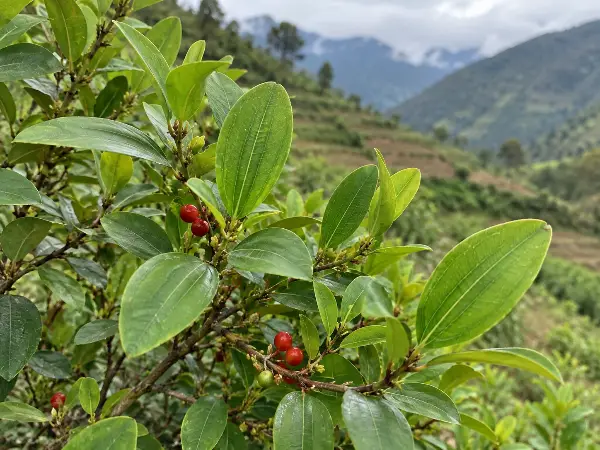
Coca tea hasn’t been shown to prevent altitude sickness. Drinking it for prevention “did not decrease the risk of AMS” in the 2022 Cusco study, and the Wilderness Medical Society says coca’s value for prevention “has not been properly studied.”
In 2010, 62.8% of travelers surveyed at Cusco’s airport used coca products for prevention, against 16.6% for acetazolamide, almost 4 to 1. Acetazolamide went with less altitude sickness and coca with more. A survey like this shows a link but can’t show cause. 22 of the 24 audit articles that mentioned coca presented it as a help.
It has 2 catches. A cup can make you fail a drug test: in a 2005 report in the British Journal of Sports Medicine, every urine sample taken in the 24 hours after 1 cup of 250 ml tested positive for a cocaine breakdown product. None of the 25 mentioned that. And coca leaf is a Schedule II controlled substance under US federal law, so leave the leaves and tea bags in Peru.
Our dieta tapers coffee over the weeks before you fly instead of stopping it cold, so you don’t arrive with a withdrawal headache. During the week, coca tea takes its place, and it’s on the day-2 schedule. Drink it if you like it, and skip it if you’re drug tested at work.
Oxygen Helps, But A Can Won’t Last
Bottled oxygen eases altitude sickness. Oxygen at 1 to 2 liters a minute “will improve headache within about 30 minutes,” the CDC says.
The small cans sold to travelers hold “5 L at most,” in the CDC’s words, too little for lasting relief. At 1 to 2 liters a minute, that’s 2.5 to 5 minutes of oxygen.
We keep oxygen at the house, along with a defibrillator, and a physician stays on site every night.
Your First 2 Days In The Sacred Valley, Planned For Altitude (2026)
Both days are for adjusting, with no ceremony. Our house sits at about 2,800 m, in the CDC’s medium band like Cusco.
We ask guests to land in Cusco 2 full days or more before the first ceremony. Our airport transfer drives you about 90 minutes down to the valley the day you land. Day 1 is intake with our physician and an early night. On day 2 you walk on the valley floor, and we check your blood pressure and resting pulse. If the altitude is still getting to you, we’d rather find out on day 2 than at 9 pm on a ceremony night.
The dieta already rules out alcohol before and during the week, which covers the CDC’s first 48 hours. Our physician reads your heart and lung history with the altitude in mind, and it can rule this house out. For guests it rules out, a retreat in the Amazon lowlands avoids altitude altogether.
A ceremony night adds a fast, purging and a sleepless night, so we keep altitude and the first cup apart. What to expect walks through the rest of the week.
Fly into Cusco and your odds of altitude sickness in Peru are about 2 in 5, though most cases pass in 1 to 3 days. Choose your first bed with the map above, stay hydrated without forcing liters, skip alcohol for 48 hours and ask a doctor about acetazolamide before you fly. If you’re coming for a retreat, see what the week includes and send your medical history with your application.
FAQs
Is altitude sickness in Peru dangerous?
Usually not. Most cases feel like a hangover and are gone within 1 to 3 days. The 2 dangerous forms, HAPE in the lungs and HACE in the brain, are rare: the CDC puts HAPE at roughly 1 per 10,000 skiers in Colorado. Confusion, stumbling or breathlessness at rest mean go down and get medical care right away.
How long does altitude sickness in Peru last?
It usually starts 2 to 12 hours after you arrive and lasts 1 to 3 days, according to the CDC. If you don’t go any higher, most cases clear in 12 to 48 hours. If symptoms get worse instead, go down: a drop of 300 m or more brings fast relief.
Is Machu Picchu bad for altitude sickness?
Not by itself: the risk on a Machu Picchu trip comes from Cusco and the valley on the way. The citadel is at 2,430 m, almost 1,000 m below Cusco, and Aguas Calientes, the town below it, sits at about 2,040 to 2,060 m. That’s under the 2,450 m line where the CDC says risk usually starts.
Can you get altitude sickness in Lima?
No. Lima sits near sea level on the coast, far below the CDC’s 2,450 m line. The risk starts when you fly to Cusco, whose airport is at 3,310 m, or travel to Lake Titicaca at 3,810 m.
Can coca tea make you fail a drug test?
Yes. In a 2005 report in the British Journal of Sports Medicine, every urine sample taken within 24 hours of 1 cup of coca tea (250 ml) tested positive for a cocaine breakdown product. Coca leaf is also a Schedule II controlled substance in the US, so don’t bring leaves or tea bags home.
Should you drink extra water to prevent altitude sickness?
No. The 2024 Wilderness Medical Society guidelines say forced hydration hasn’t been shown to prevent altitude illness and might raise the risk of low blood sodium. Stay hydrated, since dehydration can feel like altitude sickness, but skip the 3 to 4 liter targets.