Fake Ayahuasca Shamans: How To Spot One

A fake ayahuasca shaman is someone who serves the brew on the strength of a teacher, a training or a lineage they can’t show you. You can test those claims before you pay by checking 5 things: where the healer says they’re from, who taught them, who pours the cup, how they’re paid, and how they talk about touch and secrecy. Each one takes minutes.
A real lineage doesn’t make a healer safe, though. A 2020 journal paper on sexual abuse in ayahuasca settings describes abuse by local healers and foreign ones alike. So this page gives you 2 tests: 1 for the tradition and 1 for the room.
I run a retreat center in Peru’s Sacred Valley. I’m not a shaman, and I don’t serve the medicine.
What Is A Fake Ayahuasca Shaman?
A fake ayahuasca shaman is anyone who serves ayahuasca while claiming a training, a teacher or a lineage that falls apart when you check it. The label has nothing to do with where someone was born. It covers a foreigner who started pouring after their own first retreat, and a local who invents a family line for the website.
Nobody checks those claims for you. The US State Department tells US travelers not to consume ayahuasca in Peru, and notes that the Peruvian government doesn’t regulate the groups that offer it. In practice, anyone can call themselves a shaman or a maestro. Both kinds of fake make a claim that won’t survive a phone call.
That’s why the claim is the thing to test. When a retreat says its healers are Shipibo, it’s naming a people with a known home. Peru’s Ministry of Culture estimates that 32,964 people live in Shipibo-Konibo communities, in the regions of Ucayali, Loreto, Huánuco and Madre de Dios. A claim about 1 of those communities can be checked. A claim about “the Amazon” can’t.
Why “Real Or Fake” Is The Wrong Safety Test
A real healer can still be the danger in the room. Lineage tells you which tradition you’re buying. What happens if someone crosses a line at 2am depends on everything around the healer.
The clearest statement of this is a 2020 paper in the Journal of Psychedelic Studies by 4 researchers, about the Chacruna Institute’s guide to sexual abuse in ayahuasca settings. The authors write that sexual abuse of women in the ayahuasca community “occurs across and within cultures,” and that most cases involve “female participants and male shamans.” “Many ayahuasqueros, both local and non-local,” they add, can use “their idealized position to manipulate others for their own personal sexual gratification.”
The guide, reproduced in the paper, is blunter: “South American women are also sexually abused by South American healers and Western women by Western healers.” It also says “there are many healers, religious leaders, and facilitators working with ayahuasca with great integrity.” It holds both statements at once. A checklist that only asks whether a healer is authentic can’t tell those 2 groups apart.
So run 2 tests. The lineage test asks whether this person is who they say they are. The structure test asks what stops anyone from hurting you: who else is awake in the room, who has read your medical file, what the touch rule is, and how the healer is paid.
We built our week around those 2 things: the lineage in the ceremony room, and a medical standard that starts with a physician reading every application before we offer a place. I’d rather you checked both than took either on faith.
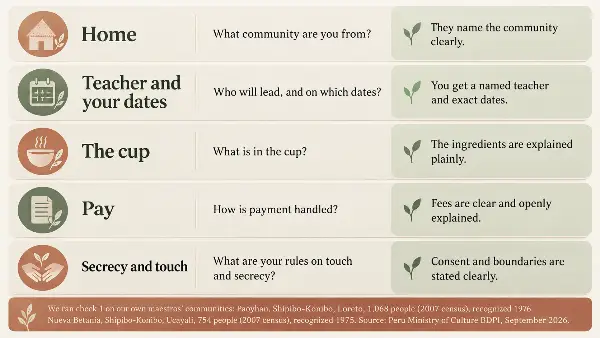
5 Checks You Can Run Before You Pay
Each check is a question to ask on a call, with the answer you want to hear and the one that should worry you. Run all 5 on any center, ours included.
| Check | Ask this | A good sign | A warning sign |
|---|---|---|---|
| Home | Where is the maestro from, and who are their people? | A named community or town, with its river or region | “The Amazon,” or “Shipibo” with no place attached |
| Teacher and your dates | Who taught them, and who will sit in my week? | A teacher’s name, plus the healers for your dates in writing | “Our experienced shamans,” or names that change after you pay |
| The cup | Who holds the cup and decides my dose? | The maestro, with a brew of vine and chacruna | The owner, “whoever leads tonight,” or a secret recipe |
| Pay | Is the maestro paid per night or per week? | A set fee that doesn’t move with the number of guests | Per head, per ceremony, or no answer at all |
| Secrecy and touch | What happens if a healer wants to work with me alone? | A plain answer on where and when, a companion allowed, and consent asked before every touch | A “special” healing that must be private or secret, or talk of love magic |
The second check matters more than it looks. A named list of healers on a website tells you who a center works with. It doesn’t tell you who will sit with you. Ask for the names on your dates, in writing, before any money moves. It sharpens the last question on our list of 17, and in my view it’s the fastest way to expose a rotating cast.
On the cup, ask whether anything goes in besides vine and chacruna. If a healer adds toé, which comes from Brugmansia, you want to know before you drink. In our own week the rule is that the maestros serve every cup and decide every dose. I don’t touch either.
How Do You Check A Shaman’s Community From Home?
Look the community up in a free public database run by Peru’s Ministry of Culture. A search takes about 2 minutes.
- Ask the center for the maestro’s home community or town, spelled out.
- Search that name in the ministry’s database of indigenous peoples, known as the BDPI.
- Read the entry. It shows which people the community belongs to, its district, its population in the 2007 census, and the date the state recognized it.
- Check that the people named in the entry match the claim. A maestro sold as Shipibo should trace back to a Shipibo-Konibo community.
The database lists Shipibo-Konibo communities in 4 regions, and none of them is Cusco. A Shipibo maestro working in the Sacred Valley has traveled there to work, and an honest center tells you that up front. A Shipibo ceremony held in the Andes is no less real for it, which we explain in our Sacred Valley comparison.
Know what the check can’t do. It proves the place exists and belongs to the people the center named. It doesn’t prove the maestro was born there, trained there or is the person in the photo. And a real healer can fail it. The ministry’s page on the Shipibo-Konibo notes large settlements in Lima going back decades, including Cantagallo, and a mestizo healer’s line runs through a teacher, not a community. In every case, the teacher’s name does the work the database can’t.
Peru’s 2008 heritage declaration names the traditional knowledge and use of ayahuasca by Amazonian native communities as national cultural heritage. It sets no test for any single healer. Still, if a center claims an indigenous lineage, the claim should lead back to a community or town you can name.
We Looked Up Our Maestros’ Communities In 2026
The database lists the 2 communities our maestros come from. The entries read like this, with the region added.
| Community | People | District | Region | Population (2007 census) | Recognized |
|---|---|---|---|---|---|
| Paoyhan | Shipibo-Konibo | Padre Márquez | Loreto | 1,068 | 1976 |
| Nueva Betania | Shipibo-Konibo | Callería | Ucayali | 754 | 1975 |
You can open Paoyhan’s entry and confirm it yourself. The entries name the district only. Padre Márquez sits in Ucayali province, inside the Loreto region, so you’ll see Paoyhan described both ways. The state has recognized each of them as a native community for about 50 years.
That’s the whole claim this check supports, and I’d be wary of any center that stretched it further. It confirms the places we named are real Shipibo-Konibo communities, and nothing about our maestros as people.
Can A Westerner Become An Ayahuasca Shaman?
Some do, after long training under a named teacher who still vouches for them. The fake version is someone who drank at a retreat, felt called, and started pouring for others without a teacher who’d say they’re ready.
My rule of thumb: drinking ayahuasca 50 times doesn’t make you a facilitator, any more than flying 50 times makes you a pilot.
The Chacruna guide names the pattern that worries me more than anyone’s nationality: “Some South American, and indeed Western, men have learned to take advantage of some of these exalted images of healers.” The costume is the risk, whoever wears it.
The same risk is why I don’t serve the medicine at our house. I own the business. A guest shouldn’t have to wonder whether the person holding their cup learned from a teacher or from a podcast.
Ask any Western practitioner 2 things. Who taught them, by name and place. And whether that teacher would say they’re ready to serve alone. A real one answers both without a pause.

Per Night Or Per Week: Why The Pay Model Matters
How a healer is paid tells you what the business rewards. Pay per head or per ceremony, and the reward is a fuller room and more nights of drinking.
A healer paid by the night can still be excellent. You should still know what the business rewards before you drink in its room.
Our maestros are paid a fee per week. The fee is the same whether 4 guests come or 12, and their travel and time away from home are paid on top. We publish this on our site so you can hold us to it.
Ask any center the same question. If the answer is that the healer gets a share of what you pay, ask how big the share is and who else takes one.
What Misconduct Sounds Like Before It Happens
Most of the warning signs in the guide are things a healer says before anything physical happens. The paper’s authors write that “many reported cases suggest” women are often invited by healers for “special” healing experiences, then “manipulated or forced into sexual acts.” They name individual healings, called sopladas or limpiezas, as a common setting, where guests may not know what normal touch and nudity look like.
The guide is fair to healers here. It says an individual healing “can be very beneficial,” and that “you are free to interrupt or decline any treatment.” It also suggests asking “another participant or a trusted companion to be with you during any such treatment.”
Here are the lines it tells you to listen for:
- A healer who promotes “tantric” exercises and sexual contact that “they claim can heal someone from past traumatic experiences.”
- One who “encourages pacts of silence and secrecy between you,” or “says he wants to teach you love magic.”
- Any request to undress. Curaciones, sopladas and limpiezas “do not require you to remove your clothes,” and “It is certainly not necessary for you to be naked.” In certain Colombian yagé traditions guests are usually asked to take off their shirt for a limpieza, “but it is normal for bras or camisoles to be kept on,” and the same holds for plant baths.
- Touch you didn’t agree to. “It is not necessary for healers to touch intimate parts of your body or any area to which you do not consent.”
One line in it is worth reading twice: “consensual sex may still involve an imbalance and abuse of power.” A healer holds your dose, your night and your trust. A yes given in that room isn’t the same as a yes given over dinner.
If any of this happens to you, the fault is the healer’s and the center’s. It’s never yours for missing a sign.
Our own rule is consent asked before every touch. You’ll find it in the question list linked above.
If A Healer Crosses A Line In Peru
Move away from the healer and go straight to another member of staff, or to the center’s doctor if it has one. Don’t walk off alone in the dark while the brew is still working. Get medical care, then report it. The US State Department’s Peru travel advisory says to report crimes to the National Police at 105, and it lists the US Embassy in Lima at +51-1-618-2000.
The same advisory says US citizens have been sexually assaulted while under the influence of ayahuasca or kambo, and it encourages victims to contact the embassy and local police. The embassy can help you find medical care, report the crime and contact family with your written consent. It can’t run the case, because local authorities investigate and prosecute crimes.
The State Department’s crime victim guidance adds that consular staff can’t give legal advice, represent you in court or pay your legal or medical bills. Its emergency lines are 888-407-4747 from the US or Canada and +1-202-501-4444 from anywhere else, and it points US citizens to RAINN’s 24/7 hotline for counseling.
At our house, the physician is awake for every ceremony, start to finish, by rule, so you can go straight to her. Write down what happened while it’s fresh, and keep any messages the healer sent you.
Spotting fake ayahuasca shamans is half the work. The other half is the room around the healer. Check the home community, the teacher, the cup, the pay and the rules about touch, and get the names for your dates in writing from every center you’re weighing. Then send us your dates and ask us the same 5 questions.
FAQs
Is a fake ayahuasca shaman always a foreigner?
No. A foreigner who started pouring after their first retreat and a local who invents a family line both count, because the label describes a claim that fails a check. Abuse doesn’t follow nationality either. A 2020 journal paper says sexual abuse of women in ayahuasca circles “occurs across and within cultures.”
Should a shaman ever ask you to undress or keep a secret?
No. The Chacruna guide to sexual abuse in ayahuasca settings says healings “do not require you to remove your clothes.” A shirt may come off for a limpieza in certain Colombian yagé traditions, and for plant baths you can wear swimwear or whatever you’re comfortable in. The guide lists pacts of silence and secrecy as a warning sign, so treat any request for secrecy as one.
Can a Westerner become an ayahuasca shaman?
Some do, after long training with a named teacher who still vouches for them. The warning sign is someone who drank at a retreat, felt called, and began serving others without that teacher. Ask who taught them, where, and whether that teacher knows they serve alone.
How can you check a shaman’s community from home?
Search the community’s name in the BDPI, the Ministry of Culture’s public database of indigenous peoples. Each entry shows the people, the district, the 2007 census population and the year the state recognized the community. Shipibo-Konibo communities are listed in 4 regions: Ucayali, Loreto, Huánuco and Madre de Dios. A match confirms the place is real, not that the healer trained there.
What should you do if a healer crosses a line in Peru?
Move away from the healer and go straight to another member of staff or the center’s doctor, not off alone in the dark. Get medical care, then report it. The US State Department lists Peru’s National Police at 105 and the US Embassy in Lima at +51-1-618-2000. It encourages US citizens who are victims of sexual assault to contact both the embassy and local police.
How do you spot a fake ayahuasca shaman?
Before you book, ask where the maestro is from, who taught them and who will sit in your week. Then ask who pours the cup, how the healer is paid and what happens if a healer wants to work with you alone. Look up any native community in Peru’s Ministry of Culture database. A real answer is specific and goes in writing, while a fake ayahuasca shaman stays vague or changes the story after you book.