Ayahuasca For Trauma And PTSD: What 7 Studies Found
Ayahuasca for trauma has more stories behind it than proof. No randomized trial has shown that it treats PTSD. The 2023 PTSD guideline from the US Departments of Veterans Affairs and Defense found too little evidence to recommend it for or against. What evidence exists comes from small studies with no comparison group.
If you take PTSD medication, a real risk comes before the first ceremony. The 3 drugs that guideline recommends for PTSD all have to stop before ayahuasca. In a 28-week trial, 26% of people switched from 1 of them to a placebo relapsed, against 5% who stayed on it. We also read 25 Peru retreats’ websites for what they say about trauma: 14 say ayahuasca heals or may help with it, and 4 say what happens if you’re overwhelmed in ceremony.
If you’re in crisis now, call or text 988 in the US. Veterans can dial 988 and press 1, or text 838255. Elsewhere, call your local emergency number.
Our own 12-guest Sacred Valley house takes guests with PTSD after our physician reviews their file.
Can Ayahuasca Heal Trauma?
Nobody has shown that it can. Some people feel better after a retreat, but the studies behind those reports are small and short, so they can’t separate the brew from the setting, the hope or the passing of time.
Ayahuasca for trauma means drinking the Amazonian plant brew, usually at a retreat, to ease PTSD or the lasting effects of past trauma. As of November 2026, no randomized trial has shown it works. The 2 studies we found that tracked PTSD symptoms afterward included 53 veterans who drank it, and neither had a comparison group.
The US government’s 2 reviews agree, in different tones. The VA/DoD guideline, version 4.0 from 2023, rates ayahuasca neither for nor against: “There is insufficient evidence to recommend for or against psilocybin, ayahuasca, dimethyltryptamine, ibogaine, or lysergic acid diethylamide for the treatment of PTSD.” A July 2020 brief from the Defense Department’s Psychological Health Center of Excellence found “no evidence that ayahuasca is effective in the treatment of PTSD.” The brief came out before every study below, so we give the guideline more weight.
A randomized trial registered by the University of São Paulo compares 1 dose of ayahuasca with esketamine, a form of ketamine, in people with PTSD. It plans for 10 participants and was still enrolling in 2026, so there are no results yet.
What 7 Ayahuasca Trauma Studies Measured
We found 7 studies that looked at trauma or PTSD in people who drank ayahuasca. Only 2 tracked PTSD symptoms on a full scale, none had a control group, and the longest PTSD follow-up was 3 months, in 7 veterans.
| Study | Who | What it found | What it couldn’t show |
|---|---|---|---|
| 2023, Scientific Reports | 339 guests at retreats in Costa Rica and Peru, 33 of them veterans, tracked for 3 months | 61% of those with a PTSD diagnosis relived a past event in ceremony, against 36% without one | It had no PTSD scale |
| 2025, Brain and Behavior | 58 veterans: 45 at ayahuasca retreats in Peru, 13 at psilocybin retreats in Jamaica | Average PTSD checklist (PCL-5) scores fell from 39.95 to 19.14 at 4 weeks | It excluded anyone on antidepressants and stopped at 4 weeks |
| 2023, Psychological Trauma | 8 combat veterans on a 3-day program in Central America | 5 of 7 kept a reliable drop in PTSD scores at 3 months | 8 people, and adverse experiences in ceremony were reported |
| 2024, Drug Science, Policy and Law | 231 drinkers recruited online, asked afterward | Childhood trauma didn’t predict a harder ceremony | It relied on memory of the night |
| 2024, Frontiers in Psychiatry | 15 immigrants and refugees from the Middle East and North Africa at 1 retreat, 11 of 14 who answered reporting trauma | Depression, anxiety and shame fell, and most reported no lasting adverse effects months later | 15 people, and only a 1-item PTSD screener, at the start |
| 2021, book chapter | 520 people surveyed, 246 with a PTSD history | About 16% to 20% of each PTSD group met or saw something dangerous | Answers were self-selected, with no PTSD scale |
| 2021, Frontiers in Psychiatry | 63 guests at 1 Iquitos retreat | More childhood trauma went with a bigger drop in depression right after, but not at 6 months | It had no PTSD measure |
Some numbers you’ll see quoted need context. The 2025 paper reports its PTSD result as a 26.1% improvement, and a press release called it “a 26% reduction in PTSD symptoms.” The paper divides the drop by the checklist’s full 0 to 80 range. Against where the veterans started, average scores fell 52%. And the paper reports no count behind the “more than 80%” no longer meeting PTSD criteria that a February 2026 news feature quoted.
What Happens To Your PTSD Medication Before A Retreat?
It usually has to stop, and if it’s working, coming off carries a real risk of its own. The 3 drugs the 2023 guideline recommends for PTSD all raise serotonin, and the brew doesn’t mix with them.
The guideline rates paroxetine and sertraline, both SSRIs, and venlafaxine, an SNRI, “strong for” PTSD. Ayahuasca’s vine blocks MAO-A, so serotonin breaks down more slowly, and the brew carries DMT, which acts on serotonin receptors. Add a serotonin drug and the risk is serotonin syndrome, so retreats, ours included, ask you to come off these drugs first.
Coming off has a downside, and none of the 8 pages we read that rank for this topic mentions it. A 2001 trial in the American Journal of Psychiatry followed 96 people with PTSD who had responded to at least 24 weeks of sertraline. Each was randomly kept on it or switched to a placebo, without knowing which, for 28 weeks. 26% of the placebo group relapsed, against 5% who stayed on sertraline.
The biggest veteran study can’t speak to this trade: it screened out anyone taking antidepressants or antipsychotics.
Here, an SSRI or SNRI needs a full taper that your own prescriber plans, then at least 6 weeks without it, or 8 for fluoxetine, before your first ceremony. Add the 7-night retreat and you’re off the drug for at least 7 weeks, not counting the taper. Our physician confirms the taper is done. If the dates get tight, we move your week instead of hurrying the taper. If your prescriber thinks coming off isn’t safe for you, the answer is no.
That’s 1 trial of 1 drug. If your medication isn’t helping, the trade looks different, and the guideline ranks trauma-focused therapy above any pill. Decide with your prescriber, months before you book, and treat a retreat that offers a fast taper as a warning sign.
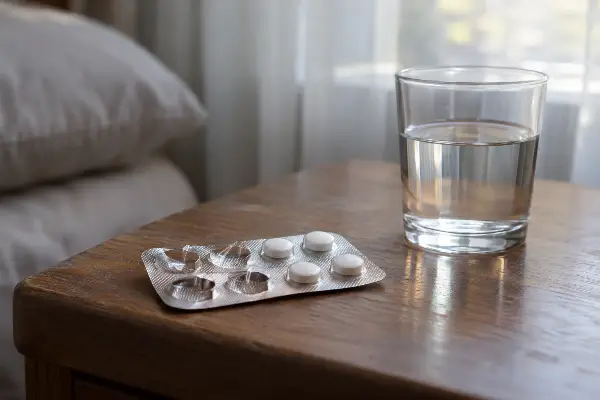
What About Prazosin Or A Benzodiazepine?
Don’t stop either one on your own to qualify. Our physician reviews both, and any dose change is your prescriber’s call.
Prazosin gets a weak “suggest” from the guideline for PTSD nightmares, though not for PTSD as a whole. It’s a blood pressure drug, and its product information warns of fainting with sudden loss of consciousness, usually within 30 to 90 minutes of the first dose. A ceremony night brings a purge and getting up in the dark, so we read prazosin like any blood pressure pill. Ask your prescriber how to restart it after any pause.
The guideline is strongly against benzodiazepines for PTSD, but some people with PTSD take them. The FDA’s 2020 safety announcement, which added a boxed warning, says stopping them abruptly or tapering too quickly can bring serious withdrawal reactions, including seizures that can be life-threatening. Your prescriber plans any taper, and our physician reviews the plan before you travel.
What Veterans Relive In Ceremony
In the 1 study that counted, veterans most often relived a loss, harm they’d caused someone else, or an illness or injury. 19 of the 32 veterans who answered (59%) relived at least 1 past event in ceremony.
That was the 2023 study of 339 retreat guests. Among veterans who’d been through each kind of event, 54% relived a loss (13 of 24), 53% relived harm they’d caused (10 of 19), and 50% relived an illness or injury (6 of 12).
One claim on trauma pages is that childhood, not combat, sits underneath. That study didn’t ask, but a 2014 JAMA Psychiatry study of 60,378 US adults backs part of the idea: men who served in the all-volunteer era reported more childhood adversity than men who never served, in all 11 categories. 27.3% reported 4 or more kinds, against 12.9%. Its authors suggest that for some, enlisting was a way out.
Some retreats run veterans-only weeks, 1 of the 25 centers we audited among them. The authors of the 2021 survey advise keeping people with PTSD to a small share of any group, and warn that a group made up only of PTSD patients “may make the therapy re-traumatizing rather than therapeutic.” That’s their proposal, drawn from theory and anecdote, not from their survey data or a trial.
If you’re a veteran in crisis, dial 988 and press 1, or text 838255. The VA’s mental health page lists other ways to reach care.
What 2 Veteran Studies Can And Can’t Show
They show PTSD scores falling after a retreat, not that the brew caused it. The 2025 study followed 58 veterans, 81% of them with a PTSD diagnosis, but its scores pool ayahuasca with psilocybin, it logged no doses or adverse events, and a veterans’ nonprofit and a retreat company supported it. The case series from 2023 had 8 people. Without a comparison group, a drop can come from the setting, time away, hope or recovery that would have happened anyway.
How Often Does Trauma Come Back Up In Ceremony?
For people with PTSD, more often than not. In a 2023 study that tracked 339 retreat guests, 19 of the 31 guests with a PTSD diagnosis who answered (61%) relived a past event in ceremony, against 36 of the 100 without one who answered (36%).
Reliving hurt at the time: it went with more discomfort in ceremony, with or without a PTSD diagnosis. But it didn’t predict a worse result on the 1 later measure the study took. At 3 months, neuroticism, a trait score for negative emotion, fell about as much or slightly more in people who relived an event, though neuroticism isn’t a PTSD measure.
The authors recommend telling people before they drink that this can happen. So we do: anyone who reports trauma hears it on the screening call, before booking.
If it happens here, raise a hand. A facilitator comes to you, a maestro often comes over to sing to you, and someone walks you out of the room whenever you ask. If 1 night was enough, you can sit out the next one, and nobody will press you to drink.
Childhood Trauma And A Hard Night
A childhood trauma history doesn’t seem to make the night harder. A 2024 online survey of 231 drinkers found childhood trauma didn’t predict a more difficult ceremony, and its authors concluded ayahuasca “is not immediately more distressing for people with trauma histories.”
A harder night didn’t bring more growth either: a more difficult ceremony didn’t predict more posttraumatic growth, the positive change some people report after hard events. It’s 1 survey of people recalling a past ceremony, so treat it as a hint.
If You’re A Survivor Of Sexual Assault
Tell the retreat before you book, and ask who may touch you. Among non-veterans in the 2023 study, 41% of women who had been sexually assaulted relived it in ceremony (13 of 32), against 10% of men (1 of 10).
Its authors say it may be “conditionally prudent” for research to screen out some trauma types, sexual assault among them. A past assault isn’t a stop here, but the room matters more for you.
Here, staff ask before they touch you, each time, and we go through that rule on day 1, before anyone drinks. If you’d rather nobody touches you at all, tell us, and that holds for the whole night. Ask any retreat about touch before you book, and learn how healer misconduct starts.

When Ayahuasca For Trauma Makes Things Worse
The setting is the risk you can choose. In the Global Ayahuasca Survey, where people drank predicted adverse mental health effects about as strongly as an anxiety disorder did.
The survey’s 2022 paper on harms covered 10,836 people. Against drinking in a religious setting, it put the odds of an adverse mental health effect at 1.26 times as high in traditional shamanic settings, 1.57 in non-traditional ones and 1.71 with no supervision. An anxiety disorder carried odds of 1.26. PTSD wasn’t tested.
Across the 2021 survey, respondents described ceremonies that retraumatized them, sexual abuse by shamans or facilitators, no supervision, admixture plants and no follow-up.
Psychedelics can also leave trauma of their own. A 2026 study in Psychological Medicine looked at 243 people whose distressing psychedelic experiences had lasting effects, and 31.3% met self-reported PTSD criteria. Only 22 of the 243 had their hard experience on ayahuasca, and the study recruited people because their experiences were hard, so 31.3% isn’t a rate for drinkers in general.
If you came home worse, don’t wait it out alone. Call or text 988 in the US, and veterans can press 1 after dialing. Voices, fixed beliefs or nights without sleep need a doctor the same day, and our psychosis guide lists those same-day warning signs. For the slower weeks after, the fears guests bring covers what to expect.
Who With PTSD Should Wait?
Wait if you have thoughts of suicide with a plan, if your trauma happened in the last 3 months, or if you’d have to hurry off a medication that’s working. PTSD on its own isn’t a stop here.
| If this is you | Our rule | Why |
|---|---|---|
| PTSD or a trauma history | Our physician reviews it, and you hear on the screening call that memories may come up | In the 2023 study, 61% with a PTSD diagnosis relived an event |
| Thoughts of suicide with a plan or intent | We pause your application and help you reach crisis care first | A retreat isn’t crisis care |
| A trauma in the last 3 months | We’ll ask you to book a later week | PTSD can’t be diagnosed until symptoms last more than a month |
| An SSRI or SNRI, such as sertraline, paroxetine or venlafaxine | A taper your prescriber plans, then 6 weeks clear, or 8 for fluoxetine | Serotonin syndrome with the vine, and a higher relapse risk once you stop |
| Prazosin | Physician review. Don’t stop it to qualify | Its product information warns of fainting |
| A benzodiazepine | Physician review. Any taper is your prescriber’s plan | The FDA warns that sudden stops can cause seizures |
| Psychosis or bipolar disorder of your own | Absolute stop | The published psychosis cases |
Every application goes to our physician before we offer a place, as our physician’s screening sets out, and our published stops list the rest. If we say no, you’ll hear why in writing, with a list of referrals.

What 25 Peru Retreats Promise About Trauma In 2026
They promise more than the studies show and say little about the night itself. Across 25 Peru centers’ own websites, 14 say ayahuasca heals, releases or may help with trauma. None publishes a rule that staff ask before touching you, and 4 say what happens if you’re overwhelmed in ceremony.
| Published on the center’s website | Centers (of 25) | Ours |
|---|---|---|
| Ayahuasca heals, releases or treats trauma, with no hedge | 8 | We don’t say it |
| Ayahuasca may help with trauma | 6 | We don’t say it |
| It isn’t medical treatment | 10 | Yes |
| Traumatic memories may come up | 12 | Yes, on the screening call |
| A stated PTSD or trauma rule | 5 | Yes, physician review |
| A stop period for SSRIs or other antidepressants | 14 | Yes, 6 weeks, or 8 for fluoxetine |
| Prazosin, by name | 1 | Yes |
| Staff ask before touching you | 0 | Yes |
| What happens if you’re overwhelmed in ceremony | 4 | Yes |
| Follow-up for more than 3 months | 1 | Yes, 12 months |
| PTSD results from its own guests | 0 | We don’t publish any |
The claims run ahead of the rules. 8 centers say outright that ayahuasca heals, releases or treats trauma, but only 5 state any rule for guests with PTSD, and 1 of those turns away anyone above a PTSD checklist cutoff it doesn’t publish.
The antidepressant rules spread wider than the science does. 14 set a stop period, from 7 days to 2 months, and 1 names fluoxetine for a longer one. For anyone on fluoxetine, a 7-day stop falls well short of the drug’s own US label, which asks for 5 weeks or more between stopping it and starting an MAO inhibitor.
A center may follow rules it doesn’t publish. But its website is the only part you can check before you pay. 3 name a licensed psychologist or psychiatrist on their team, and 1 runs veterans retreats with a partner nonprofit. Ask about the rest when comparing retreats in Peru.
Where Trauma-Focused Therapy Fits
First, and ayahuasca doesn’t replace it. Trauma-focused therapy is what the 2023 guideline recommends over any drug, at its top grade, “strong for.”
The 3 therapies it names are Cognitive Processing Therapy, Eye Movement Desensitization and Reprocessing (EMDR) and Prolonged Exposure, each run from a manual by a trained therapist.
MDMA-assisted therapy got the same “insufficient evidence” rating as ayahuasca. The FDA declined to approve it in August 2024, and a revised application was reported filed in August 2026.
With PTSD, tell your therapist before you book a retreat, and keep seeing them after. We call you 4 times in your first 3 months home and keep calling for a year. Those calls support the retreat. They don’t stand in for trauma treatment.
Whether ayahuasca for trauma is right for you is a choice to make with your therapist and prescriber, not around them. How a week here runs sets out the 7 nights if you decide to come, and our physician reads your file before anything is booked.
FAQs
Is ayahuasca good for PTSD?
Nobody has shown that it is. The 2023 VA/DoD guideline found too little evidence to recommend ayahuasca for PTSD or against it. The 2 small studies we found that measured PTSD symptoms after it had no comparison group. The longest PTSD follow-up was 3 months, in 7 veterans.
Is ayahuasca for trauma safe if you take PTSD medication?
Not on the main PTSD drugs. Paroxetine, sertraline and venlafaxine raise serotonin, and the vine blocks an enzyme that breaks it down, so they have to stop first. Stopping carries its own risk. A 2001 trial found that 26% of people with PTSD who were switched from sertraline to a placebo relapsed, against 5% who stayed on it.
Does ayahuasca for trauma work for veterans?
It hasn’t been properly tested. A 2025 study of 58 veterans, 45 of whom drank ayahuasca, found average PTSD checklist scores fell by about half at 4 weeks. But there was no comparison group, and anyone on antidepressants was left out. A study of 8 combat veterans found 5 of 7 still better at 3 months.
Can ayahuasca help with childhood trauma?
No trial has tested it. A 2021 study followed 63 guests at 1 Iquitos retreat. More childhood trauma went with a bigger drop in depression right after the retreat, but not at 6 months. A 2024 survey of 231 drinkers found childhood trauma didn’t predict a harder ceremony.
Can ayahuasca retraumatize you?
It can. In a 2021 survey of 520 drinkers, some described the ceremony itself as retraumatizing, and about 16% to 20% of those with a PTSD history met or saw something dangerous. A 2026 study of 243 people with lasting distress after a psychedelic found 31.3% met self-reported PTSD criteria, though only 22 had their hard experience on ayahuasca.
How does ayahuasca compare with MDMA or trauma therapy for PTSD?
Trauma-focused therapy comes first: the 2023 guideline recommends it over medication, and rates Cognitive Processing Therapy, EMDR and Prolonged Exposure “strong for.” It rates both MDMA-assisted therapy and ayahuasca as having too little evidence to call. The FDA declined to approve MDMA-assisted therapy in August 2024.