Can You Drink Tap Water In Peru On An Ayahuasca Retreat?

Can you drink tap water in Peru on an ayahuasca retreat? No, and the answer is the same in Lima, Cusco and the Sacred Valley. The CDC’s chapter on Peru tells visitors to avoid untreated water, “including tap water at hotels and restaurants.” Drink factory-sealed bottled water, water you’ve boiled, or water treated in a way that stops viruses as well as bacteria and parasites.
Peru’s own numbers show why. In the 12 months to September 2024, Peru’s national statistics office found no chlorine at all in the tap water of 39.9% of people on the public network. In rural areas, it was 87.8%.
We read 25 articles on drinking tap water in Peru in October 2026. 23 said not to drink it, which is right. But 15 recommended a filter, purifier, tablets or UV, and only 3 warned that some filters miss viruses. 4 said tap water is fine for brushing your teeth. The CDC says it might not be.
Guests at our ayahuasca house in the Sacred Valley fly in through Cusco, so these rules apply from the airport on, including any nights in town before the first ceremony.
Is Tap Water In Peru Safe To Drink?
Not for travelers. The CDC and Peru’s own water data agree on that, Lima included, and the US State Department says tap water isn’t safe to drink in many areas.
Tap water in Peru isn’t safe for travelers to drink, on an ayahuasca retreat or anywhere else in the country. The CDC tells visitors to avoid untreated water, including tap water in hotels and restaurants. Peru’s statistics office found no chlorine in the tap water of 39.9% of people on the public network, and of 87.8% in rural areas.
Peru sets a floor for its water suppliers under a 2010 national regulation: at least 0.5 mg of free chlorine per liter in 90% of the samples taken across the network each month, and never below 0.3 mg. That leftover chlorine keeps killing germs on the way to the tap. INEI, the statistics office, checks the water in people’s homes against that line in its household survey.
| Where | At or above the 0.5 mg/L floor | Some chlorine, below the floor | No chlorine |
|---|---|---|---|
| All of Peru | 40.4% | 19.7% | 39.9% |
| Urban areas | 47.7% | 22.3% | 30.0% |
| Rural areas | 4.7% | 7.5% | 87.8% |
Lima does better than the countryside, and still not well enough. A 2018 analysis of a national household survey estimated that 34% of homes in Metropolitan Lima had chlorine below 0.5 mg per liter in 2016. The State Department adds a catch for visitors: “Many restaurants and hotels serve tap water unless bottled water is specifically requested.”
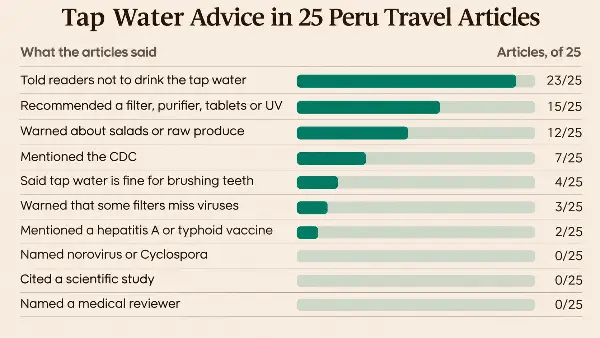
What 25 Articles On Peru’s Tap Water Said In 2026
Most got the headline right: 23 of the 25 told readers not to drink the tap water, and the other 2 gave a mixed answer. The details are where they went wrong.
We read the 25 on 28 October 2026. They’re English-language articles, taken in the order they came up across 5 web searches. We skipped spam, duplicates, forums, data pages and pages that never gave an answer, and checked every article against the same 14 questions.
| Topic | What the 25 articles said | What the CDC says |
|---|---|---|
| Drinking tap water | 23 said don’t; 2 gave a mixed answer | Avoid it, including in hotels and restaurants |
| Brushing teeth | 4 said tap water is fine; 3 gave a mixed answer | Tap water might be unsafe for brushing teeth |
| Salads | 12 warned about them; 1 said salad washed in tap water is fine | Avoid salads; greens can stay contaminated even if washed |
| Filters | 15 recommended a filter, purifier, tablets or UV; 3 warned that some miss viruses; 2 said a filter removes viruses, with no warning | Microfilters don’t reliably remove viruses such as norovirus |
| Boiling | 6 gave a time, from 1 minute to 5 to 10 minutes; 3 said to boil longer at altitude | 1 minute, or 3 minutes above 6,500 ft |
| Germs | None named norovirus or Cyclospora | Norovirus is common in travelers to Peru; Cyclospora is endemic there |
| Vaccines | 2 mentioned a hepatitis A or typhoid vaccine | Hepatitis A for all travelers to Peru; typhoid for most |
The sourcing was thin too. 7 mentioned the CDC, none cited a scientific study, and none named a medical reviewer. 6 recommended a named filter or purifier brand, and 1 offered a discount code.
How Long Should You Boil Water In Cusco?
Boil it for 3 minutes. That’s the CDC’s advice above 6,500 ft, about 1,980 m, and Cusco, the Sacred Valley and the town below Machu Picchu all sit higher than that.
The CDC doesn’t fully agree with itself here. Its consumer guide says to boil water for 1 minute, and for 3 minutes above 6,500 ft. Its Yellow Book for travel clinics says a full minute is enough, because at common travel elevations water still boils “well above the temperature required to inactivate enteric pathogens.” WHO says a rolling boil is enough. We go with the 3 minutes. It costs a little gas, and it satisfies both CDC pages.
Water boils at a lower temperature the higher you go. We worked out the boiling point at each stop from standard air pressure:
| Stop on a retreat trip | Elevation | Water boils at | CDC boiling time |
|---|---|---|---|
| Lima | Near sea level | About 99.5°C (211°F) | 1 minute |
| Iquitos and other Amazon towns | Near sea level | About 99.5°C (211°F) | 1 minute |
| Aguas Calientes, below Machu Picchu | About 2,040 m | About 93°C (200°F) | 3 minutes |
| The Sacred Valley floor, Ollantaytambo to Pisac | About 2,800 to 2,970 m | About 90°C to 91°C (194°F to 195°F) | 3 minutes |
| Cusco | 3,399 m | About 88.7°C (192°F) | 3 minutes |
| Puno, on Lake Titicaca | About 3,810 m | About 87.3°C (189°F) | 3 minutes |
A hotel kettle that clicks off at the boil gives you neither CDC time. Use a pot on the stove and time it. Then let the water cool with a lid on.
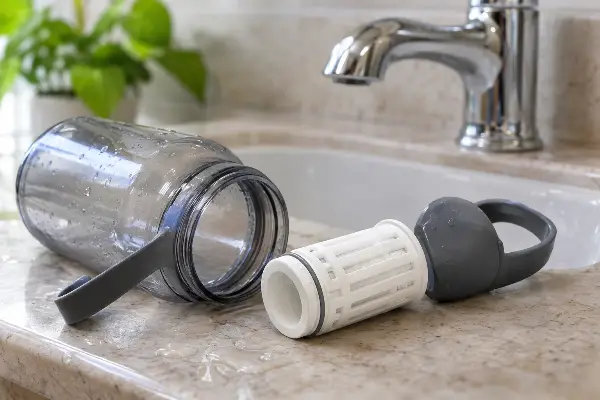
A Filter Bottle Alone Won’t Make Peru’s Tap Water Safe
Most portable filters catch parasites, and bacteria only if their pores are fine enough, the CDC says, but microfilters don’t reliably remove viruses. That matters in Peru, where the CDC says norovirus is common among travelers and hepatitis A risk is present throughout the country.
The CDC’s chapter on treating water for travel names the virus to worry about: portable microfilters “do not reliably remove enteric viruses (e.g., norovirus).” Those viruses are about 0.03 microns across, smaller than a microfilter’s pores. An ultrafilter, with pores of 0.01 microns, should catch them.
Only 3 of the 25 articles we read gave that warning, though 15 recommended a filter, purifier, tablets or UV.
| Method | Bacteria | Viruses, such as norovirus and hepatitis A | Giardia | Cryptosporidium |
|---|---|---|---|---|
| Boiling | Yes | Yes | Yes | Yes |
| Microfilter, 0.2 to 0.4 micron | Yes | Not reliably | Yes | Yes |
| Ultrafilter, 0.01 micron | Yes | Yes | Yes | Yes |
| Chlorine or iodine | Yes | Yes | Yes, with a longer wait | Poorly |
| Chlorine dioxide | Yes | Yes | Yes | Yes |
| UV light, in clear water | Yes | Yes | Yes | Yes |
So match the device to the job. For tap water in places without well-developed water and sanitation, the CDC’s table accepts any single method except a microfilter, and it says to use an ultrafilter instead. If you already own a microfilter, the CDC says you can treat the filtered water with chlorine to deal with viruses.
Read the box, and don’t take “purifier” on trust. Makers can claim an EPA purifier designation, but “the EPA does not independently test the validity of these claims,” the CDC notes. When you judge a center, ask how it treats its drinking water, and what it does about viruses.
Near Lake Titicaca, Boiling Won’t Fix The Water
Boiling, filters, tablets and UV deal with germs. None of them removes chemicals such as arsenic, and a 2014 study found high arsenic levels in water around Lake Titicaca.
The study, in the Bulletin of the World Health Organization, tested 151 water sources in 12 Peruvian districts, 10 of them in the Puno region around Lake Titicaca. 116 of them, 77%, had arsenic above WHO’s limit of 10 micrograms per liter. Wells in Juliaca, the airport town for Puno, reached 193.1 micrograms per liter, more than 19 times the limit. The team’s samples from the Rímac river as it runs through Lima were over the limit too, though those were river samples, not treated tap water.
The CDC’s line on chemicals is short: “You cannot make water containing harmful chemicals, toxins, or radioactive materials safe by boiling or disinfecting it.” Around Lake Titicaca, drink sealed bottled water, and don’t count on boiling to fix tap water there.
Teeth, Ice, Salads And Ceviche
These are where careful travelers still slip. The CDC’s food and water precautions cover every one of them.
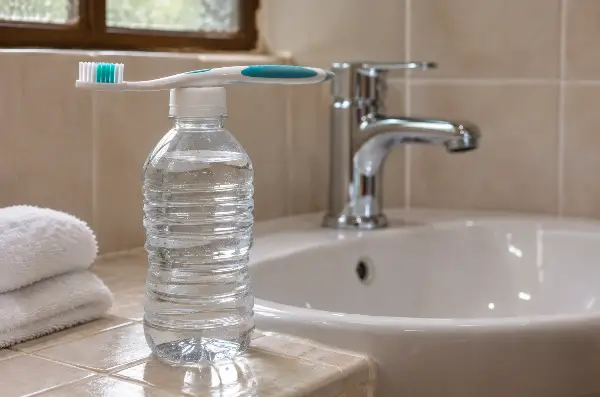
Brushing Your Teeth And Showering
Use bottled or boiled water for your toothbrush. The CDC says tap water “might be unsafe for drinking, preparing food and beverages, making ice, cooking, and brushing teeth,” and it tells travelers to avoid putting tap water in their mouths unless they’re reasonably sure it’s safe.
That’s stricter than 4 of the 25 articles we read, which said tap water is fine for brushing.
Showering is fine. Keep your mouth closed under the water, which is the CDC’s advice too.
Ice, Juices And Hot Drinks
Ask for drinks without ice. The CDC’s Peru chapter says bottled water and sodas are usually safe, “but ice is not.”
Fresh juice is a risk of its own. Giardiasis, a parasite infection, is more frequent among people in Peru who drink fresh juices, the same chapter says. Its symptoms usually start 1 to 2 weeks after infection and last 2 to 6 weeks.
Tea and coffee made with water straight off the boil are generally safe.
Salads, Fruit, Ceviche And Cyclospora
Skip salads and raw vegetables, and peel your own fruit. Washing produce in tap water doesn’t make it safe. The CDC’s typhoid page says, “Lettuce and other greens can stay contaminated even if washed.”
Peru has its own reason for this rule. Cyclospora cayetanensis, a parasite named after Universidad Peruana Cayetano Heredia in Lima, is endemic to Peru, the CDC says, and it spreads through contaminated food and water. Untreated, it can last more than a month. It’s treated with a drug that isn’t usually prescribed for other travelers’ diarrhea, so a doctor’s diagnosis matters.
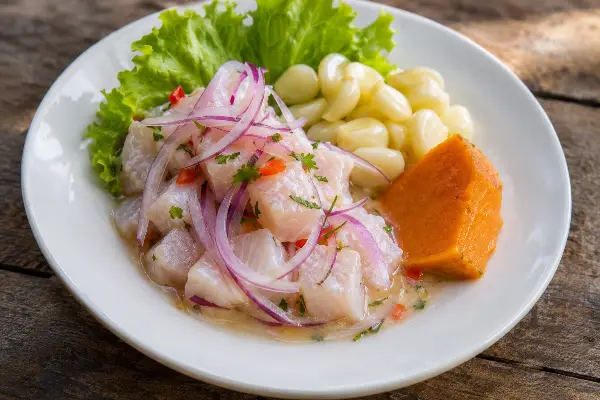
Ceviche is the other trap. The CDC’s Peru chapter calls raw fish dishes like ceviche and tiradito popular and a risk for foodborne illness, and it warns that cold sauces might carry germs. Food cooked and served hot is safe.
Which Vaccines Cover Peru’s Water?
Hepatitis A and typhoid. The CDC recommends hepatitis A vaccine for travelers to Peru “because risk is present throughout the country,” and a typhoid vaccine for most travelers, “particularly those visiting rural areas.”
Book a travel clinic at least 4 weeks before you fly, the CDC says. The typhoid vaccine has to be given at least 2 weeks before travel, and it protects 50% to 80% of people who get it, so the food and water rules still apply.
Hepatitis A is slow. Symptoms show up 28 days after infection on average, and anywhere from 15 to 50 days, so you could be home before you feel it.
You can skip cholera. The CDC says “cholera vaccine is not indicated for travel to Peru.” The country had a large outbreak that began in January 1991 in Chancay, north of Lima, but “no cases have been reported in many years.” Yellow fever and malaria pills are a separate question, and our page of pre-booking questions covers yellow fever and malaria for a Sacred Valley trip.
What If Your Stomach Turns Before Your First Ceremony?
Tell the physician at your day-1 intake, and don’t take anything for it until the physician agrees. Most travelers’ diarrhea is bacterial or viral, and it usually clears within a week.
The best numbers come from Cusco itself. A 2006 study in the American Journal of Tropical Medicine and Hygiene surveyed 5,988 travelers leaving Cusco’s airport in 2002, and 24% had diarrhea on their trip. Travelers who’d been given advice on safe food and water had higher odds, not lower (odds ratio 1.46). Each unsafe food or drink went with slightly higher odds, and staying in Cusco less than a week went with lower ones. It was a survey, so it can’t prove cause and effect, and the trips it covered date from 2002. Its authors concluded that “conventional recommendations are not invariably effective.” Our read: knowing the rules doesn’t help unless you follow them meal by meal.
Bacteria cause 75% to 90% of travelers’ diarrhea by the CDC’s estimate, and viruses at least 10% to 25%. Bacteria and viruses usually make you sick 6 to 96 hours after exposure. Parasites take 1 to 2 weeks, except Cyclospora, which can show up faster, in 2 to 14 days. Untreated bacterial diarrhea usually lasts 3 to 7 days, and viral diarrhea 2 to 3.
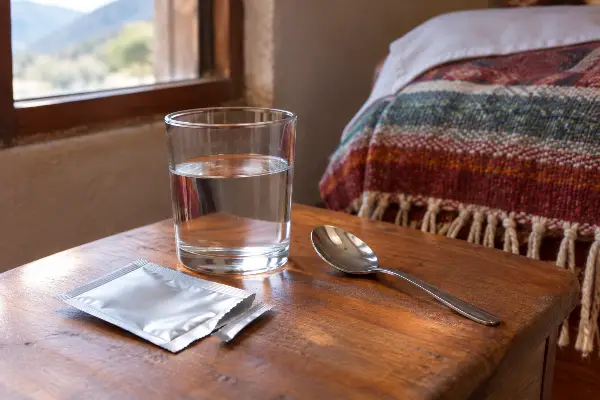
Drink fluids, and if you use oral rehydration salts, mix them with bottled or boiled water. The CDC says antimotility drugs alone aren’t for diarrhea with blood or fever. As a general rule, see a doctor for blood in your stool, a fever, signs of dehydration, or diarrhea that lasts more than 2 weeks.
A stomach bug isn’t the ceremony purge. The purge happens in the ceremony itself, when the brew can bring on vomiting or diarrhea. Diarrhea that starts before your first ceremony is a medical question for the physician.
Be careful with pharmacy medicine, too. The State Department warns that counterfeit medication is common in Peru. Here, the physician screens your medicines before a place is offered, and during the week you take medicine only as agreed with the physician, including anything for an upset stomach. A physician is on site all 7 nights. The nearest clinic is 20 minutes away, and the Cusco hospital the house works with is about an hour by road.
Tap Water In Peru On An Ayahuasca Retreat Week
Plan your water in 3 stages: before you fly, on the way in, and at the house.
Before you fly. See a travel clinic at least 4 weeks out about hepatitis A and typhoid. Pack oral rehydration salts and a way to treat water that covers viruses: an ultrafilter, chlorine dioxide tablets, a UV device, or a microfilter plus a chlorine step.
On the way in. In Cusco and any town before day 1, drink sealed bottled water, brush with it, and ask for drinks without ice. Eat food cooked and served hot, and skip salads, fresh juice and ceviche. If you’re working out how long to stay, count any nights in town as part of the plan.
At the house. Meals come from the dieta kitchen, and our guide to the dieta at home covers the weeks before you fly. Drink to thirst rather than forcing liters; our altitude guide explains why. Water comes round the ceremony room in the small hours, and electrolytes follow every ceremony.
That’s tap water in Peru on an ayahuasca retreat: sealed or treated water from the day you land, 2 vaccines before you fly, and a word with the physician if your stomach turns. The dieta table on our ayahuasca page lists the week’s medication rules. When you’re ready, apply once. A physician reads every application, and we reply within 48 hours on weekdays.
FAQs
Can you brush your teeth with tap water in Peru on an ayahuasca retreat?
Use sealed bottled water or water that’s been boiled. The CDC says tap water might be unsafe for brushing teeth, and it advises travelers to keep tap water out of their mouths unless they’re reasonably sure it’s safe. 4 of 25 travel articles we read in October 2026 said tap water is fine for brushing, but that isn’t the CDC’s advice.
What happens if you drink tap water in Peru before an ayahuasca retreat?
You may get travelers’ diarrhea. In a survey of 5,988 travelers leaving Cusco’s airport, 24% had diarrhea on their trip. Bacteria and viruses usually cause symptoms within 6 to 96 hours, and parasites within 1 to 2 weeks. If you’re unwell when you arrive, tell the physician at intake before you take any medicine.
Is ice safe in Peru?
Not unless you know it was made with safe water. The CDC’s Peru chapter says bottled water and sodas are usually safe, but ice is not. Ask for your drinks without ice, in restaurants and hotels too.
Is tap water in Lima safe to drink?
No. The CDC says some tourist areas in Lima may have a lower risk of travelers’ diarrhea, but it still tells visitors to avoid tap water in hotels and restaurants. A national household survey put chlorine below Peru’s 0.5 mg per liter standard in an estimated 34% of homes in Metropolitan Lima in 2016.
Is bottled water safe in Peru?
Usually, when it’s factory-sealed. The CDC says bottled water and carbonated drinks are usually safe in Peru, and it suggests wiping cans and bottles clean before you drink. Near Lake Titicaca it’s the better choice, because a 2014 study found arsenic above WHO’s limit in 116 of 151 water sources tested in 12 Peruvian districts.
Can you shower with tap water in Peru?
Yes. The CDC’s advice is to avoid getting tap water in your mouth when you shower or bathe. Use bottled or boiled water for your toothbrush, even in the same bathroom.